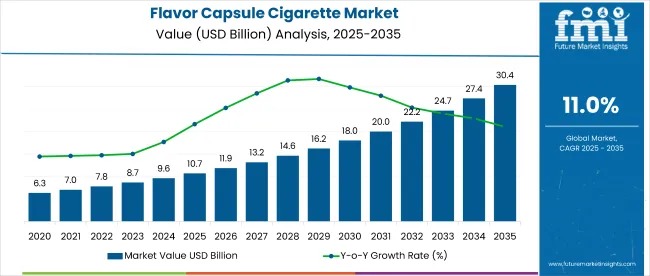
The global flavor capsule cigarette market is poised for robust growth, valued at USD 10.7 billion in 2025 and expected to reach USD 30.4 billion by 2035, reflecting a CAGR of 11%. This surge is fueled by rising demand for customizable smoking experiences, product innovation, and the expanding adoption of Heated Tobacco Products (HTPs).
Increasing youth preference for flavored smoking options, particularly among millennials and first-time smokers, is a primary driver of market expansion. Flavor capsule cigarettes, offering interactive and sensory-enhancing experiences, are reshaping consumer behavior and stimulating growth across regions. The segment currently captures 14-16% of the broader tobacco market, with capsule variants holding a dominant 40-45% within flavored tobacco products.
Gain Preview Access to Methodology, Sample Charts, and Key Findings by Requesting Your Sample Report! https://www.futuremarketinsights.com/reports/sample/rep-gb-10410
Market Dynamics and Growth Drivers
- Customization and Sensory Appeal: Consumers can personalize flavor release mid-smoke, enhancing taste, aroma, and overall experience.
- Innovation in Capsule Formats: Developments such as dual-flavor capsules, customizable filters, and HTP compatibility are widening consumer appeal.
- Rising HTP Adoption: Reduced emission levels compared to traditional cigarettes support regulatory acceptance and consumer preference.
However, the market faces challenges from regulatory restrictions, particularly flavor bans in Europe and North America. These regulations are prompting manufacturers to innovate, creating alternative flavor delivery systems and exploring new product designs to navigate compliance while maintaining consumer engagement.
Segment Insights
Flavor Analysis:
Menthol is projected to dominate the flavor segment, accounting for 56% of global market share in 2025. Its cooling effect and smoother smoke profile enhance nicotine absorption and appeal to younger smokers, making it a key growth driver.
- Reduces harshness and improves sensory experience.
- Widely popular in both developed and emerging markets.
- Regulatory scrutiny may influence regional availability.
Product Type Analysis:
Single capsule cigarettes lead the product type segment with 69% market share. Their simplicity, affordability, and accessibility make them highly popular among first-time users, particularly in developing markets.
- Affordable entry point for smokers.
- Provides multi-sensory experience through aroma, taste, and sound.
- Dominates in Asia and Latin America.
Price Range Analysis:
Economic flavor capsule cigarettes capture 74% of the market, appealing to price-sensitive consumers in high-population regions such as India, Indonesia, and Brazil.
- Drives volume growth in developing markets.
- Promotes market penetration through indirect retail channels.
Distribution Channel Analysis:
Retail sales dominate, holding 67% of global market share. This includes convenience stores, supermarkets, and online platforms, making it the preferred channel for urban consumers seeking convenience and variety.
- Supermarket and hypermarket penetration accelerates sales.
- Online platforms enable discreet and diverse flavor access.
Regional Outlook
Asia-Pacific emerges as the key growth region, with Japan projected as the fastest-growing market at a CAGR of 7.1% from 2025 to 2035. The USA follows, expanding at a CAGR of 5.5%, fueled by a strong base of menthol cigarette consumers and widespread retail presence.
Europe presents mixed growth trends:
- France: CAGR of 5.0%, driven by youth adoption and capsule popularity despite flavor bans.
- Germany: CAGR of 4.8%, supported by a well-established tobacco industry and innovation in packaging and capsule formats.
- UK: CAGR of 4.5%, with manufacturers introducing menthol alternatives and specialty retail channels mitigating regulatory restrictions.
Competitive Landscape
The flavor capsule cigarette market is moderately consolidated, with major players including Marlboro, ITC, Imperial Tobacco, Dunhill, and Lucky Strike. These companies leverage:
- Deep market penetration and broad distribution networks.
- Diversified product portfolios tailored to regional preferences.
- Innovations in hybrid filters and dual-flavor capsule technologies.
Recent launches highlight the competitive momentum:
- Philip Morris International (Marlboro): Introduced 30 new capsule cigarette brands in Latin America in 2024, including watermelon and cherry-menthol variants.
- British American Tobacco (Lucky Strike, Pall Mall, Kent): Released 27 new capsule flavors targeting young consumers in Latin America, featuring berries, melon, and energy drink-inspired options.
Key Trends and Challenges
Trends:
- Rising popularity of dual-flavor capsules.
- Expansion of Heat-Not-Burn (HTP) technologies.
- Growing online retail presence offering variety and discretion.
Challenges:
- Stringent flavor bans in major markets.
- Health risk awareness affecting younger demographics.
- Rising competition from e-cigarettes and non-combustible alternatives.
The flavor capsule cigarette market is set for sustained growth over the next decade, driven by flavor innovation, consumer engagement, and regional adoption of advanced tobacco technologies. Stakeholders investing in this segment will benefit from understanding evolving preferences, regulatory dynamics, and technological advancements that are reshaping the global tobacco landscape.