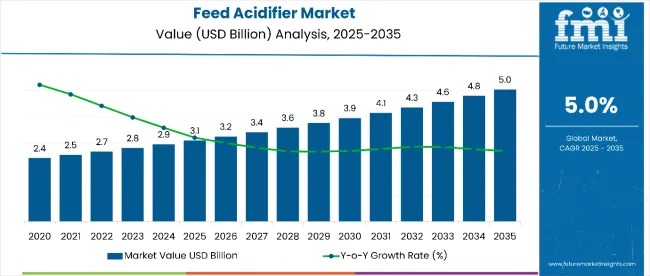
The global feed acidifier market is estimated to be valued at USD 3.1 billion in 2025 and is projected to reach USD 5.0 billion by 2035, registering a steady compound annual growth rate (CAGR) of 5% over the forecast period. The growth is being fueled by increasing demand for antibiotic-free feed additives, expanding livestock and poultry production, and the rising preference for organic acids that improve gut health and nutrient absorption in farm animals.
The market is expected to create an absolute dollar opportunity of USD 1.90 billion by 2035, reflecting a 1.52 times increase over the next decade. By 2030, the market is projected to reach USD 3.9 billion, accounting for USD 0.80 billion in incremental value during the first half of the decade, with the remaining USD 1.10 billion coming in the latter half. This moderately back-loaded growth is largely driven by the adoption of innovative acidifier formulations and the expansion of livestock production in Asia-Pacific and Latin America.
Major players such as BASF SE, Corbion NV, and Kemin Industries Inc. are consolidating their market positions through advancements in coating technologies, eco-friendly formulations, and high-performance acidifiers. Strategic partnerships, capacity expansions, and the development of safe and easy-to-use feed acidifiers continue to enhance their competitive advantage. Compliance with regulations and proven product efficacy remain key growth drivers across livestock sectors globally.
Gain Preview Access to Methodology, Sample Charts, and Key Findings by Requesting Your Sample Report! https://www.futuremarketinsights.com/reports/sample/rep-gb-12392
Market Overview and Industry Position
- Feed acidifiers are a subset of the USD 70 billion global animal nutrition market, representing approximately 4.4% of the total.
- Within the broader livestock feed additives segment, feed acidifiers account for nearly 15% of all feed additives and approximately 3% of overall feed formulation sales.
- The segment holds a 12% share in the organic livestock solutions market, reflecting rising adoption in sustainable and antibiotic-free animal feed practices.
The market is primarily driven by growing awareness of gut health benefits, the push for antibiotic-free livestock production, and enhanced nutrient absorption. Innovations such as coated powders, liquid formulations, and patented technologies like SoftAcid® are reducing corrosion and improving handling safety. Regional trends indicate strong adoption in Asia-Pacific, North America, and Europe, with a focus on sustainability, high-performance formulations, and efficacy across swine, poultry, and dairy applications.
Segment Insights
- By Acid Type: Propionic acid dominates with a 35% market share due to its efficacy in inhibiting mold, enhancing gut microflora, and preserving feed quality. Advanced coating technologies improve handling safety and reduce corrosiveness, supporting its widespread adoption.
- By Product Type: Blended feed acidifiers account for 60% of the market, offering versatility to combine multiple acids for optimal gut health, pH regulation, and microbial control. High-purity coated blends are increasingly preferred for handling ease and consistent performance.
Regional Dynamics
- Asia-Pacific drives approximately 40% of global consumption, led by rapid expansion in poultry, swine, and dairy production.
- North America exhibits a 6.7% CAGR, supported by large-scale livestock farms, antibiotic-free feed mandates, and technological adoption in feed formulations.
- Europe shows moderate growth, with France (4.9% CAGR), the UK (4.4%), and Germany (4%) focusing on regulatory compliance, sustainable feed solutions, and high-quality livestock nutrition.
- Japan records steady adoption (5% CAGR), fueled by precision nutrition programs and urbanized industrial livestock operations.
Drivers, Trends, and Challenges
- Feed acidifiers are increasingly preferred for improving enzymatic digestion, gut microflora balance, and feed efficiency, reducing the reliance on antibiotics. Studies indicate up to 15% improvement in nutrient digestibility when acidifiers are included in feed formulations.
- Innovations such as coated and liquid blends, precision livestock nutrition, and digital farm integration are accelerating adoption.
- Market expansion is constrained by raw material cost volatility, formulation complexities, and specialized handling requirements. Coated and blended acidifiers require advanced facilities, precise dosing, and quality control, which can extend development cycles and increase production costs by 12-18%.
Competitive Landscape
The feed acidifier market is moderately consolidated, with global chemical and feed additive giants, specialized nutrition companies, and regional manufacturers. Leading players like BASF SE, Corbion NV, and Kemin Industries Inc. leverage extensive R&D, established distribution networks, and regulatory expertise to supply high-performance feed solutions globally. Companies such as Yara International ASA, Biomin Holding GmbH, and Pancosma SA focus on specialty acidifiers with enhanced gut health benefits and safe handling features. Regional manufacturers like Nutrex NV, Jefo Nutrition Inc., and Addcon Group GmbH emphasize localized, application-specific solutions and technical support.
Entry barriers remain high due to the need for advanced formulation technology, regulatory compliance, and supply chain integration. Innovation, safety, handling efficiency, and customized solutions for diverse livestock species are key differentiators. Continuous R&D, pilot-scale trials, and strategic collaborations are critical for maintaining market leadership and driving adoption in emerging regions.
Conclusion
With rising global demand for antibiotic-free, sustainable, and high-performance livestock feed, the feed acidifier market is set for steady growth over the next decade. Innovations in product formulations, regional adoption, and compliance with evolving regulations position the market for a projected USD 5.0 billion valuation by 2035. Manufacturers who prioritize safety, efficacy, and tailored solutions are likely to capture the largest share in this evolving landscape.