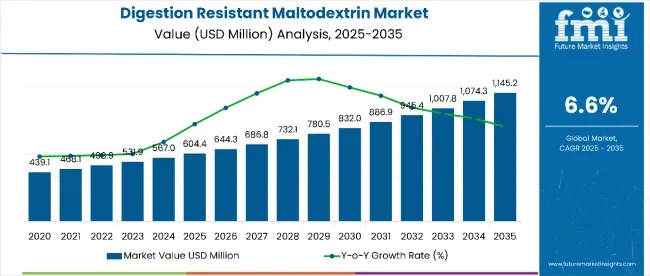
The global digestion resistant maltodextrin market is projected to grow from USD 604.4 million in 2025 to USD 1,145.2 million by 2035, reflecting a robust CAGR of 6.6%. This growth is fueled by increasing consumer interest in functional dietary fibers that support digestive health and gut microbiome balance. Expanding applications in food, beverages, and dietary supplements are further driving adoption worldwide.
By 2030, the market is expected to reach approximately USD 832.0 million, highlighting steady value addition in the first half of the forecast period. Rising awareness about the benefits of dietary fiber, coupled with the clean-label trend, is encouraging food manufacturers to incorporate DRM into products without compromising taste or texture. The growing popularity of gut health products, especially in emerging regions, is expected to sustain this momentum.
Gain Preview Access to Methodology, Sample Charts, and Key Findings by Requesting Your Sample Report! https://www.futuremarketinsights.com/reports/sample/rep-gb-6225
Leading industry players, including Roquette Frères S.A., Ingredion Incorporated, and Tate & Lyle PLC, are investing heavily in innovation and capacity expansion. Cost-effective extraction methods and sourcing from natural ingredients bolster their competitive positions. These companies are also emphasizing regulatory compliance and stringent quality control to cater to the food and nutraceutical sectors. Their R&D initiatives focus on improving functional properties, developing clean-label options, and expanding DRM applications, ensuring long-term market growth.
The corn-based segment dominates the source category, accounting for 25% of the market, due to its abundance, cost-effectiveness, and functional advantages in fiber enrichment. In terms of application, food leads with a 67% share, driven by its extensive use in fiber-enriched functional foods and beverages. Nutraceuticals and dietary supplements are witnessing growing adoption as consumers increasingly prioritize digestive wellness.
Key Market Drivers:
- Rising consumer awareness of digestive health and fiber benefits.
- Expansion of functional foods and nutraceuticals globally.
- Growing demand for clean-label and natural ingredients that maintain taste and texture.
The DRM market is evolving in response to consumer preference for natural, functional ingredients and its expanded use across food, beverage, and supplement sectors. Advances in production technologies and extraction methods enhance product quality, supporting broader applications. Companies are launching specialized, clean-label formulations aligned with regulatory standards. Strategic innovation and capacity expansion by key players are driving growth in both mature and emerging markets.
Regulatory compliance presents challenges, as functional fiber claims require careful coordination of clinical evidence, nutritional labeling, and submissions to health authorities across international markets. Regulatory specialists collaborate with technical documentation and legal teams to ensure claim substantiation and marketing compliance, which influence both ingredient approval and product positioning.
Market Analysis by Key Segments:
- By Source: Corn-based DRM leads with 25% market share, favored for cost efficiency, abundant availability, and functional properties. Wheat, potato, cassava, and other starch sources represent growing opportunities.
- By Application: Food dominates at 67% share, followed by beverages (alcoholic and non-alcoholic) and nutraceuticals. DRM enhances fiber content while preserving taste and texture across applications.
- By Form: Spray-dried powder and instantized/agglomerated forms cater to diverse manufacturing requirements.
- By Region: Asia-Pacific and Western Europe are key growth regions, with notable adoption in North America, Latin America, South Asia, East Asia, Eastern Europe, and the Middle East & Africa.
Regional Insights:
- China: CAGR of 6.0%, driven by health awareness, digestive health concerns, and government support for nutritional wellness.
- Japan: CAGR of 6.1%, fueled by an aging population and strong regulatory standards promoting high-quality DRM products.
- France & Germany: CAGRs of 5.8% and 4.9%, respectively, supported by R&D investments and advanced food technologies.
- India: CAGR of 4.8%, boosted by urbanization, e-commerce, and growing health consciousness.
- USA & UK: CAGRs of 4.7% and 4.5%, respectively, backed by mature nutraceutical sectors, clean-label trends, and strong regulatory frameworks.
Competitive Landscape:
The DRM market is moderately consolidated, with major players including Roquette Frères S.A., Ingredion Incorporated, Tate & Lyle PLC, Archer Daniels Midland Company (ADM), Cargill Incorporated, Grain Processing Corporation, Baolingbao Biology Co., Ltd., Matsutani Chemical Industry Co., Ltd., Tereos Syral S.A.S., and The AGRANA Group. These companies leverage deep expertise in starch chemistry and functional ingredient innovation to meet the growing demand for fiber-enriched food, beverages, and nutraceuticals. Key strategies include:
- Continuous R&D to improve solubility, texture, and prebiotic performance.
- Advanced production technologies to enhance purity, consistency, and cost efficiency.
- Strategic collaborations with food and beverage brands and long-term supply agreements.
- Sustainable sourcing practices and adherence to regulatory compliance for clean-label and natural ingredient trends.
Overall, the global digestion resistant maltodextrin market is poised for sustained growth, driven by rising health consciousness, innovation in functional ingredients, and expanding adoption across food, beverage, and nutraceutical sectors.