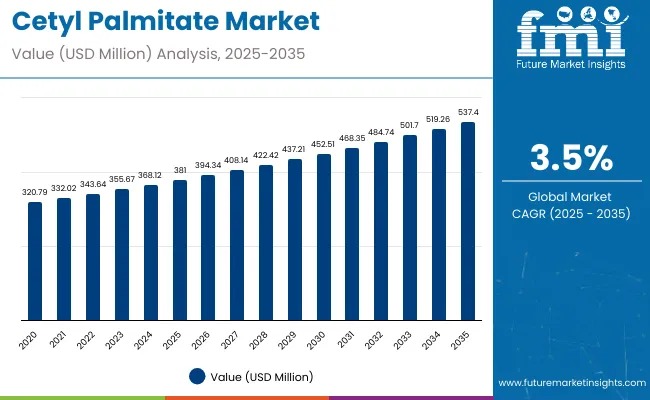
The global cetyl palmitate market is estimated to be valued at USD 381.0 million in 2025 and is projected to reach USD 537.4 million by 2035, registering a compound annual growth rate (CAGR) of 3.5% over the forecast period. The market is expected to add an absolute dollar opportunity of USD 156.0 million, reflecting a 1.41-times growth, driven primarily by rising consumer preference for naturally derived emollients and multifunctional cosmetic ingredients.
Cetyl palmitate is widely recognized for its emollient, moisturizing, and stabilizing properties, making it a critical ingredient in shampoos, conditioners, creams, lotions, and serums. The ingredient’s naturally derived, biodegradable characteristics align with growing trends toward clean-label, vegan, and cruelty-free personal care formulations, positioning it as a vital component in premium cosmetic and hair care products.
By 2030, the market is projected to reach approximately USD 452.5 million, reflecting an incremental value of USD 71.5 million over the first half of the decade. Growth between 2030 and 2035 is expected to accelerate moderately to USD 537.4 million, adding another USD 84.9 million, underlining the impact of innovative formulations and the rising adoption of sustainable, natural ingredients.
Gain Preview Access to Methodology, Sample Charts, and Key Findings by Requesting Your Sample Report! https://www.futuremarketinsights.com/reports/sample/rep-gb-4647
Market Drivers and Trends
The expansion of the cetyl palmitate market is primarily fueled by:
- Rising consumer preference for naturally derived emollients in cosmetic and personal care products.
- Premium hair care and skincare adoption, particularly in shampoos and conditioners, accounting for 60% of the product type market share.
- Cosmetics and personal care applications dominating 65% of the overall market, with high usage in creams, lotions, body butters, and serums.
- Sustainability and eco-friendly sourcing from plant oils, improving product stability, texture, and multifunctional performance.
- Regulatory approvals in North America and Europe for naturally derived esters, supporting market expansion.
Consumers are increasingly favoring multifunctional products that deliver skin hydration, enhanced texture, and hair conditioning. Formulators are investing in R&D to optimize cetyl palmitate concentrations for diverse hair types and skin applications, ensuring efficacy, regulatory compliance, and sustainability.
Regional Insights
The cetyl palmitate market shows varying growth dynamics across key regions:
- USA: CAGR of 3.8%, driven by strong adoption of natural ingredients, high disposable income, and robust cosmetic and personal care demand.
- France: CAGR of 3.6%, supported by premium cosmetics, multifunctional ingredient adoption, and EU regulatory compliance.
- Germany: CAGR of 3.4%, fueled by functional and organic cosmetic innovations and sustainable sourcing initiatives.
- UK: CAGR of 3.2%, moderated by post-Brexit supply chain challenges but supported by premium personal care adoption.
- Japan: CAGR of 2.9%, reflecting steady demand for multifunctional, naturally derived ingredients in urban centers like Tokyo and Osaka.
Competitive Landscape
The cetyl palmitate market is moderately consolidated, dominated by global specialty chemical suppliers and ingredient-focused companies such as Sigma-Aldrich Co. LLC, Croda International Plc, BASF SE, and Fine Organics. Key strategies driving competitiveness include:
- R&D investment in high-purity cetyl palmitate derivatives.
- Eco-friendly sourcing practices and sustainable production.
- Regulatory compliance with North American and European standards.
- Product customization and development of multifunctional blends for cosmetics, personal care, and premium hair care.
Mid-sized and regional players such as Evonik Industries, Caesar & Loretz, Hangzhou Dayangchem, and BioCell Technology focus on localized production, sustainable sourcing, and niche product offerings. While high raw material costs, feedstock volatility, and regulatory compliance constrain growth, innovation and multifunctionality continue to drive adoption globally.
Challenges and Restraints
Market growth faces pressures from:
- Fluctuating prices of palm and coconut oil feedstocks, increasing production costs by 10–15%.
- Limited availability of high-purity cetyl palmitate for premium applications.
- Stringent regulatory approvals requiring extended testing and development cycles.
- Complexity in processing and ensuring batch-to-batch consistency.
Despite these challenges, cetyl palmitate maintains its niche yet essential role across specialty chemicals, cosmetic ingredients, personal care, pharmaceutical excipients, industrial lubricants, food additives, and oleochemicals.
Outlook
The cetyl palmitate market is positioned for steady growth over the next decade, underpinned by eco-conscious consumer trends, premium formulation adoption, and ongoing innovations in sustainable, multifunctional cosmetic and personal care products. With manufacturers focusing on high-performance, clean-label, and naturally derived solutions, cetyl palmitate is set to strengthen its presence across North America, Europe, and Asia-Pacific, offering both incremental value and long-term market stability.