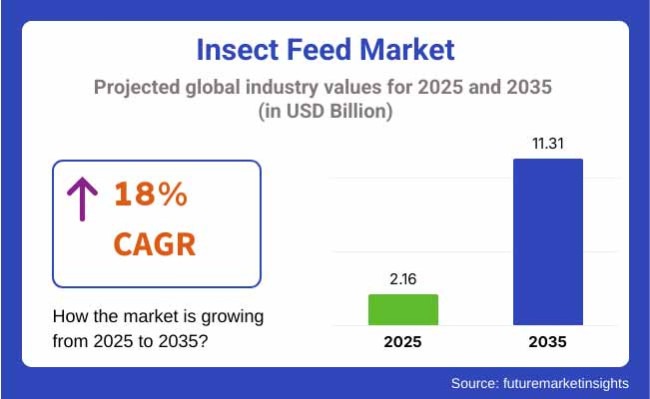
The global insect feed market, currently valued at around USD 2.16 billion, is on track to reach USD 11.31 billion by 2035 at a strong CAGR of 18%. The surge in adoption reflects the accelerating shift toward circular, sustainable, and resource-efficient animal nutrition systems.
Growing confidence among aquaculture nutritionists and sustainability experts continues to position insect proteins—especially black soldier fly (BSF) larvae meal—as one of the most promising alternatives to fishmeal and soymeal. High protein density, balanced amino acid profiles, and low environmental impact make insect ingredients ideal for meeting global food system challenges.
Explore trends before investing – request a sample report today! https://www.futuremarketinsights.com/reports/sample/rep-gb-11604
Aquaculture Leads With 44% Market Share in 2025
Aquaculture remains the most influential growth driver, accounting for 44% of total insect feed revenues in 2025. Fish farmers are adopting insect meal to reduce dependence on depleting fish stocks and volatile fishmeal prices. With favorable feed conversion ratios, excellent digestibility, and rising pressure for sustainable seafood, insect-derived aquafeed is becoming a mainstream solution across Europe and Southeast Asia.
The segment is also benefiting from strong regulatory support and ESG-linked investments that prioritize low-impact protein sources, further strengthening insect feed’s industry-wide acceptance.
Premium Pet Food Emerges as a High-Value Growth Channel
The pet food segment is forecast to grow at over 16% CAGR through 2035, driven by:
- Hypoallergenic and easily digestible novel protein demand
- Premiumization and humanization of pets
- Clean-label, sustainability-focused consumer expectations
Pet nutrition brands are increasingly developing insect-based formulations co-created with veterinarians and animal nutritionists to ensure performance credibility. Growing regulatory clarity in the EU and rising openness across the U.S., South Korea, and Australia support rapid commercialization.
Semi-Annual Demand Analysis Shows Strengthening Growth Momentum
A comparative evaluation of CAGR shifts between 2024 and 2025 reveals strong upward momentum:
- H1 2024: 16.3%
- H2 2024: 16.9%
- H1 2025: 17.4%
- H2 2025: 19.0%
While H1 2025 saw a minor decline of 16 BPS, the second half recorded a notable increase of 34 BPS—signaling stronger market confidence and supply chain stabilization.
Market Drivers: Sustainability, Circular Economy, and Technological Innovation
Key forces accelerating market expansion include:
- Rising Adoption in Aquaculture
Insect larvae provide essential amino acids, micronutrients, and high-quality protein, enabling efficient fish growth while reducing reliance on overfished marine resources. - Sustainable Livestock Feeding
By upcycling organic waste into protein, insect farming supports circular economies and reduces carbon footprints in poultry and swine production. - Breakthroughs in Farming Automation
Precision farming, automated breeding, and optimized substrate utilization are improving yields and cost efficiency—making large-scale insect protein production more feasible globally.
Historical Sales and Future Forecasts
From 2020 to 2024, global insect feed sales grew at a CAGR of 16.8%. Over 2025–2035, annual expenditures are projected to rise at an elevated 18%, supported by increasing demand for sustainable sources of animal protein amid a population heading toward 10 billion by 2050.
Market Concentration Analysis
Tier 1 Leaders (40%–50% share)
Companies such as Protix, AgriProtein, and Ynsect dominate with advanced manufacturing capabilities, large-scale facilities, and extensive regulatory expertise.
Tier 2 Mid-Sized Innovators
Companies including Enterra, Innovafeed, and Aspire Food Group hold strong regional influence and are scaling through strategic partnerships.
Tier 3 Local Enterprises
Small-scale producers (< USD 5 million revenue) address niche and localized needs while contributing significant innovation at grassroots levels.
Country-Wise Outlook (2035 Projections)
- United States: USD 1,697.7 million
- Germany: USD 1,131.8 million
- China: USD 905.5 million
- India: USD 565.9 million
- Japan: USD 226.4 million
In the U.S., the need for sustainable aquaculture feed is accelerating adoption. Germany continues to strengthen circular economy initiatives through insect-based waste valorization. India’s government-backed focus on food security and urban waste conversion is fostering new opportunities for insect farming.
Competitive Outlook
Key players are expanding production capacity, forming strategic collaborations, and enhancing product nutrient profiles to meet diverse livestock requirements. Leading companies include:
- Protix
- Ynsect
- NextProtein
- EnviroFlight
- Hexafly
- Entofood
- Diptera Nutrition
- AgriProtein
- Coppens
- Others
These companies are at the forefront of advancing insect protein technologies, driving the market toward high scalability, cost efficiency, and environmental resilience.