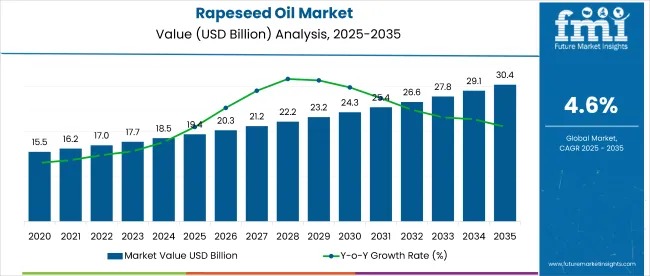
The global rapeseed oil market is projected to grow from USD 19.4 billion in 2025 to USD 30.4 billion by 2035, advancing at a stable CAGR of 4.6%. Demand continues to rise across food service, packaged foods, personal care, and biodiesel production as consumers and industries increasingly prefer heart-healthy, versatile oils with strong nutritional profiles.
Rapeseed oil’s high omega-3 content, neutral flavor, and excellent heat stability have made it a preferred choice for culinary, industrial, and nutritional applications. Its market relevance is reinforced by its share of several parent markets—accounting for 9% of the global vegetable oil market, 12% of the edible oil market, and nearly 10% of the oilseed market, reflecting its strong cultivation and consumption footprint worldwide.
In adjacent industries, rapeseed oil-based capsules hold 4% of the global dietary supplements category, and the oil maintains a 3% share in personal care ingredients, where vitamin E and antioxidant properties drive usage in moisturizers, serums, and hair care products. It further contributes 1% of biodiesel feedstock and occupies a small yet growing portion (0.2%) of the global food and beverage sector.
Explore trends before investing – request a sample report today! https://www.futuremarketinsights.com/reports/sample/rep-gb-7956
Regulatory Support Strengthening Transparency and Sustainable Production
Policies worldwide are shaping quality, sustainability, and labeling standards for rapeseed oil.
The European Union Regulation (EU) No 1169/2011 mandates precise nutrition labeling, while the U.S. FDA food labeling guide ensures clear ingredient disclosures for edible oils sold in the country. Agricultural frameworks, including the EU Common Agricultural Policy (CAP) and India’s National Mission on Edible Oils, play a pivotal role in encouraging sustainable cultivation, organic farming, and improved oilseed productivity.
These interventions are accelerating the adoption of high-purity, cold-pressed, and organic rapeseed oils, helping brands strengthen consumer trust and gain premium positioning in global markets.
France Emerging as the Fastest-Growing Market
Among global regions, Western Europe remains the leading hub, with France projected to grow at an impressive CAGR of 6.8% through 2035. Strong domestic farming capacity, elevated food-grade consumption, and biodiesel integration underpin this growth.
The UK and Germany are also witnessing steady expansion, registering CAGRs of 3.8% and 4.7%, respectively. In Germany, biodiesel blending mandates and high organic food adoption continue to influence demand, while Japan’s market is driven by an aging population, fortified food preferences, and demand for ultra-refined oils.
Product Insights: Processed Variant Leads with 72% Share
Processed rapeseed oil will remain the dominant product category, accounting for 72% of the segment in 2025. Its popularity stems from consistent quality, extended shelf life, and suitability for high-temperature cooking across food manufacturing and food service operations.
- Neutral flavor and stability support widespread use in commercial kitchens.
- Food manufacturers favor processed variants for cost-effectiveness and performance consistency.
Distribution Channel: Modern Trade Set for 38% Share
Organized retail channels will capture 38% of the market in 2025 as supermarkets and hypermarkets continue to drive high-volume sales. Consumers show strong purchasing preference for branded oils available through modern trade due to visibility, trust, and in-store promotions.
End User Outlook: Food Service Holds 61% Share
The food service sector will retain its leadership with a 61% market share, supported by the growing use of rapeseed oil in restaurants, hotel chains, catering units, and institutional cooking. Its suitability for frying, sautéing, baking, and salad dressings makes it a staple in commercial kitchens worldwide.
Key Market Trends and Challenges
Recent Trends Include:
- Rising adoption of organic and cold-pressed rapeseed oil.
- Growing incorporation of rapeseed oil in cosmetics and personal care due to vitamin E and antioxidant benefits.
Challenges Impacting Market Momentum:
- Climate-linked fluctuations in crop yields affecting global supply.
- GMO-related consumer concerns affecting adoption in select regions.
- Price volatility in oilseeds influencing procurement planning.
Country-Level Insights Highlight Robust OECD Demand
Japan’s market is growing at 4.4% CAGR, driven by demand for functional foods and omega-rich oils. Germany continues to expand due to biodiesel mandates and high per capita edible oil consumption. The UK’s bakery and snack sectors are key demand generators, while the U.S. market grows 2.8% CAGR, primarily supported by dietary supplements and functional foods.
Competitive Landscape
Leading players—including Wilmar International, Oilio, Interfat S.A., Vioil Group, Geostroy Engineering Ltd., DLG Group, Scanola A/S, Cargill, Biona Organic, Yorkshire Rapeseed Oil, and Black & Gold—are strengthening their positions through innovation in refining technology, sustainable sourcing, and expansion into premium cold-pressed variants.
Investments in supply chain traceability, organic certification, and clean-label product portfolios continue to reshape competitive dynamics across regions.