The global customized premix market is entering a decade of accelerated growth, driven by rising health consciousness, expanding fortified food portfolios, and precision-nutrition-based product development. With evolving consumer priorities and stronger regulatory alignment across regions, manufacturers are rapidly integrating multi-nutrient blends into mainstream and specialized applications.
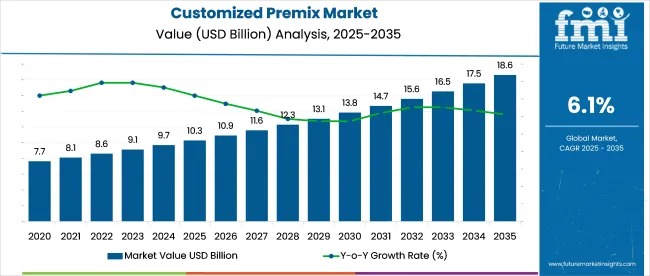
The market, valued at USD 10.3 billion in 2025, is projected to reach USD 18.6 billion by 2035, advancing at a CAGR of 6.1%. Expansion is strongly supported by the growing adoption of premixes across functional foods, pharmaceuticals, nutritional beverages, infant nutrition, and DTC wellness formats. Rising lifestyle diseases, aging populations, and the shift toward preventive healthcare have positioned premix solutions as essential enablers of smarter formulation strategies.
Asia Pacific continues to lead growth momentum, with China rising at a CAGR of 7.4%—the fastest globally—followed by India at 7.1%. These markets benefit from expanding fortification programs, maternal health directives, and urban consumer demand for nutrient-dense foods. Meanwhile, mature markets like the United States (6.5% CAGR) and Germany (6.6% CAGR) are experiencing next-generation innovation driven by clinical nutrition, OTC supplementation, and functional beverage reformulation.
A key driver is the rapid adoption of personalized and direct-to-consumer nutrition. Premix blends and DTC solutions account for a dominant 71% share of the market in 2025 as brands increasingly deliver ready-to-use micronutrient formulations for immunity, energy, cognitive support, and bone health.
Explore trends before investing – request a sample report today! https://www.futuremarketinsights.com/reports/sample/rep-gb-11526
Market Contribution Across Parent Sectors
Customized premixes contribute significantly to overlapping nutrition-focused categories:
- 18–22% of the functional food ingredients market
- 15–18% of the nutraceuticals market
- 10–12% of dietary supplements
- 20–25% of fortified food & beverage markets
These shares reflect the critical role of premixes in enabling nutrient-dense formulations aligned with consumer and regulatory expectations.
Shift from Pandemic-Driven Demand to Structured Long-term Growth
Between 2020 and 2024, demand surged due to COVID-19-induced health consciousness, with heightened interest in immunity and preventive wellness. From 2025 onward, growth becomes more systemic—driven by:
- demographic shifts
- public nutrition programs
- expanded DTC adoption
- advancements in clinical guidelines
- next-generation formulation technologies
This transformation supports durable, innovation-led expansion globally.
Premix Usage in Wheat Flour Fortification
Only three countries maintain double-digit per-capita premix consumption through mandatory wheat flour fortification—United States, Canada, and the United Kingdom—each exceeding 12 grams annually. Nations without mandates, including China, Germany, and Japan, remain below 0.20 grams per capita, limiting overall adoption despite parallel fortified food initiatives.
Top Investment Segments in the Customized Premix Market
- Premix Blends/DTC Solutions (71% Share)
The largest segment is propelled by convenience-based formulations, fast innovation cycles, and rising online nutrition brands. Manufacturers rely on premix blends to simplify supply chains and accelerate product launches. - Powder Form (67% Share)
Powders dominate due to stability, longer shelf life, compatibility with automated production, and seamless integration into bakery, beverages, infant formula, and sports nutrition. - Vitamin Premixes (45% Share)
Vitamins remain the most in-demand ingredients, fueled by their foundational role in immunity, metabolism, and overall wellness. Growing awareness of micronutrient deficiencies reinforces segment leadership. - Bone Health Function (29% Share)
Calcium-, vitamin D-, magnesium-, and phosphorus-based blends support growing demand for bone health, driven by sedentary lifestyles and orthopedic-related health burdens. - Pharma OTC Application (39% Share)
OTC products—tablets, sachets, and capsules—drive the largest application share as self-care becomes mainstream and consumers seek cost-effective preventive solutions.
Key Market Dynamics
Strong health-driven formulation shifts continue to expand product volumes:
- Over 58% of 2025 health-positioned new SKUs feature premixes
- Retail shelf space for premix-formulated foods grew 23%
- Powdered premix shipments in Asia rose 17.6% YoY
Regulatory and clinical frameworks are reshaping supplier contracts:
- 61% of EU manufacturers revised inputs following updates to NRVs
- India recorded a 21% surge in premix use in school meal programs
- Large food companies are aligning procurement with therapeutic nutrition needs
Regional Growth Highlights
- United States: Strong DTC expansion; clinical nutrition applications up 18.6% in 2024
- United Kingdom: NHS-backed initiatives boosted fortified school meal procurement by 22%
- Germany: 28% of OTC SKUs were reformulated with improved premix specifications
- China: Infant nutrition premix volumes jumped 25.8% YoY
- India: Anemia-focused premix demand rose 32% between 2022 and 2025
Competitive Landscape
Global leaders including Archer Daniels Midland Company, BASF SE, Barentz International B.V., and DSM are strengthening portfolios with targeted vitamin-mineral systems. Mid-sized innovators such as Hexagon Nutrition, Fenchem Biotek, and Fuerst Day Lawson support private-label expansion through rapid formulation customization. Regionally active firms like AQC Chem Lab, Coalescence LLC, Budenheim, and Farbest Brands are advancing specialized offerings in bone health, infant nutrition, and OTC wellness.