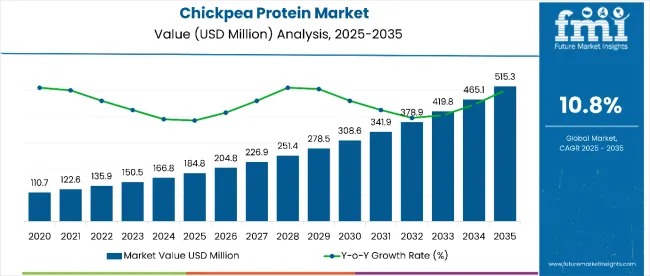
The global chickpea protein market is entering a high-growth decade, with its value projected to rise from USD 184.8 million in 2025 to USD 515.3 million by 2035, registering a strong CAGR of 10.8%. The market is forecast to create an absolute dollar opportunity of USD 330.5 million, marking a 2.79x expansion driven by accelerating demand for clean-label proteins, sustainable food sources, and plant-forward diets across major global markets.
With vegan, flexitarian, and allergen-conscious consumers reshaping product expectations, chickpea protein has become a preferred ingredient across food manufacturing, sports nutrition, pharmaceuticals, and personal care. By 2030, the market will reach USD 308.3 million, adding USD 123.5 million in the first half of the decade and USD 207 million in the latter half—a clear indication of back-loaded, accelerating demand.
Explore trends before investing – request a sample report today! https://www.futuremarketinsights.com/reports/sample/rep-gb-12547
Innovation Accelerates Market Adoption
Advancements in protein extraction, texture enhancement, and clean-label formulation are reinforcing chickpea protein’s functional appeal. Manufacturers are introducing next-generation isolates and organic product lines that offer superior digestibility, improved solubility, and neutralised taste profiles—expanding applicability in:
- High-performance sports nutrition
- Functional beverages and bakery
- Plant-based meat alternatives
- Infant and clinical nutrition
- Personal care and cosmetic formulations
Major companies—including ADM, Cargill, International Flavors & Fragrances Inc., Kerry Group, and SunOpta Inc.—are expanding production capacity and strengthening portfolio diversity through R&D investments, sustainability-driven sourcing, and strategic partnerships.
Isolates Lead with 48% Market Share
Among product segments, chickpea protein isolates dominate with 48% share, underpinned by their high purity, broad formulation flexibility, and superior nutritional value. Their rapid adoption in sports supplements and therapeutic foods positions isolates as the most lucrative investment opportunity across the forecast period.
Technological improvements in solvent extraction and enzymatic processing continue to enhance isolate performance, supporting wider penetration into mainstream and premium nutrition categories.
Conventional Segment Maintains a Firm 69% Market Share
The conventional chickpea protein segment, commanding 69% of the market, remains the preferred choice for large-scale manufacturing due to its cost-efficiency and established supply ecosystems. Its reliability and scalability enable broad usage across packaged foods, beverages, and clinical-grade nutrition solutions.
While organic chickpea protein is gaining traction, especially in high-growth Asian markets, the conventional segment continues to anchor global production volumes.
Key Drivers and Trends Shaping Growth
The next decade of chickpea protein development is shaped by:
- Rising health and wellness awareness: Consumers are prioritizing clean-label, allergen-free, and cholesterol-free protein sources.
• Expansion of plant-based diets: Vegan, vegetarian, and flexitarian lifestyles are accelerating product adoption worldwide.
• Sustainability and ethical consumption: Eco-friendly agricultural practices and low environmental footprints elevate chickpea protein’s appeal.
• Technological innovation: Improved taste, texture, and solubility unlock new applications in fortified foods and nutraceuticals.
Opportunities are also heightened by collaborations between ingredient manufacturers and food brands seeking high-quality protein alternatives to meet stringent regulatory and consumer expectations.
High-Growth Regional Markets
Growth varies significantly across key markets, with emerging regions leading expansion due to rising middle-class consumption and clean-label awareness.
Top fast-growing countries (CAGR):
- China: 12.0%
- India: 11.7%
- United States: 11.4%
- Brazil: 11.2%
- Canada: 10.8%
- United Kingdom: 9.0%
- Germany: 8.5%
China
Demand accelerates due to increased production capacity, digital retail penetration, and government support for organic farming.
India
As the world’s largest chickpea producer, India’s growth is strengthened by growing health awareness and rapid expansion in processing infrastructure.
USA
Driven by plant-forward diets, advanced extraction capabilities, and strong retail distribution across e-commerce and supermarkets.
Brazil & Canada
Both markets benefit from expanding food processing sectors, sustainability incentives, and increased adoption in functional foods.
UK & Germany
Mature markets supported by stringent quality regulations, rising vegan adoption, and innovations in allergen-free protein solutions.
Competitive Landscape
Global leaders are actively scaling operations to meet accelerating demand:
- ADM & Cargill: Investing in extraction technologies and high-purity isolates.
- IFF & Kerry Group: Developing tailored solutions for vegan, clean-label, and allergen-free product lines.
- SunOpta Inc.: Leveraging non-GMO sourcing and sustainability-first manufacturing.
The industry’s growth runway remains strong as brands intensify innovation in taste optimization, functional nutrition, and organic-certified formulations.