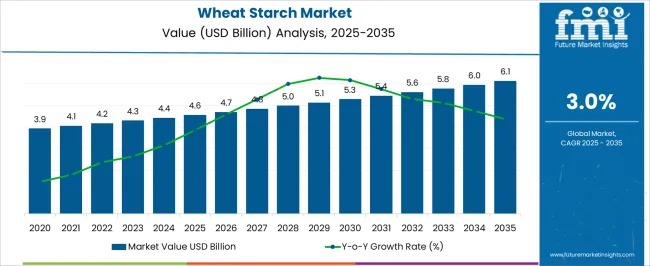
The global wheat starch market is poised for consistent growth, projected to rise from USD 4.6 billion in 2025 to USD 6.1 billion by 2035, reflecting a CAGR of 3.0%. Growth patterns highlight early acceleration, mid-term stabilization, and renewed momentum toward 2035 as demand strengthens across food processing, pharmaceuticals, and industrial sectors.
The market’s peak-to-trough analysis indicates that from 2025 to 2030, wheat starch demand increases by USD 0.7 billion with a CAGR of 3.7%, fueled by its expanding role as a thickener, stabilizer, and binder. A mild slowdown between 2030 and 2032 signals a maturity phase, followed by a renewed surge through 2035 driven by innovation and rising adoption in emerging economies.
Explore trends before investing – request a sample report today! https://www.futuremarketinsights.com/reports/sample/rep-gb-23922
Market Overview: Steady Uptick Supported by Functional Versatility
Wheat starch continues to gain traction across industries due to its clean-label appeal and functional benefits in texture, moisture management, and binding. The food and beverage sector remains the largest consumer, supported by rising consumption of sauces, bakery products, snacks, and ready-to-eat meals. Advances in processing technologies have enhanced purity, enabling broader adoption in pharmaceuticals, personal care, textiles, adhesives, and bio-based materials.
Quick Market Highlights
- Leading segment in 2025: Native wheat starch (57.3%)
- Largest form: Powder (66.5% share)
- Key end-use channel: Food & Beverages (41.2% share)
- High-opportunity regions: North America, Asia-Pacific, Europe
Segmental Insights
Native Wheat Starch Dominates Global Demand
Holding 57.3% of the 2025 revenue share, native wheat starch remains the top-performing segment, supported by clean-label trends and compatibility with natural formulation needs. Its consistent results in bakery, dairy, and sauces continue to strengthen adoption across major processing clusters.
Powdered Wheat Starch Maintains Market Leadership
With 66.5% share in 2025, powdered wheat starch remains the preferred form due to its ease of handling, long shelf life, and consistent performance in large-scale manufacturing. Uniform particle size supports precise dosing and product standardization, especially in processed foods.
Food & Beverages Distribution Channel Leads the Market
Accounting for over 41% of market value, this segment is powered by rising appetite for processed foods and the shift toward natural texturizers. Wheat starch is increasingly used to enhance mouthfeel, texture, and product stability across sauces, snacks, confectionery, and bakery goods.
Key Market Drivers, Challenges, and Trends
Key Drivers
- Rising demand for processed and convenience foods
- Expanding industrial applications in adhesives, paper, and textiles
- Strong consumer shift toward natural, non-GMO, and clean-label ingredients
Major Restraints
- Volatile wheat prices driven by climate and supply chain challenges
- Growing competition from corn, potato, and tapioca starches
Emerging Trends
- Advanced starch modifications (pre-gelatinized, resistant forms) for enhanced functionality
- Growing relevance in biodegradable plastics and sustainable packaging
- Increasing adoption in organic and clean-label product formulations
Country-Level Insights
China (CAGR: 4.1%)
Fueled by its massive food processing industry, rising demand for biodegradable packaging, and robust agricultural supply.
India (CAGR: 3.8%)
Growth supported by expanding urban consumption, growing processed food sectors, and rising domestic production capacity.
Germany (CAGR: 3.5%)
Clean-label momentum and advanced food manufacturing technologies support sustained market expansion.
United States (CAGR: 2.6%)
Demand driven by processed foods, gluten-free innovation, and clean-label product reformulations.
United Kingdom (CAGR: 2.9%)
Growing adoption in plant-based, sustainable, and reduced-waste food solutions supports market stability.
Competitive Landscape
The wheat starch market is shaped by global leaders known for advanced ingredient solutions and supply reliability. Key participants include ADM, Aminola, Cargill, Crespel & Deiters Group, Meelunie, Roquette Frères, Tereos, and others.
- ADM focuses on high-purity wheat starch tailored for food, biofuel, and textile applications.
- Cargill delivers versatile wheat starch solutions enhancing texture, viscosity, and stability across food and industrial uses.
- Roquette Frères and Tereos remain strong competitors with sustainable, high-quality starches used in food processing and specialty industrial formulations.
Innovation, clean-label alignment, and supply chain strength continue to define the competitive dynamics of the global market.
About Future Market Insights (FMI)
Future Market Insights, Inc. (ESOMAR certified, recipient of the Stevie Award, and a member of the Greater New York Chamber of Commerce) offers profound insights into the driving factors that are boosting demand in the market. FMI stands as the leading global provider of market intelligence, advisory services, consulting, and events for the Packaging, Food and Beverage, Consumer Technology, Healthcare, Industrial, and Chemicals markets. With a vast team of over 400 analysts worldwide, FMI provides global, regional, and local expertise on diverse domains and industry trends across more than 110 countries.
Contact Us:
Future Market Insights Inc.
Christiana Corporate, 200 Continental Drive,
Suite 401, Newark, Delaware – 19713, USA
T: +1-347-918-3531
For Sales Enquiries: sales@futuremarketinsights.com
Website: https://www.futuremarketinsights.com
LinkedIn| Twitter| Blogs | YouTube