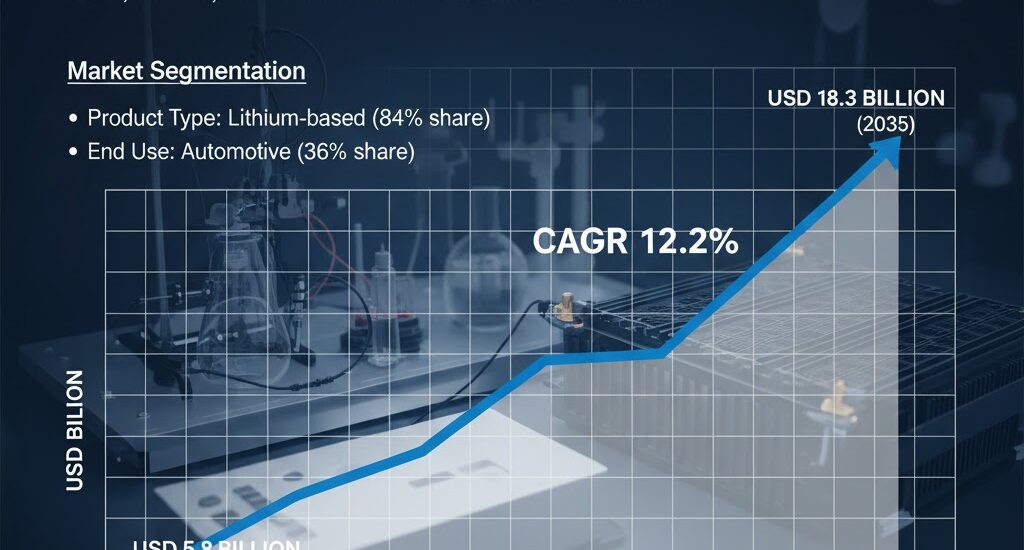
The global lithium and lithium ion battery electrolyte market is poised for exceptional growth, projected to rise from USD 5.8 billion in 2025 to USD 18.3 billion by 2035, advancing at a CAGR of 12.2%. This growth reflects the accelerating adoption of electric vehicles (EVs), surging consumer electronics demand, and expanding energy storage applications across key regions including Asia Pacific (APAC), Europe, the USA, and Saudi Arabia.
Market Summary
The lithium and lithium ion battery electrolyte market is witnessing robust expansion as global industries prioritize clean energy, electrification, and sustainability. Electrolytes—vital for ensuring battery safety, efficiency, and performance—are in high demand as governments tighten emission norms and accelerate EV penetration. The market’s absolute dollar growth of USD 12.6 billion over the decade underscores its long-term potential, driven by breakthroughs in solid-state and gel electrolyte technologies and the rapid scaling of battery manufacturing capacities.
Access the comprehensive market report for detailed regional insights, competitive benchmarking, and technological advancements! Request Sample Report
Market Drivers
- Electric Vehicle Boom: Rising EV adoption across China, India, Europe, and North America is the primary growth catalyst, with automakers investing heavily in battery innovations to enhance range and safety.
- Energy Transition Initiatives: Global renewable integration and grid-scale energy storage deployments are expanding the electrolyte’s end-use footprint.
- Technological Advancements: Continuous innovations in high-purity lithium salts, solid-state electrolytes, and non-volatile formulations are redefining performance standards.
Market Challenges
While the market outlook remains optimistic, key challenges include the high cost of lithium compounds, supply chain concentration, and environmental compliance related to electrolyte manufacturing. Addressing recycling inefficiencies and ensuring sustainable sourcing remain strategic imperatives for long-term market stability.
Key Trends
- Solid-State Electrolytes Gain Traction: Safer and higher-density electrolytes are reshaping EV battery architectures.
- Sustainable Manufacturing: Companies are increasingly adopting green chemistries and circular economy models.
- Strategic Collaborations: Partnerships among automakers, battery producers, and chemical companies are accelerating the commercialization of next-generation electrolytes.
Segmental Insights
- By Product Type: Lithium-based electrolytes dominate with 84% market share in 2025, maintaining leadership through 2035 owing to superior energy density and performance.
- By End Use: The automotive segment leads with 36% share, reflecting the expanding global EV ecosystem. Consumer electronics and energy storage systems remain key complementary sectors supporting sustained demand.
Regional Insights
- APAC (India, China, Japan): The fastest-growing region, led by India (CAGR 18.1%) and China (CAGR 13.6%), driven by national EV policies and large-scale manufacturing.
- Europe (Germany): Expanding at 18.0% CAGR, supported by the continent’s automotive leadership and stringent EU sustainability directives.
- United States: Growing steadily at 6.8% CAGR, underpinned by EV incentives, domestic production goals, and clean energy investments.
- Saudi Arabia: Emerging as a new investment hub in the Middle East, supported by Vision 2030’s focus on clean technology manufacturing and regional battery infrastructure development.
Need tailored insights? Request report customization to match your specific business objectives!
Competitive Landscape
Leading market players — including Mitsubishi Chemical Corp., Shenzhen Capchem Technology Co. Ltd., Shanshan Technology, LG Chem, and Panasonic Corporation — are strengthening their positions through R&D in advanced electrolyte chemistries and expansion of global manufacturing networks. Strategic partnerships across the battery value chain are central to achieving scalability, safety, and sustainability.
Market Outlook
The lithium and lithium ion battery electrolyte market is entering a transformative decade characterized by electrification, innovation, and regional diversification. With strong policy support and surging private investment across APAC, Europe, the USA, and Saudi Arabia, the market is set to become a cornerstone of global energy transition initiatives. Future opportunities lie in solid-state technology adoption, sustainable raw material sourcing, and vertical integration strategies enabling greater control over the battery supply chain.
About Future Market Insights (FMI)
Future Market Insights, Inc. (FMI) is an ESOMAR-certified, ISO 9001:2015 market research and consulting organization, trusted by Fortune 500 clients and global enterprises. With operations in the U.S., UK, India, and Dubai, FMI provides data-backed insights and strategic intelligence across 30+ industries and 1200 markets worldwide.
Why Choose FMI: Empowering Decisions that Drive Real-World Outcomes: https://www.futuremarketinsights.com/why-fmi