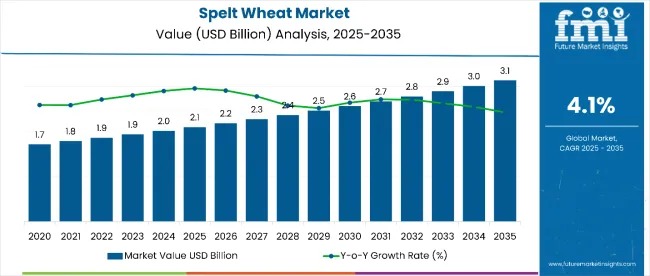
The global spelt wheat market is entering a decade of sustained expansion as health-driven consumers, specialty bakeries, and premium food manufacturers increasingly shift toward heritage grain alternatives. According to recent industry estimates, the market is valued at USD 2.1 billion in 2025 and is projected to reach USD 3.1 billion by 2035, reflecting a steady CAGR of 4.1%. During the forecast window, spelt wheat is expected to generate an absolute dollar opportunity of USD 1.0 billion, solidifying its position within the ancient grains ecosystem.
Growth remains anchored in the rising adoption of spelt across bakery applications, breakfast cereals, premium pasta formulations, and functional food categories. With 62% of demand coming from the food industry, the grain continues to benefit from its reputation for digestive compatibility, nutrient density, and clean-label appeal.
See How This Report Can Support Your Strategic Planning.
Request Sample Report With Complete Market Breakdowns and Growth Estimates. https://www.futuremarketinsights.com/reports/sample/rep-gb-8003
By 2030, the market is forecasted to cross USD 2.6 billion, adding nearly USD 500 million in the first five years, followed by a moderately accelerated USD 400 million in the latter half of the decade. Advanced organic farming practices and investments in mill modernization—particularly among leaders like Ardent Mills and Bob’s Red Mill Natural Foods—are enhancing product quality, certification reliability, and global supply availability.
Rising Preference for Ancient Grain Alternatives
As spelt continues to capture 18% of the global ancient grains market and 12% of the alternative flour market, its adoption is deeply tied to the industry-wide transition toward whole-grain, nutrient-dense, and naturally digestible ingredients. The grain also commands 8% of the organic grain market and close to 6% of the health food ingredients market, with heightened demand from premium baking mixes, breakfast cereals, and specialty grain formulations.
Enhanced processing techniques—including stone milling and temperature-controlled grinding—have significantly improved nutritional retention and flour stability. These factors contribute to spelt’s growing role as a premium alternative to conventional wheat among both artisanal and mainstream bakery manufacturers.
Market Segmentation Highlights
The market is segmented by nature, variety, format, distribution channel, end use, and region. Organic certified spelt continues to outpace conventional variants as health-driven consumers prioritize transparency and sustainability.
By End Use – Food Industry Leads with 62% Market Share
The food industry maintains a dominant 62% share, reflecting robust use across:
- Bakery and pastry applications
- Breakfast cereals and granola
- Premium pasta and whole-grain formulations
- Clean-label specialty food products
Spelt’s distinctive nutty flavor and whole-grain profile provide meaningful differentiation for manufacturers competing in saturated bakery and cereal markets.
By Variety – Whole Spelt Flour Holds 59% Market Share
Whole flour remains the preferred variety, representing 59% of total demand. Retaining the grain’s bran, germ, and endosperm drives its appeal among:
- Artisanal bakers
- Health food manufacturers
- Functional food processors
Improved stone-milling technologies are supporting higher-grade whole-flour production while preserving mineral and fiber content.
Why the Spelt Wheat Market Is Growing
Three structural shifts are fueling long-term demand:
- Nutritional Superiority & Digestive Benefits: Rising gluten sensitivity awareness is pushing consumers toward digestible wheat alternatives without sacrificing performance in bread and pastry applications.
- Heritage Grain Appeal: Spelt fits perfectly within the clean-label and ancient grain narrative dominating premium food retail.
- Government & Organic Certification Support: Policy incentives for biodiversity and sustainable farming are strengthening the supply base globally.
Market Drivers, Restraints & Trends
Heritage grain authentication systems introduced across specialty retail in 2024–2025 have markedly improved traceability and consumer confidence. Certification-ready suppliers now have a decisive edge in premium positioning and retail partnerships.
Key drivers include:
- Growth of functional foods using ancient grains
- Expansion of organic cultivation across Europe and North America
- Increased product launches targeting gluten-sensitive consumers
Restraints include limited cultivation areas in Asia and slow adoption in markets with established modern wheat consumption habits.
Country-Level Outlook
The USA leads growth with a CAGR of 4.5%, supported by strong organic retail networks and high adoption in premium bakery chains. Germany follows at 4%, backed by traditional milling heritage and robust EU organic certification. France (3.5%) and the UK (2%) show steady adoption among artisanal bakers, while Japan (1%) remains a niche market driven by urban health-food segments.
Competitive Landscape
The market remains moderately fragmented, with both regional processors and global organic suppliers competing for certification-driven demand.
Key players include:
Arnreiter Mühle GmbH, Pfahnl Backmittel GmbH, European Flour Millers, Blattmann Schweiz AG, Einbrunger Mühle Karl Rölkens, Ardent Mills, Bob’s Red Mill Natural Foods, Healthy Hildegard, Montana Flour & Grains, and The Spelt Company Somerset Ltd.
Recent developments include Ardent Mills’ FY24 ESG Report, featuring advancements in sustainable farming, plant-based innovation, and responsible sourcing—strengthening its position among global spelt suppliers.