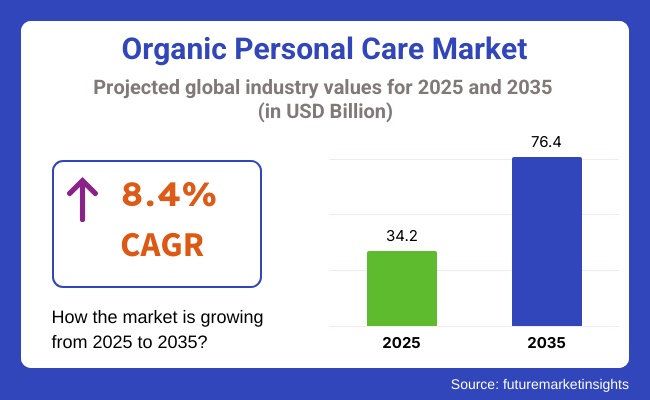
The global organic personal care market, valued at USD 34.2 billion in 2025, is poised to grow at a CAGR of 8.4% through 2035, reaching an estimated USD 76.4 billion. Fueled by increasing consumer demand for chemical-free, plant-based, and eco-friendly beauty and hygiene products, the market is transforming amid growing health consciousness and sustainability trends worldwide.
Market Trends Highlighted:
- Rising consumer preference for clean labeling, ingredient transparency, and brand sustainability.
- Significant innovation in botanical formulations and extraction technologies enhancing product efficacy and appeal.
- Increasing adoption of biotechnology and eco-friendly packaging solutions driving market evolution.
- Shift towards personalized products tailored to individual skin types and needs.
- Integration of digital technologies like AI and augmented reality in customer shopping experiences.
- Growth of cruelty-free, vegan, and certified organic offerings reflecting broader ethical consumerism.
Developments:
- Emergence of new players and heightened competition, especially in North America and Europe, with traditional brands reformulating to include organic certifications.
- Advances in biotech ingredients enabling high-performance yet natural product formulations.
- Rising usage of reusable, biodegradable packaging combating pollution and waste concerns.
- Expansion of e-commerce channels facilitating niche brand growth and direct-to-consumer access.
- Increasing government and industry focus on clean labeling regulations and third-party certifications like COSMOS and Ecocert.
Key Takeaways of the Report:
- The organic personal care market is driven by heightened consumer health awareness and environmental concerns.
- Market growth is tempered by high manufacturing costs, price sensitivity, and regulatory complexities.
- Despite challenges, innovation in product development, sustainable sourcing, and digital engagement will sustain expansion.
- Emerging economies in Asia-Pacific and Latin America are witnessing accelerated sales growth due to rising disposable incomes and local ingredient utilization.
- Risk factors include supply chain volatility, regulatory inconsistency, and the threat of greenwashing, which could undermine consumer trust.
Market Drivers:
- Increasing demand for chemical-free, plant-based beauty and hygiene products aligned with sustainability goals.
- Growing consumer preference for products free from parabens, sulfates, and synthetic fragrances.
- Rising disposable incomes in emerging markets driving adoption of premium organic personal care.
- Technological advances making organic products more efficacious and appealing, broadening consumer base.
- Expansion of product categories to include baby care, haircare, skincare, and smart personal care devices with organic elements.
Regional Insights:
North America (USA):
- Projected CAGR of 10.6% driven by strong clean beauty demand, ingredient transparency, and premiumization.
- Growing e-commerce dominance and increased R&D in botanical actives underpin market leadership.
Europe:
- UK at 9.2% CAGR with young, informed consumers prioritizing sustainability and transparency.
- France (8.8% CAGR) emphasizes luxury heritage complemented by organic innovation.
- Germany (8.5% CAGR) leads with a robust regulatory environment and eco-conscious consumers.
- Italy (8.2% CAGR) witnesses growing demand for Mediterranean botanicals and wellness-focused products.
Asia-Pacific:
- China forecasted at 10.2% CAGR, propelled by rising middle-class incomes and urban consumer demand for healthier alternatives.
- South Korea at 9.7% CAGR with rapid adoption of clean beauty and indigenous botanical ingredients.
- Japan growing at 8.6% CAGR fueled by minimalist, traditional approaches and an aging population seeking sensitive-skin solutions.
Competition Outlook:
- Intense competition fueled by both established brands and new indie entrants.
- Market leaders invest heavily in R&D, botanical ingredient innovation, and eco-friendly packaging.
- Growing emphasis on authenticity and third-party certifications to differentiate from competitors.
- Rising risk of greenwashing necessitates transparent communication and regulatory compliance.
- Digital marketing, social media engagement, and subscription models are key tools for customer retention.
Subscribe for Year-Round Insights → Stay ahead with quarterly and annual data updates : https://www.futuremarketinsights.com/reports/sample/rep-gb-18507
Key Segments of the Market Report:
- Product Types: Skincare, Haircare, Bath & Body, Baby Care, and Personal Hygiene.
- Distribution Channels: Online retail, supermarkets, specialty stores, and pharmacies.
- Consumer Demographics: Millennials and Gen Z driving demand for ethical, personalized care.
- Packaging Innovations: Biodegradable, reusable, and zero-waste packaging gaining traction.
- Technology Integration: AI-driven personalization, augmented reality for virtual try-ons, and smart hygiene devices.
Why FMI: https://www.futuremarketinsights.com/why-fmi
About Future Market Insights (FMI)
Future Market Insights, Inc. (ESOMAR certified, recipient of the Stevie Award, and a member of the Greater New York Chamber of Commerce) offers profound insights into the driving factors that are boosting demand in the market. FMI stands as the leading global provider of market intelligence, advisory services, consulting, and events for the Packaging, Food and Beverage, Consumer Technology, Healthcare, Industrial, and Chemicals markets. With a vast team of over 400 analysts worldwide, FMI provides global, regional, and local expertise on diverse domains and industry trends across more than 110 countries.
Contact Us:
Future Market Insights Inc.
Christiana Corporate, 200 Continental Drive,
Suite 401, Newark, Delaware – 19713, USA
T: +1-347-918-3531
For Sales Enquiries: sales@futuremarketinsights.com
Website: https://www.futuremarketinsights.com
LinkedIn| Twitter| Blogs | YouTube