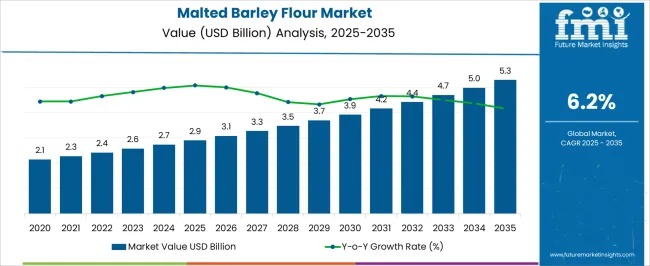
The global malted barley flour market, valued at USD 2.9 billion in 2025, is set to accelerate to USD 5.3 billion by 2035, expanding at a CAGR of 6.2%. Strong demand from bakery, brewing, and health-focused food segments continues to position malted barley flour as a high-growth grain-based ingredient across international markets. Rising consumer preference for whole grains, clean-label ingredients, and gluten-free formulations is further shaping purchasing behaviors and industrial usage patterns.
North America leads the global expansion, with the United States growing at a CAGR of 5.5%, driven by intense demand from the craft beer sector and a growing consumer shift toward nutrient-rich bakery goods. Europe follows closely, anchored by Germany and France—markets deeply rooted in brewing heritage and premium bakery production.
Request Sample Report With Complete Market Breakdowns And Growth Estimates. https://www.futuremarketinsights.com/reports/sample/rep-gb-7972
The malted barley flour market’s growth trajectory is supported by structural shifts across agriculture, food manufacturing, and beverage production. Diastatic malt remains the product leader, contributing 65% of market share in 2025 due to its dominating role in enhancing enzymatic activity for fermentation and improving dough texture in the bakery sector. The B2B channel continues to govern market distribution, capturing 50% share, supported by strong demand from large-scale food processors and breweries.
Within its broader parent categories, malted barley flour holds a notable footprint—accounting for 8–10% of the barley market, 2–3% of the global flour market, and 4–5% in grain-based ingredients. Its presence is most significant in brewing, representing 10–15% of the brewing ingredients market due to its indispensable role in fermentation.
Top Market Segments Driving Investments
By Product Type – Diastatic (65% Share)
Diastatic malt’s leadership is driven by its enzymatic benefits, wide application in brewing, and rising preference among artisanal and industrial bakeries.
Key factors include:
- Essential role in fermentation processes
- Improved dough conditioning and texture
- High demand from craft and commercial breweries
- Innovation in enzyme-rich and nutrient-enhanced formulations
By End Use – Bakeries (40% Share)
Demand is surging for whole-grain, organic, and gluten-free bakery goods. Malted barley flour enhances crust color, texture, and product stability.
Growth contributors include:
- Rapid expansion of artisanal and craft bread production
- Rising preference for healthy bakery alternatives
- Strong adoption of diastatic malt in bread and cake applications
By Source – Organic (30% Share)
With clean-label and chemical-free ingredients gaining traction, the organic malted barley flour segment represents a fast-growing category.
Market drivers:
- Increased adoption of non-GMO, clean-label ingredients
- Premium product pricing and higher margins
- Strong growth in North America and Europe
By Distribution Channel – B2B (50% Share)
Bulk supply requirements from food manufacturers and breweries continue to define this channel.
Key advantages:
- High-volume demand from industrial processors
- Strategic partnerships across brewing and food sectors
- Strengthened manufacturer–supplier networks
Country-Level Insights
United States – CAGR 5.5%
The U.S. remains the largest global market, supported by craft beer expansion, clean-label bakery innovation, and rising organic ingredient adoption.
United Kingdom – CAGR 4.1%
Deep-rooted brewing culture, increasing interest in whole-grain bakery items, and strong demand for sustainable production methods support market growth.
Germany – CAGR 4.2%
A leading force in European brewing, Germany is experiencing rising consumption of organic and health-centric malted barley flour.
France – CAGR 4.7%
France’s premium bakery culture and fast-growing craft beer segment significantly contribute to demand acceleration.
Japan – CAGR 3.9%
Driven by Western-style bakery adoption and increasing health awareness, Japan is emerging as a high-potential market for organic and gluten-free malted barley flour.
Competitive Landscape
The market is moderately fragmented, with key players including Cargill Incorporated, GrainCorp, Malteurop Group, and Soufflet Group. These companies are strengthening their portfolios through strategic expansions, advanced R&D in fortified ingredients, and investments in organic product lines. Supply chain optimization, digital expansion, and targeted marketing in high-growth regions remain top strategic priorities.
Recent industry updates highlight companies such as ADM and Ardent Mills developing fortified and organic variants to meet rising consumer demand for healthier, more functional food ingredients.