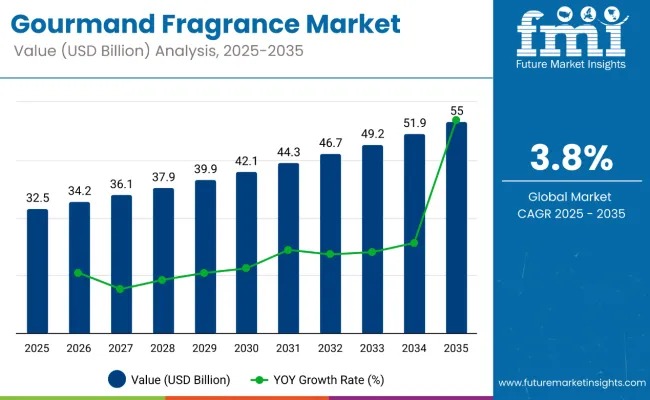
The global gourmand fragrance market has reached an estimated valuation of USD 32.55 billion in 2025, driven by strong consumer interest in sweet, dessert-inspired, and emotionally evocative scent profiles. The sector continues to strengthen its presence across personal care, home care, and niche perfumery, where sensory indulgence and mood elevation have become key purchase motivators. With consumer adoption accelerating across urban markets, the industry is on track to reach USD 55.0 billion by 2035, expanding at a steady CAGR of 3.8%.
In 2024, the market saw heightened demand for fragrances that mimic edible and nostalgic notes, particularly vanilla, caramel, praline, and tonka bean. Modern fragrance houses and luxury brands responded with innovative blends that pair sweet accords with smoky, floral, or spicy tones. One notable breakthrough was a 2025 multi-sensory perfume capsule launched by a leading French brand, integrating edible elements to enhance experiential engagement.
Request Sample Report With Complete Market Breakdowns And Growth Estimates. https://www.futuremarketinsights.com/reports/sample/rep-gb-7289
Innovation and Shifts in Consumer Preferences
Compared to the previous year, demand for emotion-evoking and nostalgic scents recorded measurable growth. Social media trends, sensory marketing, and self-care routines continue to push consumers toward fragrances resembling baked goods, confectionery, and comfort foods. Ingredients such as ethyl maltol, vanillin, and coumarin are increasingly used for their stability, affordability, and allergen-reduced benefits.
Brands have also accelerated development of clean-label, allergen-controlled, and water-based formulations. Microencapsulation technologies introduced in 2025 have improved fragrance longevity and skin compatibility, especially for sensitive-skin consumers. Fragrance layering is another rising trend, with consumers curating personalized scent trails across body care, home fragrances, and hair mists.
Regulatory Developments Supporting Market Growth
Global regulations continue to reinforce safety, transparency, and environmental responsibility:
- European Union: Strict cosmetic laws now require expanded allergen disclosure and comprehensive safety assessments through the PIF system.
- IFRA Standards: Widely adopted to maintain ingredient safety, restricting or permitting compounds based on scientific evaluation.
- Chemical Controls (REACH & Local Laws): Ongoing evaluation of fragrance molecules ensures responsible production and labeling.
Trade Landscape: Export Hubs and Import Momentum
France remains the largest global exporter of gourmand fragrances, followed by the United States, Italy, Germany, and Switzerland. Strong heritage, advanced perfumery technology, and premium brand portfolios continue to support exports from these regions.
Meanwhile, countries such as China, India, Brazil, and the UAE are becoming high-growth import markets due to rising disposable incomes, demand for luxury grooming, and rapid e-commerce expansion.
Top Investment Hotspots
Synthetic Fragrances Lead with 67.3% Market Share (2025)
Synthetic fragrances dominate due to consistency, sustainability, and formulation flexibility. Molecules such as vanillin and ethyl maltol help replicate complex caramel, cotton candy, and toasted sugar notes while reducing reliance on scarce natural ingredients.
Personal Care to Capture 61.5% of Market Share (2025)
Body lotions, mists, shower gels, and perfumes featuring gourmand profiles continue to grow as consumers prioritize comfort, mood enhancement, and sensorial skincare. Viral trends—including dessert-inspired mists and marshmallow-scented face sprays—are propelling strong adoption among younger demographics.
Evolving Consumer Trends
- Personalization: AI-driven scent profiling and bespoke perfume workshops are gaining traction.
- Sustainability: Refillable bottles, biodegradable materials, and vegan formulations are becoming mainstream.
- Unisex Expansion: Coffee, dark chocolate, tobacco, and whiskey notes are increasingly featured in masculine and unisex lines.
- Digital Retail: Virtual scent tools, AR try-ons, and influencer-driven campaigns boost online fragrance sales.
The USA dominates due to strong demand for luxurious and artisanal gourmand fragrances, supported by the booming men’s grooming sector.
In Europe, Germany and the UK show rising interest in premium, niche, and personalized scent formats.
Across APAC, China, India, and Japan display strong momentum driven by urbanization, disposable incomes, and preference for sophisticated yet culturally aligned scent profiles.
Competitive Landscape
The market remains moderately concentrated, led by global giants such as Chanel, Dior, and Guerlain, supported by France’s robust perfumery heritage. Europe continues to be the epicenter of gourmand fragrance expertise, with Italy and the UK contributing high-quality ingredients and artisanal craftsmanship.
In the US, a dynamic mix of luxury houses and indie brands fosters ongoing creativity. Across Asia Pacific, rising incomes and international brand expansion are intensifying competition while inspiring local brands to innovate with regionally beloved sweet notes.
Major ingredient suppliers and fragrance developers include:
Firmenich, Givaudan, Symrise, IFF, Takasago, Nestlé, Cargill, Blommer Chocolate, Unigrà S.r.l., CEMOI, PURATOS, Barry Callebaut, ADM WILD Europe, Wilmar International, and more.
Recent developments include Puig’s acquisition of Byredo and Dr. Barbara Sturm in 2024, and Le Monde Gourmand’s strategic retail partnership with Ulta Beauty, strengthening market penetration across North America.