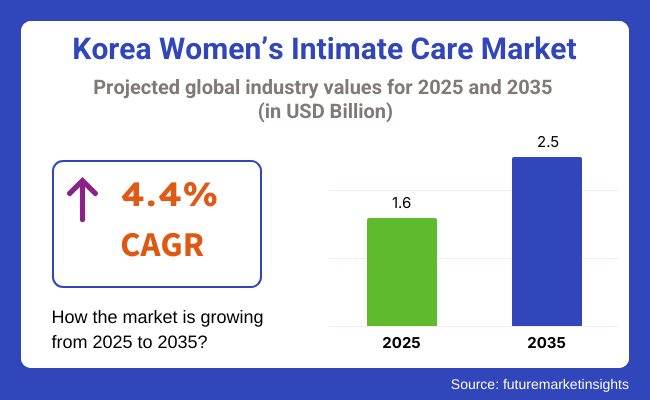
The Korea women’s intimate care market is set to reach a valuation of USD 1.6 billion in 2025, with promising growth projected at a CAGR of 4.4% from 2025 to 2035. By 2035, the market is expected to expand to approximately USD 2.5 billion, fueled by evolving social attitudes, demographic shifts, and cutting-edge product innovations.
Unlock the full market insights and exclusive data breakdowns – https://www.futuremarketinsights.com/reports/sample/rep-gb-18615
Key Market Insights and Drivers
- Market Valuation & Growth:
The Korea women’s intimate care market is forecasted to grow from USD 1.6 billion in 2025 to USD 2.5 billion by 2035, registering a healthy CAGR of 4.4%. - Changing Social and Cultural Dynamics:
Historically taboo, intimate hygiene is becoming a more transparent and accepted topic in South Korea, driven by increased awareness and destigmatization efforts around women’s health and wellness. - Consumer Demographics and Behavior:
A digitally savvy, health-conscious younger generation alongside Korea’s rapidly aging female population creates diverse demand patterns — from gentle, natural ingredients favored by youth to advanced care products for menopausal women. - Holistic Wellness Integration:
Intimate care is merging with overall skincare and wellness routines, reflecting a shift towards preventive healthcare and multi-functional products that promote long-term intimate health.
Trend Analysis by Consumer Segment
- Younger Women (Teens to 20s):
Preference for natural, hypoallergenic, and sustainable intimate care products, influenced heavily by online reviews, social media, and influencer marketing. Convenience and eco-friendly packaging also play key roles. - Women Aged 30-50:
Demand for multifunctional intimate care products that balance pH, moisturize, and manage odor. These consumers prioritize clinically validated, brand-trusted formulations integrated into everyday wellness routines. - Women Over 50:
Focus on comfort and health, addressing menopausal symptoms like dryness and irritation with medically approved, fragrance-free products, typically purchased through healthcare channels.
Risk Factors Affecting Market Growth
- Regulatory Environment:
South Korea’s stringent regulations on personal care product formulations, labeling, and advertising could pose challenges if compliance requirements change. - Consumer Education & Trust:
Despite increasing awareness, inadequate education about intimate care benefits may hinder market potential, as uninformed consumers might avoid or misuse products. - Market Saturation:
Increasing competition and similar product offerings may intensify price wars, threatening profitability and brand loyalty.
Market Segmentation Overview
- By Product:
Intimate washes dominate sales, followed by moisturizers and creams designed for hydration, irritation relief, and vaginal health. These products often feature natural ingredients like aloe vera, probiotics, and hyaluronic acid. - By Sales Channel:
Online retail leads due to convenience, privacy, and a wide product selection. E-commerce is further supported by high internet penetration and digital marketing via social media influencers. - By Age Group:
The market segments women aged 12-19, 20-25, 26-40, 41-50, and 51+, with distinct needs and preferences per group. - By Region:
Key regions include South Gyeongsang, North Jeolla, South Jeolla, Jeju, and other parts of Korea, each reflecting unique consumer profiles.
Competitive Landscape & Market Shares
- Procter & Gamble (P&G):
Market leader with 18-22% share, backed by trusted brands such as Always and Tampax, known for innovation and reliability. - Johnson & Johnson:
Holds 15-18%, offering dermatologist-tested products like Carefree and Neutrogena, focusing on skin-friendly formulations. - Hindustan Unilever Limited:
Captures 8-12%, leveraging sustainability and ethical sourcing through brands like Lux and Vanish. - Emerging Players:
Redcliffe Hygiene (5-7%) and SANFE.IN (3-5%) provide cost-effective, convenient intimate care options, while Joylux Inc. (2-4%) and QUEEN V (2-4%) emphasize health technology and organic formulations.
Subscribe for Year-Round Insights → Stay ahead with quarterly and annual data updates : https://www.futuremarketinsights.com/checkout/18615
Key Takeaways
- The Korean intimate care market is on a robust growth trajectory driven by evolving cultural norms, increased health awareness, and demographic shifts.
- Diverse consumer needs demand segmented product offerings from natural, hypoallergenic washes to advanced menopausal care solutions.
- Digital platforms and social media influencers are critical in educating consumers and shaping purchase decisions.
- Sustainability and transparency remain core values influencing brand loyalty and product development.
- Regulatory vigilance and consumer education will be crucial to market stability and growth.
Why FMI: https://www.futuremarketinsights.com/why-fmi
About Future Market Insights (FMI)
Future Market Insights, Inc. (ESOMAR certified, recipient of the Stevie Award, and a member of the Greater New York Chamber of Commerce) offers profound insights into the driving factors that are boosting demand in the market. FMI stands as the leading global provider of market intelligence, advisory services, consulting, and events for the Packaging, Food and Beverage, Consumer Technology, Healthcare, Industrial, and Chemicals markets. With a vast team of over 400 analysts worldwide, FMI provides global, regional, and local expertise on diverse domains and industry trends across more than 110 countries.
Contact Us:
Future Market Insights Inc.
Christiana Corporate, 200 Continental Drive,
Suite 401, Newark, Delaware – 19713, USA
T: +1-347-918-3531
For Sales Enquiries: sales@futuremarketinsights.com
Website: https://www.futuremarketinsights.com
LinkedIn| Twitter| Blogs | YouTube