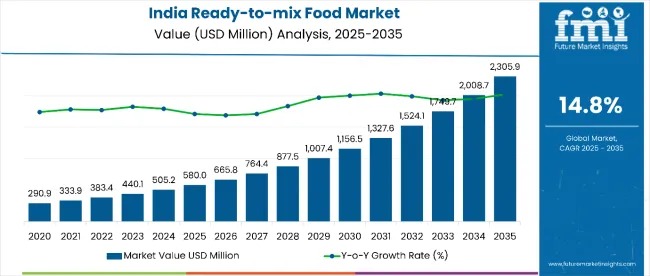
The India ready-to-mix food market is projected to grow from USD 580.0 million in 2025 to USD 2,305.9 million by 2035, expanding at a CAGR of 14.8%. This represents a 3.98x increase in value and an absolute dollar opportunity of USD 1,730.8 million over the forecast period, underscoring the market’s role as one of the fastest-growing food segments in the country.
The growth trajectory is underpinned by evolving urban lifestyles, dual-income households, and rising consumer demand for quick, hygienic, and flavorful meal alternatives. By 2030, the market is expected to surpass USD 1,156.5 million, indicating steady momentum throughout the decade. Expanding modern retail and e-commerce penetration, coupled with innovation in traditional and fusion-based mixes, is reshaping India’s packaged food landscape.
Explore trends before investing – request a sample report today! https://www.futuremarketinsights.com/reports/sample/rep-gb-111
Lifestyle Shifts and Modernization Drive Market Expansion
India’s ready-to-mix food market has transitioned from niche consumption to mainstream appeal. The trend is supported by rapid urbanization, increasing workforce participation, and growing exposure to global cuisines. Consumers are embracing ready-to-mix products as reliable meal solutions that offer convenience without compromising on taste or nutrition.
- Market Value (2025): USD 580.0 million
- Market Forecast (2035): USD 2,305.9 million
- CAGR (2025–2035): 14.8%
- Top Companies: MTR Foods, ITC Ltd., GITS Food Products, Kohinoor Foods, Priya Foods
- Leading Segment: Snack Mix (61% share in 2025)
The market’s evolution is characterized by premiumization and health-conscious consumption, driving the introduction of fortified, gluten-free, and low-sodium variants. Enhanced packaging and longer shelf life technologies have improved product accessibility across India’s tier-II and tier-III cities.
Core Market Drivers and Trends
The demand for ready-to-mix products is fueled by a confluence of demographic, economic, and cultural factors. The rise of nuclear families, busier work schedules, and increasing health awareness have collectively shifted consumption patterns toward convenience-oriented options.
Key growth drivers include:
- Convenience and time efficiency: Consumers prefer quick-prep options for breakfast, snacks, and dinner.
- Health-focused innovation: Brands are introducing fortified, high-fiber, and low-oil variants to appeal to wellness-driven consumers.
- Retail and online expansion: Widening distribution through modern trade and e-commerce enhances accessibility nationwide.
- Cultural and regional adaptation: Launches of state-specific flavors and fusion recipes increase product relevance across regions.
These trends reflect the ongoing modernization of India’s food ecosystem and the growing consumer trust in packaged meal solutions.
Regional Overview: North India Leads, East India Emerging
The regional landscape of the India ready-to-mix food market highlights diverse consumption patterns and retail developments across the country.
North India leads the market with the highest projected CAGR of 16% between 2025 and 2035. Strong urban centers such as Delhi, Chandigarh, and Jaipur drive adoption due to dense populations and robust retail networks. The region’s preference for convenience-based traditional dishes like poha, khichdi, and halwa mixes further supports growth.
West India, growing at 14.5% CAGR, benefits from strong urbanization and a rich culinary heritage. Cities like Mumbai, Pune, and Ahmedabad exhibit high demand for snack and dessert mixes, particularly during festive seasons.
South India, with a projected 13.5% CAGR, continues to dominate in traditional categories like dosa, idli, and sambar mixes. The rising IT workforce and increasing adoption of organic and millet-based variants contribute to consistent growth.
East India is emerging as a fast-developing region with 12.5% CAGR, supported by growing incomes and expanding organized retail networks. The region’s preference for sweet and snack mixes offers significant potential for market entrants.
Segmental Highlights: Snack Mix and Modern Trade Lead the Way
The snack mix segment, commanding 61% of the market in 2025, is the most lucrative category due to its universal appeal and indulgent flavors. Innovation in healthier formulations and region-specific variants, such as millet-based or baked mixes, is further driving this segment’s dominance.
In terms of distribution, modern trade channels lead with a 38% market share, attributed to wide product assortments, in-store promotions, and expanding urban reach. Organized retail formats—supermarkets, hypermarkets, and convenience stores—are reshaping how consumers discover and purchase ready-to-mix products.
Key Challenges and Opportunities
While the market outlook is highly positive, certain challenges persist. Price sensitivity among middle-income consumers and strong preferences for freshly cooked meals can temper growth in rural and semi-urban areas. However, rising disposable incomes and awareness about hygienic packaged foods are gradually addressing these barriers.
Manufacturers are responding with smaller, affordable SKUs and regionally tailored offerings to broaden market reach. Increasing focus on clean-label products, natural ingredients, and innovative packaging continues to strengthen consumer trust and loyalty.
Buy Report Now – Click Here to Purchase the Report. https://www.futuremarketinsights.com/checkout/111
Competitive Landscape: Innovation and Distribution Define Leadership
The market is moderately consolidated, with MTR Foods leading at an 18% share, followed by ITC Ltd., GITS Food Products, Kohinoor Foods, and Patanjali Ayurved Ltd. Companies are focusing on innovation in traditional Indian recipes, new-age packaging, and strategic collaborations with online retailers to expand market reach.
Aggressive marketing campaigns, cross-merchandising in retail outlets, and product launches targeting health-conscious consumers are shaping the competitive landscape. With sustained investment in R&D and modern trade infrastructure, India’s ready-to-mix food market is set to witness transformative growth through 2035, aligning with global demand trends across APAC, Europe, the USA, and Saudi Arabia.
About Future Market Insights (FMI)
Future Market Insights, Inc. (ESOMAR certified, recipient of the Stevie Award, and a member of the Greater New York Chamber of Commerce) offers profound insights into the driving factors that are boosting demand in the market. FMI stands as the leading global provider of market intelligence, advisory services, consulting, and events for the Packaging, Food and Beverage, Consumer Technology, Healthcare, Industrial, and Chemicals markets. With a vast team of over 400 analysts worldwide, FMI provides global, regional, and local expertise on diverse domains and industry trends across more than 110 countries.
Contact Us:
Future Market Insights Inc.
Christiana Corporate, 200 Continental Drive,
Suite 401, Newark, Delaware – 19713, USA
T: +1-347-918-3531
For Sales Enquiries: sales@futuremarketinsights.com
Website: https://www.futuremarketinsights.com
LinkedIn| Twitter| Blogs | YouTube