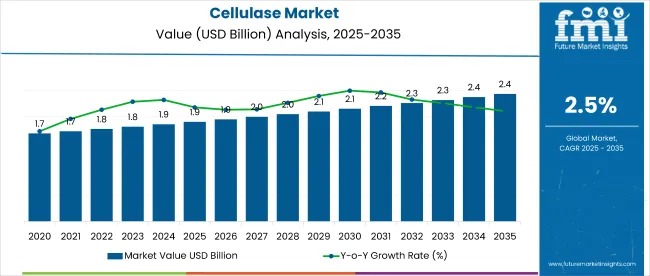
The global cellulase market is projected to expand from USD 1.9 billion in 2025 to USD 2.4 billion by 2035, registering a CAGR of 9.2%. Growth is fueled by surging biofuel production, rising demand from the textile and food industries, and increasing agricultural and medical applications.
The enzyme’s growing role in sustainable industrial processes and its potential to replace antibiotics in certain medical formulations further enhance its market relevance. With governments promoting carbon reduction, bio-based innovation, and renewable energy mandates, cellulase adoption continues to gain global momentum.
Explore trends before investing – request a sample report today! https://www.futuremarketinsights.com/reports/sample/rep-gb-2097
Key Market Highlights
- Market Value (2025): USD 1.9 billion
- Forecast Value (2035): USD 2.4 billion
- Forecast CAGR: 9.2%
- Leading Source (2025): Fungi – 45% share
- Top End-use Segment: Industrial – 38% share
- Fastest-Growing Region: Western Europe (Germany CAGR 7.9%)
Cellulase enzymes contribute significantly to industrial biotechnology (10% market share) and biofuel production (8–10%), making them key components in the global shift toward renewable energy. Their utility spans textiles (7%), food processing (5%), and pharmaceutical applications, marking broad adoption across sectors.
Regional Outlook
Europe: Germany Leads Enzyme Innovation
Germany spearheads the cellulase market in Europe, expanding at a 7.9% CAGR through 2035. The nation’s strong manufacturing base, coupled with incentives for green chemistry and sustainable textiles, positions it as a leader in enzyme utilization.
- High enzyme adoption in textiles and detergents
- Robust R&D ecosystem and technology transfer
- Government-backed sustainability initiatives
France follows with a 7.2% CAGR, driven by growth in food, pharma, and agriculture sectors that prioritize low-chemical processing and eco-friendly formulations.
North America: USA Focuses on Biofuels and Clean Manufacturing
The U.S. cellulase market is projected to expand at a 4.6% CAGR, underpinned by a mature biofuel sector and strong enzyme R&D infrastructure. The adoption of cellulase in ethanol production, textile care, and detergents continues to rise, supported by favorable policies for bio-based innovation.
- Strong industrial and research ecosystem
- Leading enzyme producers expanding capacity
- Increased government support for renewable energy
Asia-Pacific: Japan and Emerging Economies Drive Adoption
Japan is forecast to grow at a 7.5% CAGR, leveraging advanced enzyme engineering and industrial biotechnology for sustainable production. The broader Asia-Pacific region is witnessing a surge in bio-based textiles, clean-label foods, and enzyme fermentation startups, positioning it as a future growth hotspot.
- Expanding food and nutraceutical enzyme use
- Enzyme integration in sustainable textile production
- Government funding for green technology
Middle East: Saudi Arabia Strengthens Circular Economy Focus
Saudi Arabia is witnessing a steady shift toward bio-based manufacturing and enzyme-integrated industrial processes, supported by its Vision 2030 diversification plan. With growing investments in green chemistry, waste management, and renewable fuel research, cellulase adoption is expected to accelerate through 2035.
Market Segmentation Insights
By Source:
- Fungi: 45% market share in 2025 — favored for high yield and stability
- Bacteria: ~25% share — fast action but limited scalability
- Actinomycetes: ~15% share — diverse enzyme profiles but production challenges
By End Use:
- Industrial: 38% share — biofuel and biomass conversion dominant
- Textile and Detergents: Rapid adoption for biopolishing and eco-wash formulations
- Food & Beverages: Increasing use in juice clarification and brewing
- Healthcare & Pharma: Emerging use in drug formulations and digestive aids
Market Dynamics
Growth Drivers:
- Rising demand for bio-based industrial solutions
- Increasing use in biofuel production and sustainable textiles
- Expanding applications in food, beverage, and pharmaceuticals
Challenges:
- High production and purification costs
- Regulatory constraints for enzyme safety and GMO-based processes
- Temperature and pH sensitivity impacting enzyme stability
Recent Industry Developments
- May 2025: Worthington Biochemical expanded its New Jersey facility, increasing high-purity cellulase output by 30% for biopharma and research use.
- Leading Companies: Amano Enzyme Inc., MP Biomedicals, Sigma-Aldrich (Merck), and Creative Enzymes are investing in high-efficiency, thermostable cellulase variants for diverse industries.
These advancements underline the industry’s push toward enhanced enzyme performance, cost efficiency, and industrial scalability.
Buy Report Now – Click Here to Purchase the Report. https://www.futuremarketinsights.com/checkout/2097
About the Cellulase Market
The global cellulase industry remains a cornerstone of industrial biotechnology, supporting sustainable manufacturing, bioenergy production, and eco-friendly consumer goods. From textiles and biofuels to pharmaceuticals and food, cellulase continues to redefine the path toward greener industrial solutions.
About Future Market Insights (FMI)
Future Market Insights, Inc. (ESOMAR certified, recipient of the Stevie Award, and a member of the Greater New York Chamber of Commerce) offers profound insights into the driving factors that are boosting demand in the market. FMI stands as the leading global provider of market intelligence, advisory services, consulting, and events for the Packaging, Food and Beverage, Consumer Technology, Healthcare, Industrial, and Chemicals markets. With a vast team of over 400 analysts worldwide, FMI provides global, regional, and local expertise on diverse domains and industry trends across more than 110 countries.
Contact Us:
Future Market Insights Inc.
Christiana Corporate, 200 Continental Drive,
Suite 401, Newark, Delaware – 19713, USA
T: +1-347-918-3531
For Sales Enquiries: sales@futuremarketinsights.com
Website: https://www.futuremarketinsights.com
LinkedIn| Twitter| Blogs | YouTube