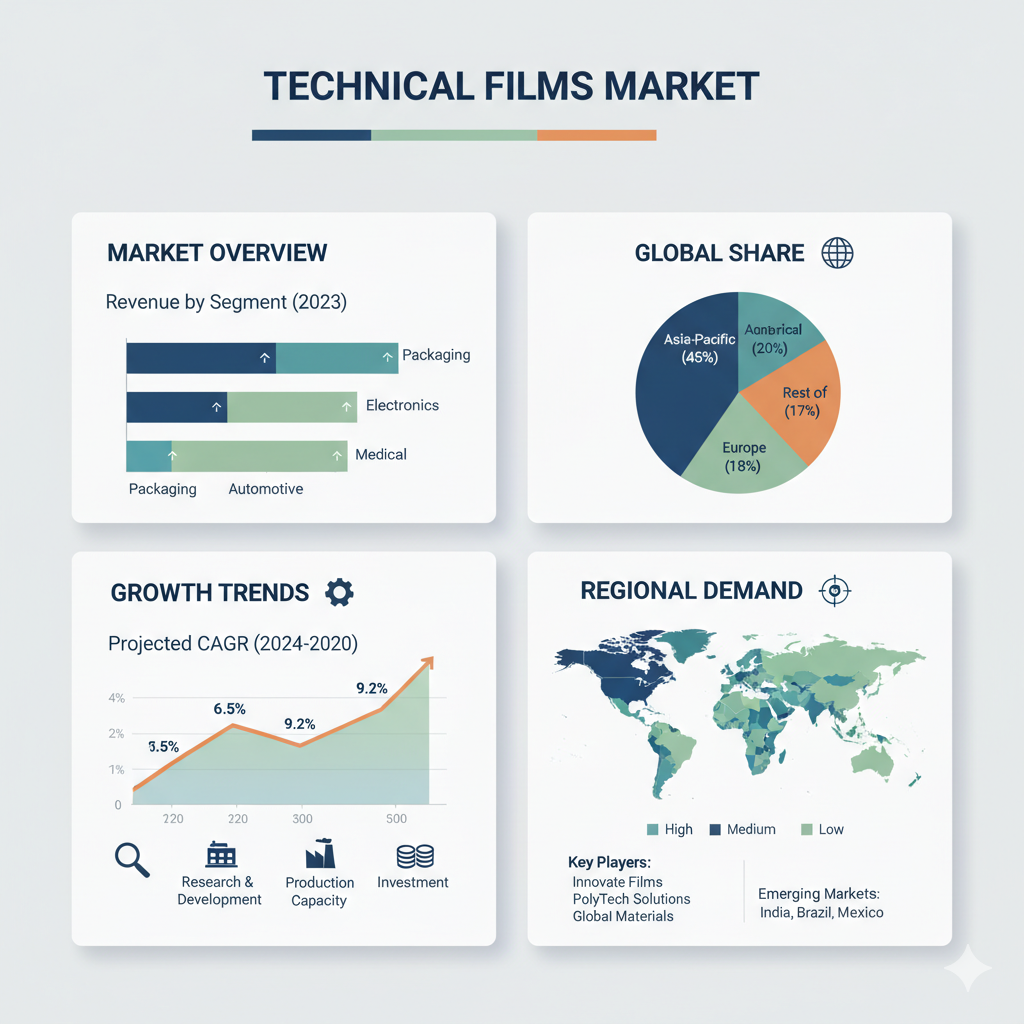
As the global demand for high-performance, sustainable materials accelerates, the technical films industry is poised to embark on a thrilling phase of expansion. According to recent market analysis of the technical films sector, the total market value is projected to reach USD 71.5 billion by 2035, representing a compound annual growth rate (CAGR) of approximately 5.3% over the 2025–2035 period.
This transformation presents a powerful opportunity for both well-established manufacturers and agile new entrants to stake their claim—bringing fresh technologies, deeper capabilities and expanded geographic reach to bear on this evolving landscape.
Legacy Players Setting the Pace
Industry incumbents, including tier-one names such as Amcor, Berry Global and Mondi, continue to lead the charge. Amcor distinguishes itself through innovations in flexible and recyclable film products; Berry Global is pushing compostable and biodegradable solutions into multi-application segments; Mondi remains a go-to for high-barrier and multilayer film technologies tailored to packaging, construction and industrial uses. These established players serve as pillars of stability and innovation, investing heavily to maintain leadership in a market defined by sustainability, performance and customization.
Yet, the market structure is more dynamic than it may seem. While the top 10 players currently hold roughly 32 % of industry share, the next 20 hold about 38 %—and the remainder another 38 %. That means the “rest of the pack” still comprises a significant portion of the market and a fertile opportunity zone for newer companies or niche specialists to grow.
Emerging Players and New Technologies Rewrite the Playbook
For new manufacturers looking to enter or expand in the technical films space, the signals are unmistakable: there is room to innovate, differentiate and carve out meaningful share. Key technological frontiers include:
- Multilayer film constructs that integrate multiple functions such as barrier protection (moisture, oxygen, UV) and structural strength in one film.
- Recyclable and biodegradable materials, driven by regulatory pressures and eco-conscious consumers worldwide.
- Smart or interactive films, embedding sensors or active functionalities into the film substrate, opening fresh territory in electronics, automotive and packaging.
- Automation and AI-driven production that compress lead-times, boost precision, reduce waste and support high-mix, low-volume manufacturing models.
These technology vectors matter not just for performance, but for competitive differentiation. Manufacturers willing to invest in R&D, align with sustainability imperatives, and partner across supply chains will find themselves in a strong position.
Why Expansion Makes Sense Now
Several converging factors validate the timing for growth. Consumer preferences are shifting toward highly customized, high-performance film solutions that support end-user needs in packaging, automotive, construction and electronics. Sustainability is no longer optional — energy-efficient production, circular-economy deployment and upcycling are becoming standard expectations. Meanwhile, cost-efficiencies emerge as technical films offer advantages over traditional materials by reducing processing steps and delivering “done-film” functionality.
Geography also plays a key role: regions such as Asia-Pacific, Africa and Latin America are experiencing industrialization, rising incomes and increased demand for tailored film solutions. At the same time, e-commerce growth fuels the need for high-barrier packaging films that reliably protect goods in transit. Together, these dynamics open routes to expansion for manufacturers focused on innovation and market agility.
A Strategic Roadmap for Manufacturers
For established players: the imperative is clear — maintain your lead by doubling down on eco-friendly film portfolios, accelerating high-barrier and smart-film developments, and deepening partnerships with emerging markets. Continual investment in automation, AI and advanced materials will buffer against commoditization and sustain margin pools.
For new entrants and niche specialists: the opportunity lies in identifying under-served segments, leveraging novel materials or smart-film designs, and scaling production with flexibility. By adopting agile manufacturing models, targeting regional growth zones, and aligning with sustainability goals, these companies can rapidly carve out meaningful presence.
Outlook and Market Implications
As the technical films industry evolves, pay-offs will accrue not just to those who chase volume, but to those who master selective leadership—whether through advanced technology, sustainability credentials or geographic foothold. With the market projected to breach USD 71.5 billion by 2035, the space is large enough for multiple winners. However, the formula for success is shifting: speed, flexibility and aligned innovation will trump size alone.
Manufacturers ready to embrace this new era — whether existing giants enhancing their portfolio or fresh players entering with bold propositions — are well-positioned to thrive. This is the moment to act, to design the films of tomorrow, and to meet the performance, sustainability and customization demands that will define the next decade.