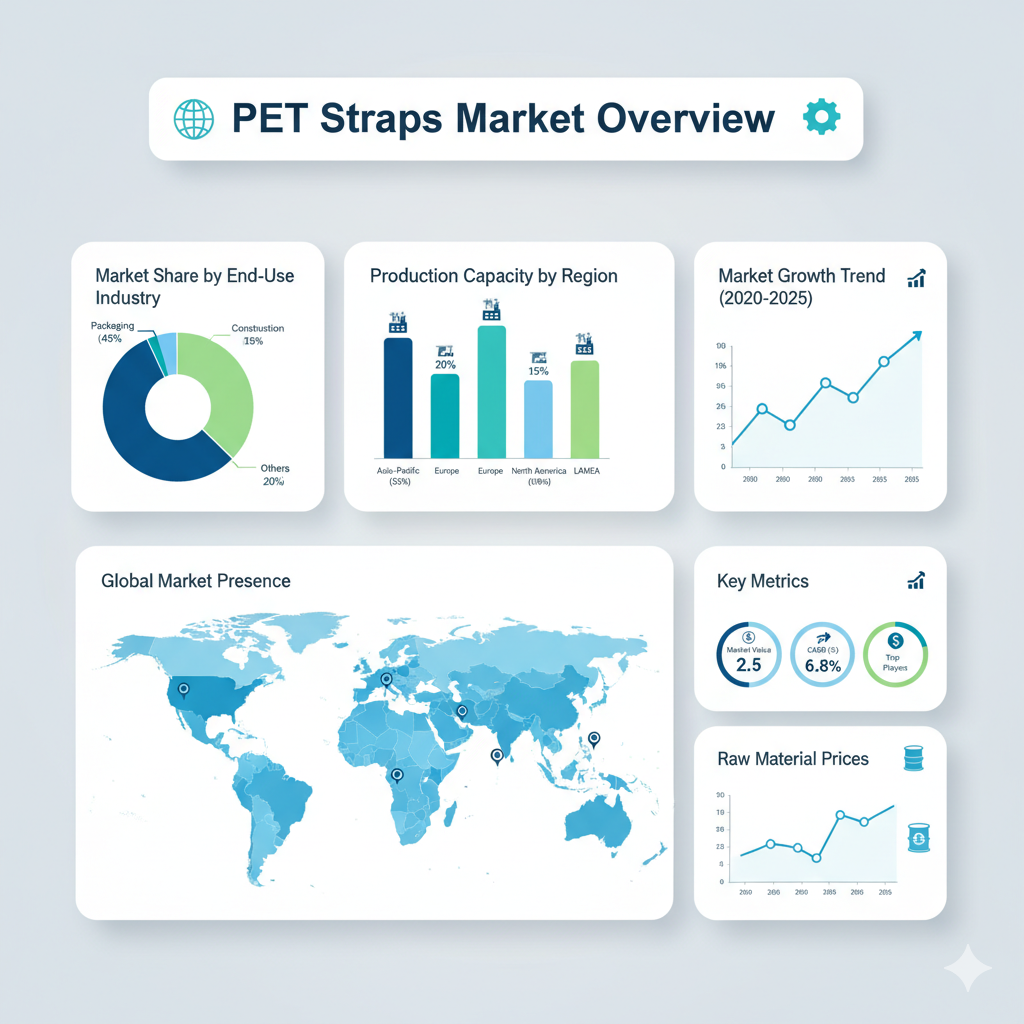
The global polyethylene terephthalate (PET) market straps is undergoing a transformative phase—one marked not just by incremental expansion, but by bold reinvention. Analysis of the latest industry findings reveals that both long-established manufacturers and ambitious new entrants are gearing up to expand their footprint and invest in next-generation technologies.
For decades, Tier-1 firms have dominated the sector. Their broad production capabilities, extensive distribution networks and trusted reputations have made them the first choice for major end-users in sectors such as logistics, construction, paper & printing and food & beverage. However, the growth story now hinges equally on mid-tier players and innovative start-ups that are bringing sustainable materials, smarter automation and customised solutions into the mix.
Established Leaders Reinvent Themselves
Legacy manufacturers are no longer resting on past glories. Instead of simply scaling quantity, these firms are pivoting strategically. They’re unveiling ultra-high-tensile PET straps crafted from 100% recycled materials, and implementing energy-efficient manufacturing systems. The message is clear: durability meets decarbonisation. At the same time, intelligent production systems—powered by data, sensors and automation—are being adopted to raise efficiency and reduce cost per unit.
These developments underscore a key insight: growth isn’t only about capturing larger volumes, but about providing better solutions in an era that prizes strength, sustainability and supply-chain transparency. Established manufacturers are focusing on retaining their leadership by addressing evolving customer needs and regulatory pressures.
Newer Players Challenge and Complement
Meanwhile, mid-size companies and emerging specialists are carving out distinctive niches. Operating at the intersection of affordability, flexibility and regional responsiveness, these manufacturers are bringing innovation in three pivotal dimensions:
- Customisation: By offering PET straps in a wider range of widths, strengths and applications, they help customers solve packaging and bundling challenges specific to their operations.
- Recycled & Eco-Material Focus: These firms emphasise post-consumer PET feedstock, circular processes and end-of-life recyclability as central to their value proposition.
- Smart Manufacturing & Tracking: Some of the newer entrants are integrating AI-driven production controls, smart labelling (QR codes, RFID) and traceability features to meet the demands of logistics and regulatory ecosystems.
This complementary dynamic between legacy players and agile challengers is reshaping the competitive landscape, bringing in more choice, more innovation and more value for end-users.
Technology at the Heart of the Evolution
The common denominator across manufacturers at every tier is technology. Whether it’s the use of recycled materials, reinforcement fibres to boost strap strength, or fully-automated lines with real-time process monitoring, the capabilities being developed today will define competitive advantage tomorrow.
Specifically, the industry is witnessing:
- A shift toward 100% recycled PET material in strap production, reducing dependency on virgin feedstock and enhancing environmental credentials.
- Expansion of ultra-high-tensile straps that enable heavier loads while using less material.
- Deployment of automated strapping systems and associated control systems to increase output consistency and reduce waste.
- Implementation of smart labelling and traceability, enabling end-users to monitor strap usage, tamper-proofing and logistic movements more effectively.
For manufacturers seeking expansion, the opportunities are compelling. The end-user segments—from warehousing to construction to food & beverage packaging—are all ramping up demand for stronger, lighter, greener solutions. The “one-size-fits-all” strap is giving way to “fit-for-purpose” offerings.
Why Now Is the Time to Expand
- Sustainability mandates are tightening globally, pushing demand for recycled-content PET and circular models.
- Cost pressures in logistics and transportation are driving end-users toward materials that reduce weight, improve safety and simplify operations.
- Regionalisation of supply chains—especially in the Asia-Pacific region—means that local and regional manufacturers are better positioned to respond quickly.
- Technology adoption means that even smaller manufacturers can level the playing field with higher-tier competitors by offering smart, differentiated products.
Call to Action for Manufacturers and Technology Suppliers
Whether you are an established PET strap manufacturer ready to scale into new geographies or a regional player keen to leap into smarter, greener production, the next window of opportunity is now. Key investment areas include recycled material sourcing, process automation, reinforcement technologies, and smart-labelling/traceability systems.
Technology suppliers, too, have a meaningful role to play. The market signals clear demand for modular, flexible manufacturing solutions that enable custom widths/strengths, integration with AI/IoT for predictive maintenance, and systems capable of supporting full circularity of PET materials.
Conclusion
The PET straps market is evolving fast. The convergence of sustainability, automation and smart logistics is rewriting the value proposition. For manufacturers—both established and new—the time to act is ripe. Growth will go to those who embrace stronger, greener and smarter strap solutions, and who partner actively with technology enablers and supply-chain stakeholders. The future is no longer just about holding heavy loads—it’s about doing so responsibly, efficiently and intelligently.