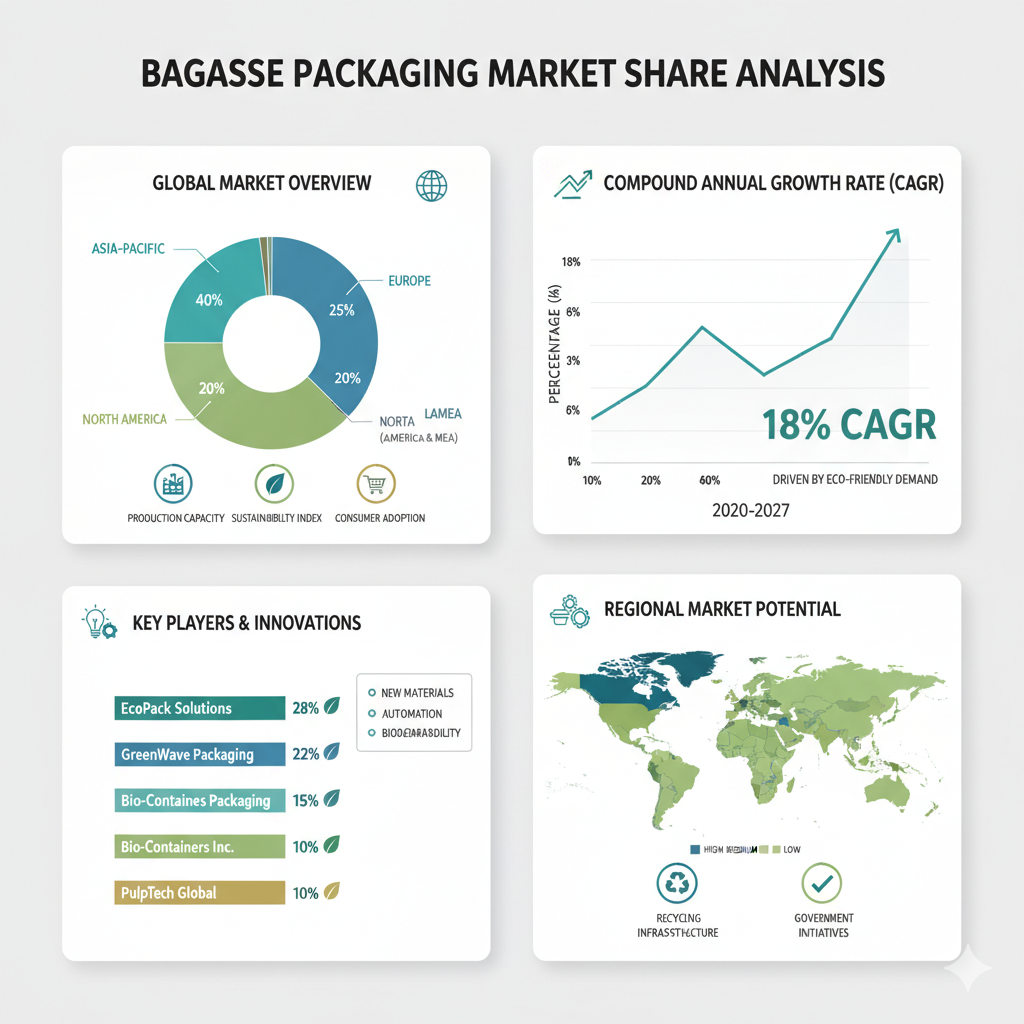
The global packaging industry is witnessing a powerful shift as the bagasse-based packaging sector speeds into a new era of growth and innovation. According to recent market insights, the “Bagasse Packaging Market” is projected to climb to a value of USD 15 billion by 2035, driven by a compound annual growth rate (CAGR) of roughly 6.5% between 2025 and 2035.
This momentum presents an exceptional opportunity not only for established manufacturers but also for newer entrants looking to expand their footprint and embrace advanced technologies.
Established Manufacturers Stepping Up the Innovation Game
Long-standing players in the space are deepening their commitments to sustainability, automation, and new material blends. Market leaders such as Ecoware, BioPak, and Huhtamaki continue to set the pace, leveraging their scale and technological investments to drive performance and brand leadership.
- Ecoware has elevated its production capabilities by adopting advanced molding techniques, ensuring that bagasse packaging remains both compostable and structurally robust.
- BioPak is focusing on cost-accessible innovations, enabling broader adoption of bagasse packaging solutions across food service and retail.
- Huhtamaki is spearheading smart packaging applications—embedding QR codes, RFID tags and supply-chain traceability into bagasse formats to strengthen engagement and transparency.
These established manufacturers are not merely scaling—they are evolving. Automation of production lines, integration of renewable energy sources, and hybrid material development are all part of their strategic road-map. The result: bagasse packaging is increasingly able to match the performance characteristics of conventional plastics while delivering clear environmental benefits.
Emerging Players and New Entrants: A Growth-Oriented Frontier
At the same time, the industry is welcoming a wave of regional and specialist manufacturers eager to take advantage of raw-material availability, changing regulations, and shifting consumer behaviour. With sugar-cane by-product streams abundant in nations across Asia-Pacific, Africa and Latin America, new entrants are well-positioned to play.
These up-and-coming firms are embracing innovation in the following ways:
- Leveraging regional supply chains to reduce input cost and improve local responsiveness.
- Introducing novel compound materials—such as bagasse blended with other compostable fibres—to enhance moisture and heat resistance.
- Partnering with governments and brand-owners to build out regional composting and recycling infrastructure, thereby closing the loop and strengthening the circular economy.
For new manufacturers aiming to expand, this is the moment to act. Whether by aligning with global sustainability mandates, or by securing partnerships in foodservice, retail, healthcare and e-commerce segments, the opportunities are abundant.
Technology & Market-Drivers Fuel the Surge
Three major themes are underpinning the surge in bagasse packaging:
- Regulatory & Consumer-Push Influences
Governments around the world are enforcing bans on single-use plastics and ramping up incentives for compostable alternatives. Simultaneously, consumers are actively choosing brands that offer clear eco-credentials and transparent sustainability messaging. Established and new manufacturers alike are capitalising on these trends.
- Material & Production Innovation
Advancements in moulding techniques, automation of manufacturing lines, and hybrid material development are all advancing rapidly. Companies are increasingly able to deliver bagasse packaging that can stand up to heat and moisture, making it viable in foodservice, retail and even healthcare packaging. The key winners will be those manufacturers that invest in technology platforms that reduce cost per unit while preserving sustainability credentials.
- Circular Economy & Infrastructure Build-out
Beyond product innovation, the rise of circular economy models is central. Manufacturers are increasingly aligning with recycling and composting infrastructure, using renewable energy in their production, and utilising sugar-cane by-products more efficiently. For new entrants, integrating into this chain early can provide differentiation and long-term viability.
What This Means for Manufacturers Who Want to Expand
For established players, the message is clear: double down on technology, broaden product portfolios, and enhance global footprint. There is a premium on scalability and innovation—with early adopters likely to capture the lion’s share of growth.
For new and mid-sized manufacturers, this is a unique inflection point. With top 10 players currently accounting for roughly 55% of the global market, the remaining 45% remains a rich terrain for growth. By focusing on regional raw-material advantages, hybrid-material R&D, and smart partnerships, these companies can gain meaningful traction.
To unlock this potential, manufacturers should consider:
- Investing in automated, energy-efficient production lines that allow economies of scale.
- Exploring novel material blends that enhance the functional performance of bagasse-based packaging.
- Collaborating with brand-owners and retailers to design packaging solutions tailored to sustainability goals and cost-effectiveness.
- Engaging with local governments and infrastructure providers to build out composting and recycling solutions, thus strengthening the product lifetime story.
Outlook & Call to Action
As the bagasse packaging market continues to mature, manufacturers—both well-established and new-comers—stand at the threshold of significant opportunity. The combination of regulatory momentum, consumer demand and technological innovation creates fertile ground for growth. A USD 15 billion global market by 2035 is not a distant dream—it’s an actionable target.
Now is the time for manufacturers to position themselves as leaders in the next phase of sustainable packaging. Whether scaling up, innovating or entering the market for the first time, the call is clear: adopt the technology, align with sustainability, and stake your position in the future of bagasse-based packaging.