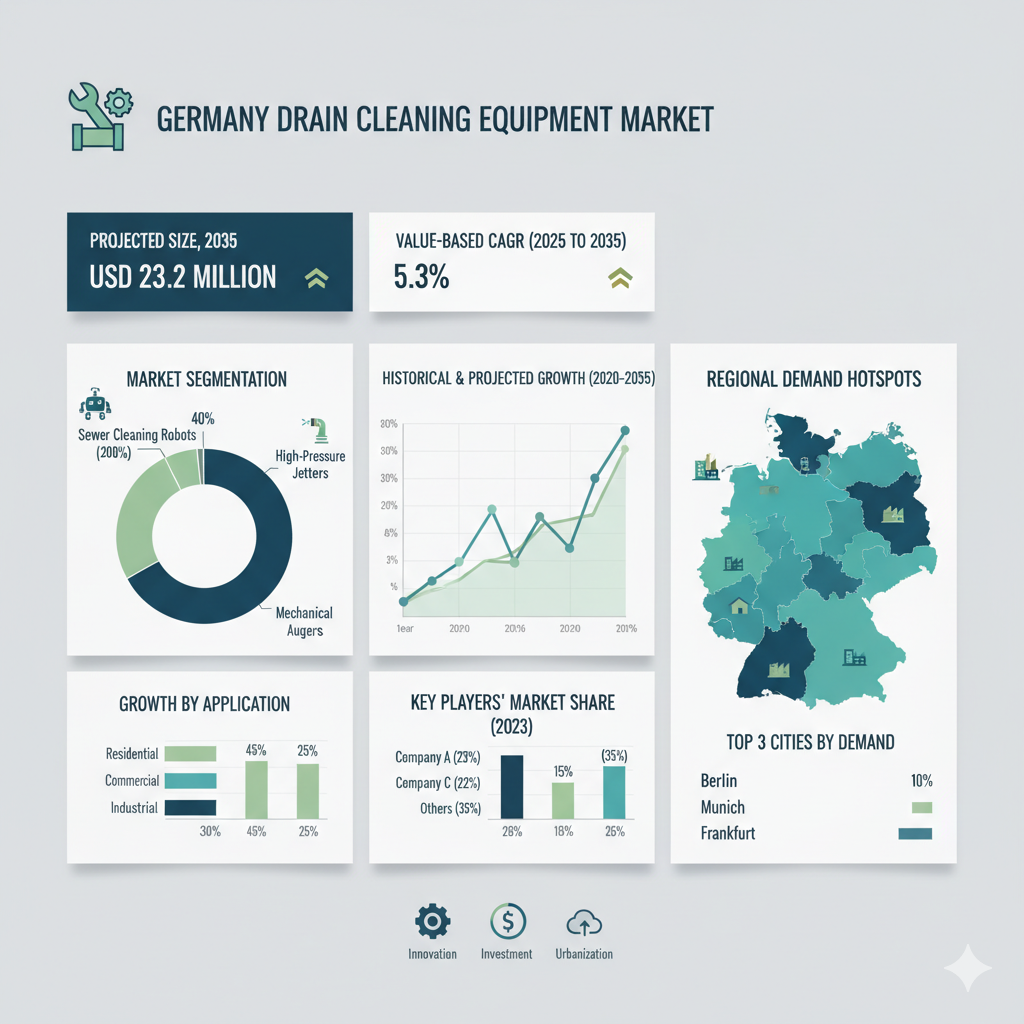
Germany’s drain cleaning equipment market is entering a period of strong expansion, creating new opportunities for both long-standing manufacturers and emerging innovators. Recent market analyses project the sector to reach USD 23.2 million by 2035, growing at a compound annual growth rate (CAGR) of 5.3% from 2025 to 2035.
This promising outlook is being driven by modernization of ageing infrastructure, adoption of advanced technologies, and the country’s growing commitment to sustainable and efficient waste-management systems. Together, these factors are reshaping the competitive landscape and opening new pathways for companies eager to expand, innovate, and lead in an evolving industry.
Established Manufacturers: Strong Foundations, Smarter Futures
Industry leaders such as RIDGID, Spartan Tool, and General Pipe Cleaners currently dominate the market, backed by decades of reliability and brand strength. However, as German infrastructure projects move toward digitization and environmental compliance, these companies are pivoting to integrate smarter, more sustainable technologies into their product lines.
By leveraging their existing networks and technical expertise, established players are introducing equipment with advanced features such as IoT-enabled diagnostics, robotic cleaning modules, and water-efficient jetting systems. Their focus is increasingly on lighter, more adaptable tools for dense urban environments and modular systems designed for energy conservation and reduced water waste.
This evolution reflects a broader shift toward value-added innovation. Manufacturers that once competed primarily on durability and performance are now differentiating themselves through automation, connectivity, and sustainability—the new cornerstones of the modern drain cleaning industry.
Emerging Players: Innovation on the Rise
Alongside industry giants, a new wave of regional manufacturers and start-ups is gaining momentum. Smaller firms like Rioned and Kaiser AG have carved out a strong presence by developing customized and high-tech cleaning systems, emphasizing eco-friendly operation and digital monitoring capabilities.
Meanwhile, emerging start-ups are bringing disruptive innovation to the market—pioneering AI-driven inspection systems, robotic drain-cleaning units, and real-time monitoring platforms. These young companies are not just filling gaps in the supply chain; they are redefining performance expectations and pushing the industry toward smarter, more efficient solutions.
For these agile newcomers, Germany offers fertile ground for growth. The country’s stringent environmental regulations, combined with heavy investment in infrastructure modernization, provide the ideal environment for testing and scaling next-generation equipment. By focusing on niche markets—such as municipal wastewater management, industrial drain diagnostics, or energy-efficient sewer cleaning—emerging firms can rapidly establish themselves as technology leaders.
Technology and Sustainability: The Dual Growth Engine
Across the market, two central forces are driving momentum: technological advancement and sustainability.
- Modern Infrastructure Needs: Germany’s ageing sewage and drainage systems demand sophisticated, high-performance solutions that minimize downtime and maximize cleaning efficiency.
- Technological Transformation: Integration of robotics, IoT sensors, and automated controls is changing how maintenance is performed—reducing manual labor while improving accuracy and safety.
- Sustainability Mandates: With environmental compliance taking center stage, manufacturers are prioritizing low-emission motors, water-saving jet systems, and equipment designed for long-term durability and recyclability.
Companies that successfully merge innovation with sustainability will not only enhance their market share but also contribute to a greener, smarter urban ecosystem.
The Road Ahead: Expand, Innovate, Collaborate
For established brands, the path forward involves expanding product portfolios, embracing automation, and deepening local partnerships across Germany’s diverse industrial and municipal sectors.
For new entrants and regional manufacturers, collaboration and specialization will be key. By aligning with larger firms or focusing on specific technology niches—such as smart cleaning robotics or AI-assisted diagnostics—smaller players can accelerate growth while strengthening the market’s overall technological backbone.
With consistent demand across residential, commercial, and municipal applications, the next decade represents a pivotal growth phase. Germany’s emphasis on sustainable infrastructure ensures long-term potential for all stakeholders—from equipment producers and distributors to contractors and service providers.