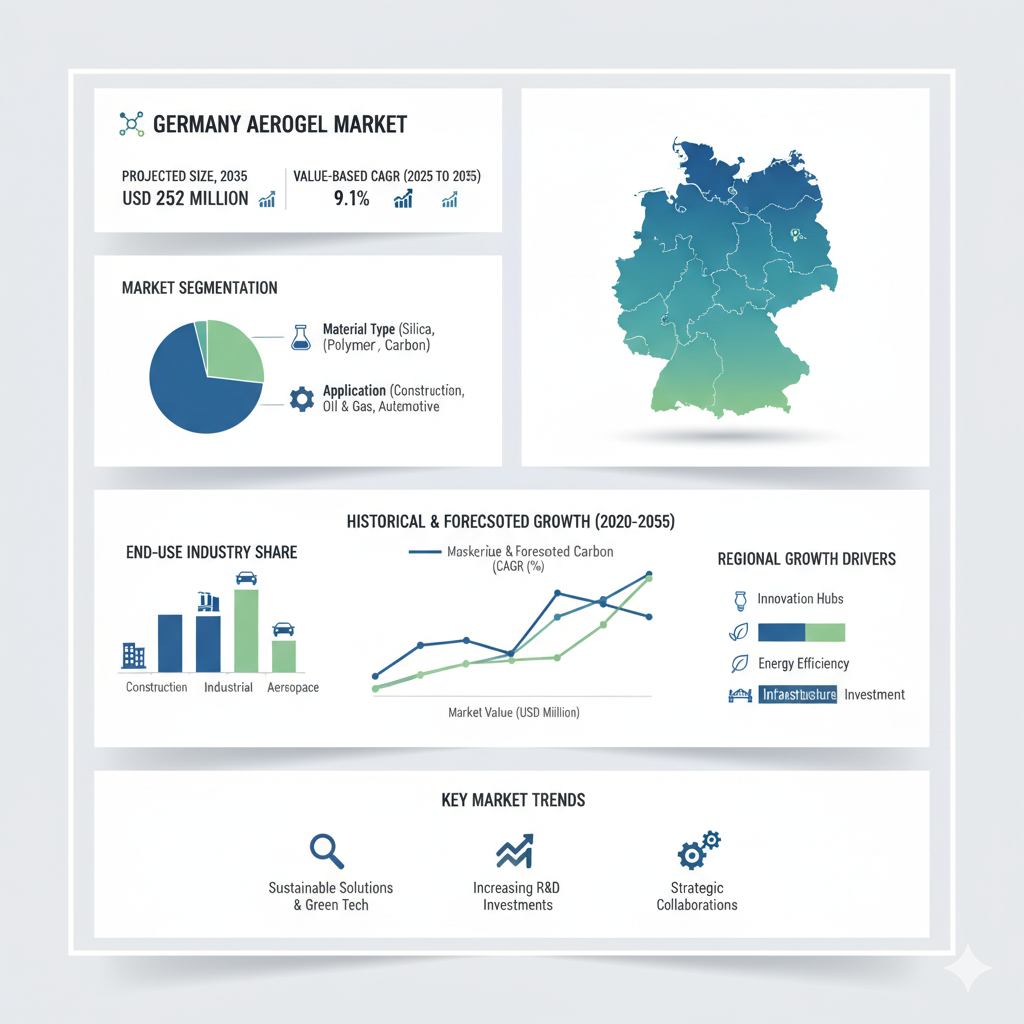
Germany’s aerogel sector is entering an era of dynamic transformation, creating exceptional opportunities for both established industry leaders and promising new entrants. According to a recent market outlook by Future Market Insights, the Germany aerogel market is projected to reach approximately USD 252 million by 2035, with a robust compound annual growth rate (CAGR) of 9.1 % from 2025 through 2035.
This growth is being driven by Germany’s vigorous push toward energy-efficiency, sustainable infrastructure upgrades, electrification of transportation, and advanced manufacturing adoption. The report highlights key end-use sectors—construction (about 40 % share), automotive & aerospace (approx. 25 %), oil and gas (~20 %), and energy storage—as major demand engines.
For manufacturers who have long operated in the aerogel space, as well as newcomers bringing fresh technologies, this is a pivotal moment to scale, innovate, and capture market share.
Established Players: Strengthening Foundations
Major global firms like Aspen Aerogels, Cabot Corporation and Germany’s own chemical giant BASF SE continue to dominate the market, accounting for around 65 % of the Germany aerogel market. Their advantage lies in proven manufacturing capabilities, deep R&D investments, and strategic relationships with end-users in construction, EV battery systems, industrial insulation and beyond.
For example, Aspen Aerogels has expanded distribution across Germany to support the building and EV markets. Cabot’s German subsidiary leverages a long history of aerogel production and process development, while BASF has launched bio-based aerogel product lines and invested in pilot plants for advanced aerogel insulating panels.
These manufacturers are well-positioned to deepen product portfolios (silica aerogels, polymer aerogels, carbon aerogels) and expand across new forms (blankets, panels, particles) to meet demand across sectors.
Emerging / New Entrants: Time to Innovate and Scale
Simultaneously, emerging innovators—start-ups and niche manufacturers—hold about 10 % of the current market and are poised for ascension. These companies are pioneering next-generation aerogel technologies: bio-based substrates, composite systems, carbon aerogels for energy storage, and lightweight solutions for aerospace, EVs and renewable-energy applications.
Companies such as aerogel-it GmbH are developing fully bio-based lignin aerogels, a major step toward sustainable insulation material innovation. Another example, Deutsche Aerogel GmbH, focuses on advanced thermoelectric insulation systems for e-mobility and high-performance industrial use.
For these entrants, now is the time to scale pilot production, form strategic partnerships, and access Germany’s policy-driven demand environment—particularly in areas like building retrofitting, EV thermal management, and renewable-energy storage.
Why Germany?
Germany’s “Energiewende” (energy transition) and stringent building-efficiency regulations are powerful growth drivers for high-performance insulation materials. Meanwhile, automotive and aerospace sectors are shifting toward lightweight and thermally stable materials — a sweet spot for aerogels. Industrial and oil/gas sectors continue to demand advanced insulation for extreme environments, cryogenics and pipeline systems.
Strategic Imperatives for Manufacturers
- Scale production cost-effectively: With projected growth and rising demand, manufacturers must optimize production and supply-chain systems to reduce cost per unit and cater to price-sensitive applications.
- Innovate material platforms: Introducing polymer or carbon aerogels, bio-based raw materials, hybrid composites and novel form-factors (panels, thin films) will unlock new applications.
- Align with systems-level applications: For EV battery thermal management, aerospace insulation, renewable-energy storage, and building retrofits, go beyond material innovation to system integration and service-layer offerings.
- Leverage Germany as a European hub: With strong domestic demand and Europe-wide export potential, German operations provide a strategic launchpad for expansion.
- Forge partnerships and ecosystem approaches: Collaborate with OEMs, building-specialist contractors, energy-system integrators, universities and research institutes to co-develop solutions.
In Closing
Germany’s aerogel market is no longer a niche insulation story—it is a cornerstone of industrial transformation, energy savings, vehicle electrification and sustainable construction. For established manufacturers, the mandate is to scale, diversify and deepen end-use penetration. For new entrants, the window is open to present differentiating technologies, embed in growth sectors and build footholds in one of Europe’s most advanced materials markets.