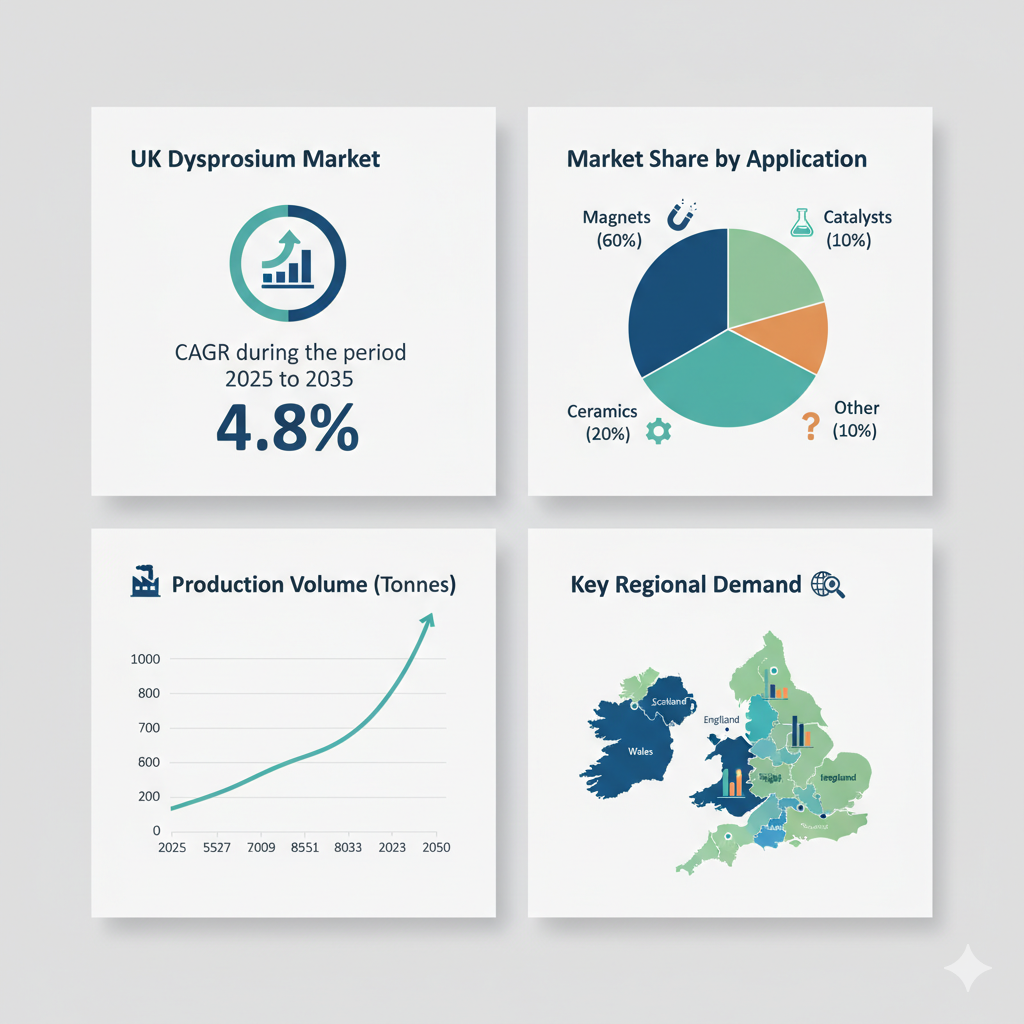
As the United Kingdom accelerates its transition toward renewable energy, electric mobility, and advanced defense technologies, a major transformation is taking shape in the country’s dysprosium market. A new industry report projects that the UK dysprosium sector will grow steadily at a compound annual growth rate (CAGR) of around 4.8% between 2025 and 2035—signaling a wave of opportunity for both established producers and new entrants eager to stake their claim in this strategic field.
Expansion Opportunities for Established and New Manufacturers
For industry leaders such as Lynas Rare Earths Ltd., China Northern Rare Earth Group, Hitachi Metals, MP Materials, and Arafura Resources, the growth trend reinforces the importance of continued investment and innovation. These long-standing players already maintain strong positions in the global supply chain and are now looking to strengthen their presence in the UK market by developing local partnerships, expanding production capabilities, and integrating advanced processing technologies.
At the same time, new and emerging manufacturers are finding fertile ground for expansion. The UK’s strategic aim to reduce import dependency and promote domestic value creation opens doors for companies offering innovative extraction, refining, or recycling technologies. Smaller players with flexible operations and technology-driven approaches are particularly well-positioned to benefit from government-backed initiatives promoting sustainable and localized supply chains.
Technology Driving the Next Phase of Growth
The current wave of growth in the UK dysprosium market is not merely about supply—it’s driven by technological transformation. Dysprosium’s unique magnetic and thermal properties make it indispensable for several fast-growing industries:
- Renewable energy: As the UK expands its offshore wind and grid storage infrastructure, dysprosium’s role in high-performance permanent magnets for wind turbine generators becomes increasingly vital.
- Electric vehicles (EVs): With the UK committed to phasing out combustion engine vehicles, demand for electric motors using dysprosium-based magnets continues to surge. The element’s ability to retain magnetic strength under high temperatures enhances motor efficiency and longevity.
- Defense and aerospace: High-precision systems such as radar arrays, guidance systems, and propulsion components rely on dysprosium alloys for enhanced durability and performance in extreme conditions.
Manufacturers investing in advanced processing, recycling, and magnet fabrication technologies will gain a competitive edge as industries demand higher-quality, more sustainable materials.
Building Supply Chain Resilience
Globally, a significant portion of dysprosium supply has traditionally come from China, creating potential vulnerability for import-dependent markets. The UK is now taking decisive steps to mitigate this risk by diversifying its supply base and encouraging local and regional production partnerships. Collaborations with mineral-rich nations such as Australia and Canada, along with the development of recycling systems for end-of-life electronics and magnets, are becoming central to the UK’s resource strategy.
For both established and emerging manufacturers, this shift presents opportunities to:
- Establish downstream magnet and alloy fabrication operations within the UK or allied regions.
- Invest in recycling infrastructure to recover dysprosium from retired EV motors, turbines, and electronics.
- Forge long-term partnerships with renewable energy, automotive, and defense OEMs to co-develop application-specific materials and secure stable demand.
Challenges to Overcome
While the market outlook remains optimistic, manufacturers must navigate several challenges to sustain growth. The high cost of production and refining continues to weigh on profitability, particularly given the UK’s limited domestic mining capability. Moreover, environmental regulations surrounding rare earth extraction and processing are becoming increasingly stringent, requiring companies to adopt sustainable, low-impact methods.
Balancing environmental responsibility with economic feasibility will be critical. Forward-thinking firms are already exploring cleaner extraction methods, circular-economy business models, and automation technologies to improve efficiency while meeting regulatory and ESG expectations.
A Bright Future for the UK Dysprosium Market
The decade ahead promises significant expansion opportunities across renewable energy, electric transportation, and defense manufacturing. As these sectors advance, dysprosium will remain a key enabler of next-generation magnet and alloy technologies—cementing its role as one of the UK’s most strategic materials.
For established manufacturers, the focus will be on scaling operations, advancing material science, and deepening collaboration with end-user industries. For newer entrants, niche specialization—such as recycling, precision component fabrication, or sustainable processing—offers a clear path to market differentiation.
In essence, the UK dysprosium market represents both a challenge and an invitation: a challenge to innovate sustainably and an invitation to participate in shaping the future of critical materials. For any manufacturer aiming to expand its footprint, invest in new technologies, or align with the UK’s green industrial ambitions, now is the time to act.