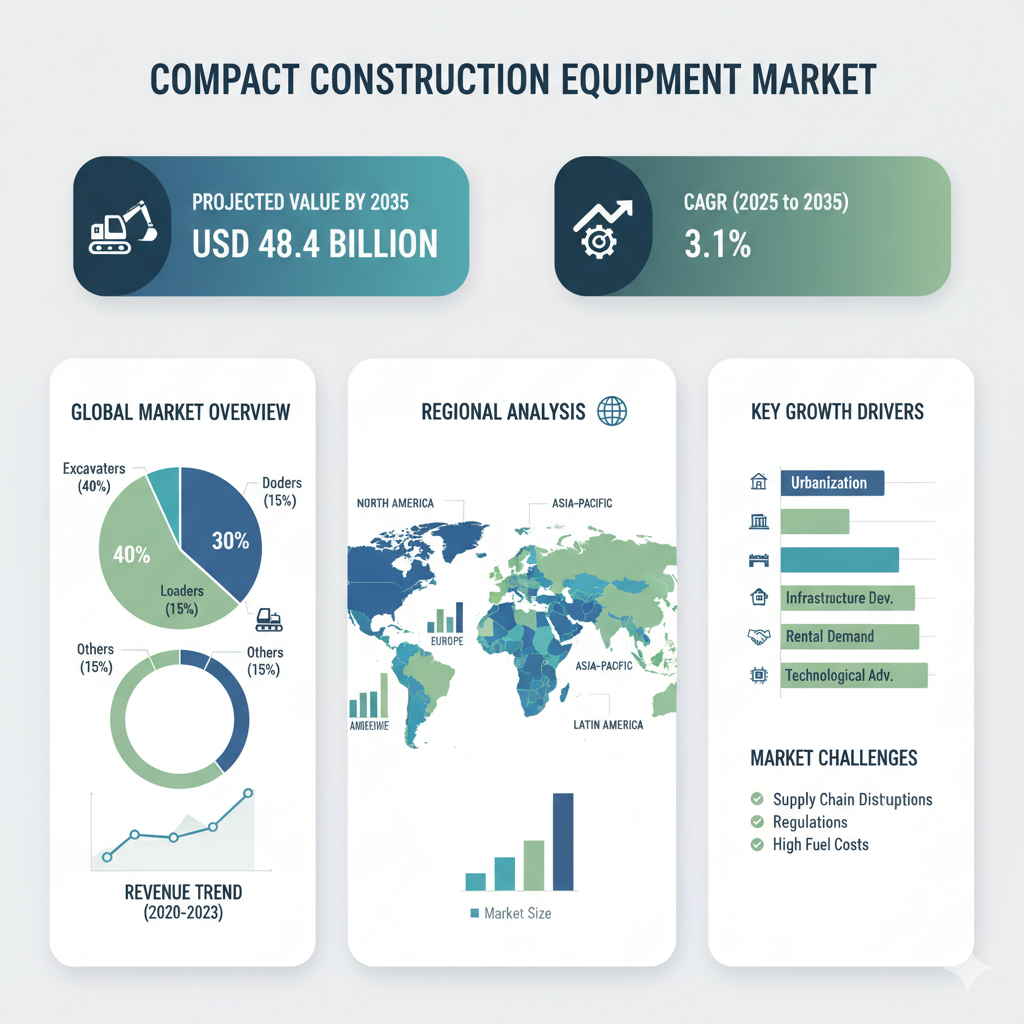
As urbanization accelerates and sustainable infrastructure becomes a global priority, the compact construction equipment market is entering an exciting phase of transformation. Recent industry insights indicate that the market is projected to reach USD 48.4 billion by 2035, growing steadily at a CAGR of 3.1 % from 2025 to 2035. This growth presents remarkable opportunities for both established players and new entrants who are eager to innovate, expand, and redefine the future of compact machinery.
Established Manufacturers: Leveraging Scale, Innovation, and Global Reach
Global leaders such as Caterpillar, Volvo Construction Equipment, Bobcat, JCB, and Komatsu continue to dominate the market, together accounting for over one-third of global sales. These companies are driving progress through a focus on intelligent technology, sustainable manufacturing, and machine versatility.
- Caterpillar has integrated artificial intelligence and real-time diagnostic systems into its compact track loaders to optimize performance and adaptability across diverse terrains.
- Volvo Construction Equipment is investing heavily in battery-electric compact excavators designed for clean, quiet, and efficient operations in dense urban settings.
- Bobcat is pioneering autonomous skid-steers and machine-learning-enabled attachments to improve operator safety and efficiency.
- JCB continues to lead in hybrid backhoe loader development, combining fuel efficiency with reduced carbon emissions.
- Komatsu is experimenting with hydrogen-powered compact loaders as part of its broader sustainability roadmap.
For these established manufacturers, innovation is no longer optional—it is essential. With urban construction booming and environmental regulations tightening, the demand for compact machines that deliver performance, efficiency, and low emissions is surging. Companies with strong service networks and adaptable product lines are especially well-positioned to capture this growth.
New and Emerging Manufacturers: Capturing Niche Opportunities
While the market shows signs of consolidation, regional and domestic manufacturers still hold roughly one-third of total share, reflecting enormous potential for emerging players. Smaller and mid-tier manufacturers are increasingly finding success by addressing local needs and tailoring solutions to specific market segments.
The sub-100 HP equipment category—responsible for nearly half of global compact machinery sales—offers particularly high potential. This segment is in high demand for municipal projects, small-scale construction, landscaping, and rental applications. New entrants can gain competitive advantage through specialization, cost innovation, and flexible production models.
Forming joint ventures or technology partnerships with larger OEMs allows smaller manufacturers to tap into advanced R&D, electrification technologies, and distribution networks. In turn, these collaborations help global brands localize production and offer competitively priced solutions in emerging markets.
Technology and Innovation: The Next Frontier
Three major technology trends are reshaping the competitive landscape and offering fertile ground for new investment and business expansion:
- Electrification and Hybrid Systems
With governments setting aggressive carbon-reduction goals, manufacturers are shifting toward fully electric or hybrid compact machines. This transition not only reduces emissions but also lowers long-term operating costs and noise levels on job sites. - Smart Telematics and Automation
Compact equipment is becoming increasingly intelligent. Telematics, GPS-based monitoring, and AI-driven predictive maintenance are enabling contractors to reduce downtime and optimize fleet management. For manufacturers, this opens the door to new revenue models built around data, analytics, and remote diagnostics. - Multi-Function and Modular Design
As construction spaces tighten, customers seek versatile machines that can switch between attachments quickly. Manufacturers focusing on modular systems—where a single base unit can handle multiple tasks—are seeing growing adoption across urban, residential, and infrastructure projects.
The Path Forward: Expansion, Partnership, and Adaptability
For established companies, growth will come from expanding their electrified product lines, integrating smart systems, and strengthening after-sales and rental networks in fast-urbanizing regions. For new entrants, success will depend on agility—focusing on niche markets, cost efficiency, and partnerships that unlock access to advanced technologies and international distribution.
Strategically, manufacturers seeking to expand should:
- Invest in zero-emission product development to meet the global shift toward sustainability.
- Adopt digital and connected-machine platforms that improve lifecycle management and customer experience.
- Focus on urban and residential applications, where compact, versatile equipment has the greatest value.
- Develop adaptable, modular product ranges that allow customers to perform multiple tasks with fewer machines.
A Future Built on Collaboration and Innovation
The compact construction equipment market is more than just expanding—it is evolving. The convergence of sustainability, digitalization, and infrastructure investment is opening unprecedented opportunities for both legacy brands and rising innovators. Established players are redefining what compact equipment can achieve, while newcomers are introducing fresh perspectives, agile manufacturing models, and inventive solutions tailored to regional demands.
As the industry progresses toward 2035, collaboration between technology developers, equipment makers, and construction firms will play a central role in shaping the market’s next chapter. Those who act decisively—by integrating sustainable technology, building partnerships, and aligning closely with customer needs—will be the ones to lead this transformation.