The global Unidirectional Tape (UD) market share analysis is entering a transformative phase as industries increasingly seek lightweight, durable, and high-strength materials for performance-driven applications. From aerospace and automotive manufacturing to wind energy and industrial sectors, UD tapes are becoming integral components of the next-generation composites revolution.
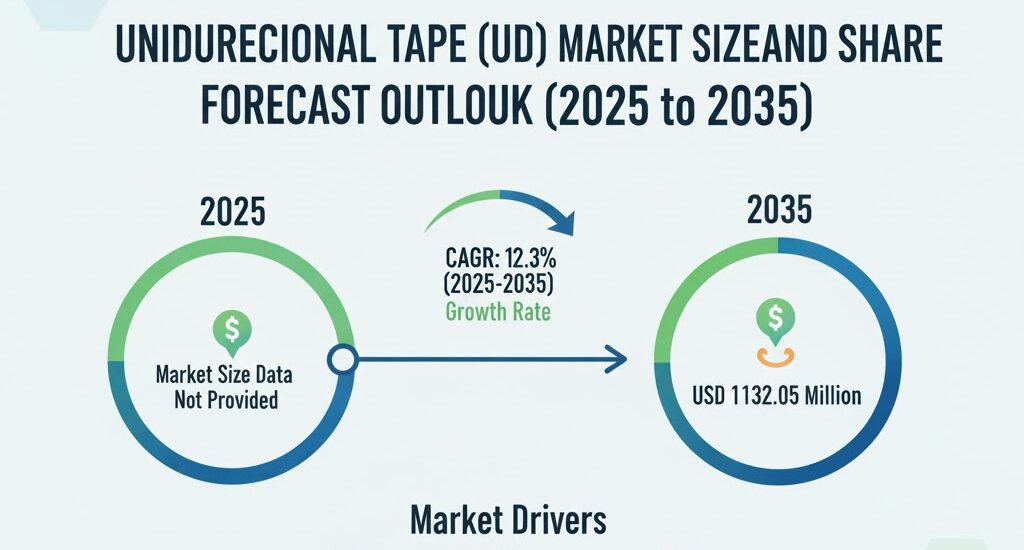
According to the latest industry outlook, the market is projected to grow at a CAGR of 12.3% between 2025 and 2035, reaching a valuation of USD 1,132.05 million by 2035. This impressive trajectory reflects a global shift toward fuel efficiency, recyclability, and superior mechanical performance—key attributes of modern composite materials.
Innovation Defining the Market: Key Players and Their Technological Edge
Industry pioneers such as Solvay, Toray Industries, and Teijin Limited continue to spearhead innovation, setting benchmarks for performance, sustainability, and scalability.
- Solvay stands out with its high-performance thermoplastic UD tapes designed for aerospace applications, offering superior fatigue resistance and processability.
- Toray Industries remains a frontrunner in carbon fiber-based UD tapes, driving adoption in both the automotive and renewable energy sectors.
- Teijin Limited excels in advanced composite technologies, addressing the rising demand for eco-friendly and high-load-capable materials in automotive and wind energy projects.
Collectively, these three leaders command 13% of the global market share, while emerging innovators such as Hexcel Corporation, Mitsubishi Chemical, Gurit, and Celanese are steadily strengthening their foothold through niche product development and regional expansion.
The market structure remains moderately concentrated, with the top 10 players holding roughly 27% of the industry share, leaving ample room for new entrants to bring in specialized and cost-efficient solutions.
Technological Shifts Accelerating Market Evolution
The technological landscape of the UD tape industry is evolving rapidly, with manufacturers integrating automation, advanced fibers, and recyclable materials into production.
Thermoplastic UD tapes are gaining traction due to their recyclability and processing flexibility, addressing environmental concerns without compromising performance. Advanced fiber integration, combining carbon and glass fibers, enhances stiffness and strength while reducing material weight. Moreover, automation-ready tape formats are optimizing large-scale production for applications like aircraft fuselage panels and EV structural components.
Sustainability: The Core of Market Strategy
Sustainability has emerged as a central pillar of market growth. UD tape producers are aligning with global environmental objectives by adopting energy-efficient manufacturing and promoting recyclable composites.
Companies are particularly focused on:
- Recyclable thermoplastics, enabling closed-loop production and end-of-life recovery.
- Lightweight design engineering, which significantly contributes to fuel efficiency and emission reduction in vehicles and aircraft.
- Energy-optimized processes that minimize waste and carbon footprints during manufacturing.
These initiatives resonate strongly with modern consumers and regulators who prioritize sustainability alongside performance.
Regulatory and Regional Insights Shaping Market Growth
Government policies and regional regulations are playing a vital role in the adoption of UD tapes.
In North America, stringent fuel efficiency and emission control mandates drive the demand for lightweight materials in transportation and aviation. The region currently holds 35% of the global market share, thanks to its strong aerospace manufacturing base.
Europe, holding 30%, is a leader in sustainability-driven regulations, encouraging the use of recyclable composites across industries. Meanwhile, Asia-Pacific, with a 25% share, is the fastest-growing region due to rapid industrialization, EV adoption, and renewable energy expansion—especially in China, Japan, and South Korea.
Other regions, collectively contributing 10%, are emerging as promising export markets, with Africa and Latin America witnessing early adoption of UD tapes in energy and transport infrastructure.
Access Expert Analysis & Forecasts – Buy Now Before Prices Rise!
Explore trends before investing — request a sample report today!
End-Use Industry Dynamics: Aerospace, Automotive, and Beyond
The aerospace industry, representing 40% of global demand, remains the largest consumer of UD tapes due to their unmatched strength-to-weight ratio. Automotive applications account for 30%, as electric vehicle manufacturers leverage these materials to boost range and reduce emissions.
The wind energy sector contributes around 20%, with UD tapes being used in the production of turbine blades for improved durability and performance. The remaining 10% encompasses industrial and sports applications, where tailored composite solutions enhance product functionality.
Challenges and Opportunities: A Balanced Market Outlook
While the future appears bright, the market faces several challenges. High production costs, particularly for carbon fiber UD tapes, remain a key constraint. Additionally, limited recycling infrastructure in developing regions hampers circular economy initiatives.
However, these challenges also open doors for innovation. The rise of automated tape placement (ATP) technologies, investment in renewable energy, and the rapid expansion of electric mobility present significant growth opportunities. Emerging manufacturers can gain a competitive edge by developing cost-effective and recyclable composites tailored for mass production.
Strategic Roadmap: The Future of UD Tape Manufacturing
The path ahead for UD tape manufacturers involves deeper integration of sustainability and automation. Recyclable thermoplastic tapes will dominate material development, while automated layup technologies are expected to revolutionize production efficiency.
Companies focusing on fiber integration, regional expansion, and strategic collaborations will be best positioned to capture untapped market potential. Asia-Pacific and Latin America, in particular, offer fertile ground for investment in local manufacturing facilities to serve fast-growing energy and transport sectors.
About Future Market Insights (FMI)
Future Market Insights, Inc. (ESOMAR certified, recipient of the Stevie Award, and a member of the Greater New York Chamber of Commerce) offers profound insights into the driving factors that are boosting demand in the market. FMI stands as the leading global provider of market intelligence, advisory services, consulting, and events for the Packaging, Food and Beverage, Consumer Technology, Healthcare, Industrial, and Chemicals markets. With a vast team of over 400 analysts worldwide, FMI provides global, regional, and local expertise on diverse domains and industry trends across more than 110 countries.
Contact Us:
Future Market Insights Inc.
Christiana Corporate, 200 Continental Drive,
Suite 401, Newark, Delaware – 19713, USA
T: +1-347-918-3531
For Sales Enquiries: sales@futuremarketinsights.com
Website: https://www.futuremarketinsights.com
LinkedIn| Twitter| Blogs | YouTube