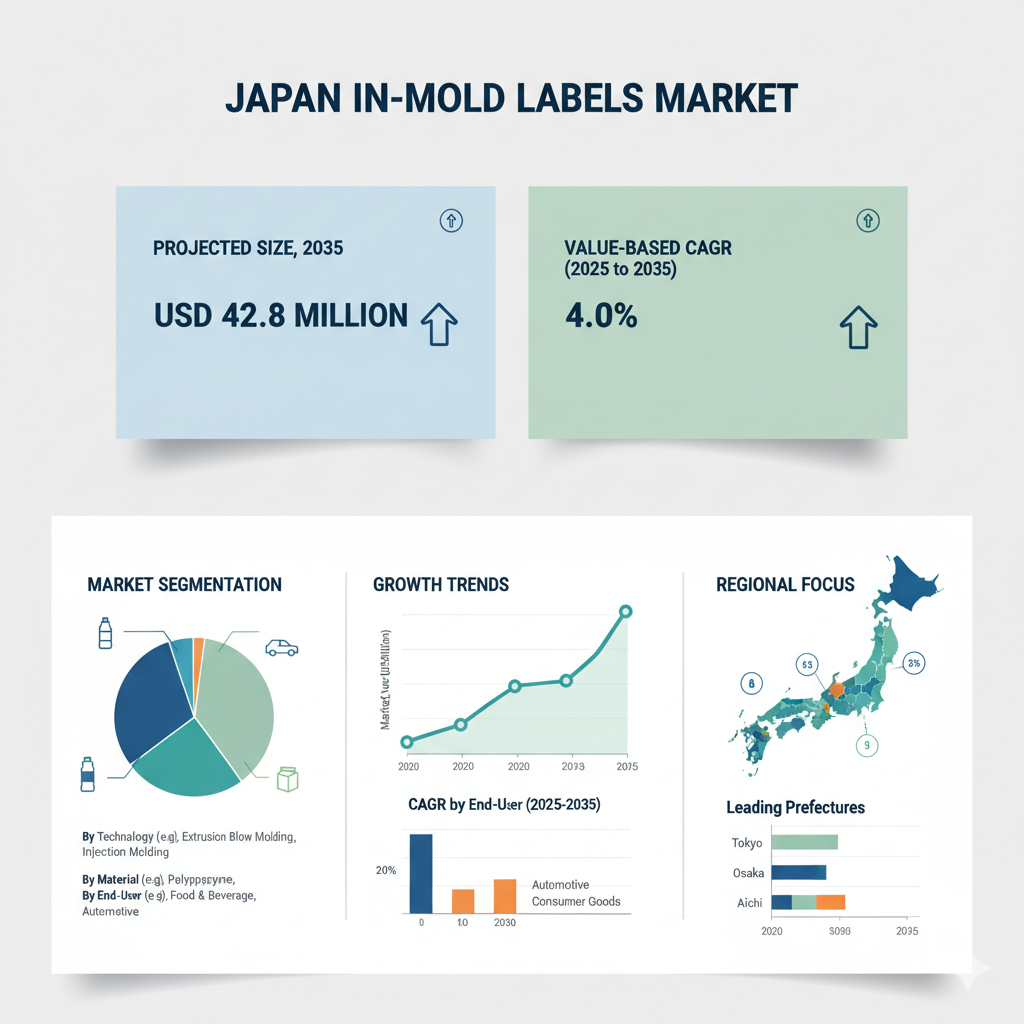
The global Japan’s in-mold labels (IML) market is projected to grow from US $28.9 million in 2025 to approximately US $42.8 million by 2035, expanding at a steady compound annual growth rate (CAGR) of 4.0 %.
This growth represents a prime opportunity for both long-established and emerging manufacturers looking to scale their operations and tap into the country’s demand for high-performance, sustainable packaging solutions. Established leaders like Toppan Printing Co., Ltd., Dai Nippon Printing Co., Ltd. (DNP), and Mitsubishi Chemical Corporation are setting the pace through innovative material development, digital printing, and advanced molding technologies.
Established Manufacturers Driving Innovation
Toppan Printing has introduced ultra-thin injection-moulded containers that reduce wall thickness by around 30 % using proprietary molding technology. These lightweight containers align with its sustainable packaging initiative and demonstrate how leading players are integrating innovation with environmental responsibility.
Mitsubishi Chemical, another key market participant, continues to expand its product range by offering high-performance films and plastic materials designed for improved strength and recyclability. Its emphasis on multi-layer barrier structures ensures packaging that not only enhances protection but also contributes to reducing overall material waste.
Similarly, DNP has been advancing renewable-resource films and automated packaging systems that align with Japan’s growing sustainability focus. Their approach to combining advanced printing precision with renewable materials underscores how established firms are reinventing themselves to meet next-generation market demands.
Emerging Players: Opportunities to Grow
While Tier 1 companies currently dominate the in-mold labels market, smaller and emerging manufacturers have a timely opportunity to carve out their own niches. The adoption of mono-material polypropylene (PP) and digital printing technologies offers newcomers the chance to deliver flexible, customized, and eco-friendly solutions.
Within the material category, polypropylene is the clear frontrunner, accounting for more than three-quarters of the market and expected to grow further by 2035. Its lightweight properties, ease of recyclability, and compatibility with injection molding make it the ideal choice for manufacturers focused on efficiency and sustainability.
Injection molding itself remains the most widely adopted process, representing nearly three-quarters of the market share. This dominance is due to its precision, high output speed, and compatibility with mono-material designs — factors that directly reduce waste and improve recyclability.
Why Japan Is the Ideal Growth Market
Japan’s packaging landscape demands durability, visual appeal, and sustainable performance — particularly across industries like food and beverage, cosmetics, and personal care. In-mold labels meet these needs by fusing the label and container into one durable, seamless product. This eliminates adhesives, enhances moisture and heat resistance, and supports detailed, vibrant graphics that maintain their clarity over time.
Moreover, Japan’s strong commitment to circular economy principles is accelerating the shift toward recyclable packaging solutions. Mono-material in-mold labels, especially those made from polypropylene, are increasingly valued for their ability to streamline the recycling process.
The surge in digital printing technologies also adds momentum to market growth. Manufacturers now have the ability to produce short runs, integrate variable data such as QR codes or batch numbers, and achieve superior image quality. These advances not only meet the evolving demands of brand owners but also open new revenue channels for smaller, more agile manufacturers.
A Call for Strategic Collaboration
To sustain long-term growth, both established and emerging players are focusing on collaboration and technology partnerships. Forming alliances across material suppliers, printing specialists, and mold processors allows manufacturers to broaden capabilities, reduce time-to-market, and capture a larger share of Japan’s rapidly modernizing packaging industry.
For large enterprises, the focus is on strengthening next-generation material portfolios, expanding digital printing capacities, and enhancing value-added services like product traceability and authentication. Meanwhile, new entrants can benefit from targeting niche segments — offering custom print-on-demand services or sustainable regional packaging solutions that larger corporations may overlook.
About the Market Outlook
The Japan In-Mold Labels Market Report (2025–2035) provides comprehensive insights into market segmentation by material, printing method, and process type, along with detailed profiles of leading companies and emerging innovators. The report projects continued growth as manufacturers align with global sustainability trends, digital transformation, and evolving consumer expectations.
With strong market fundamentals and increasing adoption of eco-friendly materials, Japan stands at the forefront of a new era in packaging — one where innovation, design, and environmental consciousness converge.