The Global Carbon Nanotubes (CNT) Market is witnessing robust growth, fueled by the rising demand for advanced materials in electronics, energy storage, aerospace, and automotive industries. Carbon nanotubes—renowned for their exceptional electrical conductivity, tensile strength, and thermal stability—are emerging as a key enabler in next-generation technologies, from electric vehicles and smart devices to renewable energy solutions.
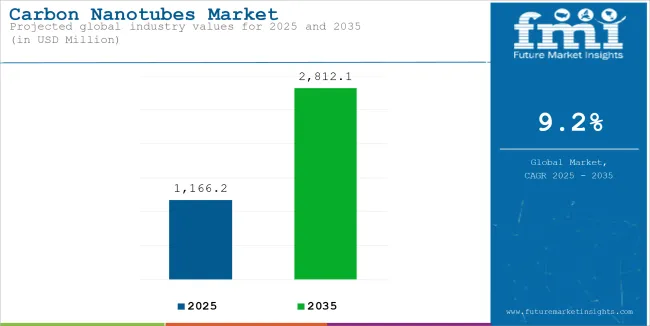
The market size of the global carbon nanotube in 2025 will be USD 1,166.2 million and the projection will escalate to an astronomical USD 2,812.1 million by the year 2035 with a 9.2% compound annual growth rate (CAGR) in the study duration. Use of CNTs in energy storage devices such as lithium-ion batteries and super capacitors will be one of the factor drivers for such a growth pattern.
Market Overview
The market for carbon nanotubes is expanding rapidly as industries seek lightweight, durable, and high-performance materials for manufacturing and product innovation. With the increasing shift toward sustainable and efficient energy systems, CNTs are being used in batteries, supercapacitors, and solar cells, offering superior energy density and charge transport capabilities.
In 2025, the global carbon nanotubes market is projected to be valued at USD 7.6 billion, with expectations to reach USD 18.4 billion by 2035, growing at a CAGR of over 9%. Advancements in nanotechnology, chemical vapor deposition (CVD) production techniques, and CNT-polymer integration are further supporting market expansion across multiple industries.
Key Market Drivers
- Rising Demand in Electronics and Electrical Applications
Carbon nanotubes are increasingly used in conductive films, transistors, and sensors, replacing traditional materials such as silicon and indium tin oxide. Their unique structure provides high electron mobility, enabling faster, smaller, and more energy-efficient devices.
- Adoption of CNTs in printed and flexible electronics.
- Use in electromagnetic interference (EMI) shielding materials for electronic components.
- Development of CNT-based conductive inks for smart wearables and displays.
- Expanding Use in Energy Storage Systems
The push for electrification and renewable energy is boosting CNT demand in lithium-ion batteries and supercapacitors. CNTs enhance the electrode conductivity and mechanical stability, extending battery life and performance.
- Use in EV batteries and hybrid energy systems.
- Increasing research in CNT-based hydrogen storage and fuel cells.
- Integration in grid-level storage solutions for renewable power systems.
- Growth in Composite and Structural Materials
CNTs are incorporated into polymers, metals, and ceramics to create composite materials with superior mechanical and thermal properties. These composites are gaining traction in automotive, aerospace, defense, and construction sectors.
- Applications in lightweight vehicle parts for fuel efficiency.
- Use in aerospace components to reduce weight and increase durability.
- Growing use in industrial coatings and 3D printing materials.
- Advancements in CNT Manufacturing Technologies
Recent improvements in chemical vapor deposition (CVD) and plasma-enhanced CVD have significantly reduced production costs and improved product consistency. Mass production of single-walled (SWCNT) and multi-walled carbon nanotubes (MWCNT) has made CNTs more accessible to mainstream industries.
- Continuous R&D in scalable and eco-friendly synthesis processes.
- Automation in dispersion and purification techniques.
- Enhanced quality control and standardization across manufacturers.
- Rising Adoption in Medical and Environmental Applications
CNTs are being explored for use in drug delivery, biosensors, and water purification due to their unique surface chemistry and adsorption properties.
- Development of CNT-based nanocarriers for targeted drug delivery.
- Use in filtration systems for pollutant and heavy metal removal.
- Integration in bio-imaging and diagnostic tools for early disease detection.
Market Segmentation
By Type:
- Single-Walled Carbon Nanotubes (SWCNT)
- Multi-Walled Carbon Nanotubes (MWCNT)
By Method of Production:
- Chemical Vapor Deposition (CVD)
- Arc Discharge
- Laser Ablation
- Others
By Application:
- Electronics & Semiconductors
- Energy Storage & Conversion
- Aerospace & Defense
- Automotive
- Medical & Healthcare
- Construction & Coatings
By End-Use Industry:
- Electrical & Electronics
- Energy
- Automotive
- Aerospace
- Healthcare
- Industrial Manufacturing
Regional Insights
- North America leads the global carbon nanotubes market, driven by strong R&D investments and widespread adoption in electronics, defense, and nanotechnology sectors. The U.S. remains a hub for CNT innovation and commercialization.
- Asia Pacific is expected to exhibit the fastest growth, with countries like China, Japan, and South Korea expanding their nanomaterials production capacities. Increasing EV production and government support for advanced material research are fueling demand.
- Europe is focusing on sustainability and lightweight composites, particularly in the automotive and aerospace sectors, with Germany and the UK leading adoption.
- Rest of the World regions, including Latin America and the Middle East, are showing growing interest in CNT applications for renewable energy and infrastructure modernization.
Key Market Trends
- Integration in EV and Battery Technologies: Increasing use of CNTs in next-generation battery electrodes for improved charge rates and longer life cycles.
- Growing Focus on CNT-Based 3D Printing: Manufacturers are exploring CNT-reinforced filaments and resins for additive manufacturing.
- Shift Toward Sustainable CNT Production: Focus on low-emission synthesis and biomass-based feedstocks for eco-friendly CNT manufacturing.
- Collaborations and Partnerships: Strategic alliances between nanotech firms and automakers to accelerate CNT adoption in EVs.
- Rising Investments in Healthcare Nanotechnology: Exploration of CNTs for biosensors, drug delivery, and regenerative medicine.
Future Outlook
The Carbon Nanotubes Market is set for strong expansion as industries increasingly integrate nanotechnology into mainstream manufacturing. Innovations in scalable production, material hybridization, and sustainability will open new avenues across emerging sectors like biomedicine, energy storage, and smart materials.
Future growth is expected to be driven by:
- Widespread commercialization of CNT composites in automotive and aerospace.
- Next-gen energy solutions using CNT-enhanced batteries and capacitors.
- Global standardization and cost reduction through mass production technologies.
- Collaborative R&D initiatives between government bodies and private players.
With the convergence of innovation, sustainability, and performance, carbon nanotubes are set to transform multiple industries, solidifying their position as a cornerstone of the global advanced materials market.
Request Your Sample Report Today and discover growth opportunities!
https://www.futuremarketinsights.com/reports/sample/rep-gb-78
Checkout Now to Access Industry Insights:
https://www.futuremarketinsights.com/checkout/78
About Future Market Insights (FMI)
Future Market Insights, Inc. (ESOMAR certified, recipient of the Stevie Award, and a member of the Greater New York Chamber of Commerce) offers profound insights into the driving factors that are boosting demand in the market. FMI stands as the leading global provider of market intelligence, advisory services, consulting, and events for the Packaging, Food and Beverage, Consumer Technology, Healthcare, Industrial, and Chemicals markets. With a vast team of 400 analysts worldwide, FMI provides global, regional, and local expertise on diverse domains and industry trends across more than 110 countries.
Contact Us:
Future Market Insights Inc.
Christiana Corporate, 200 Continental Drive,
Suite 401, Newark, Delaware – 19713, USA
T: +1-845-579-5705
For Sales Enquiries: sales@futuremarketinsights.com
Website: https://www.futuremarketinsights.com
LinkedIn| Twitter| Blogs | YouTube