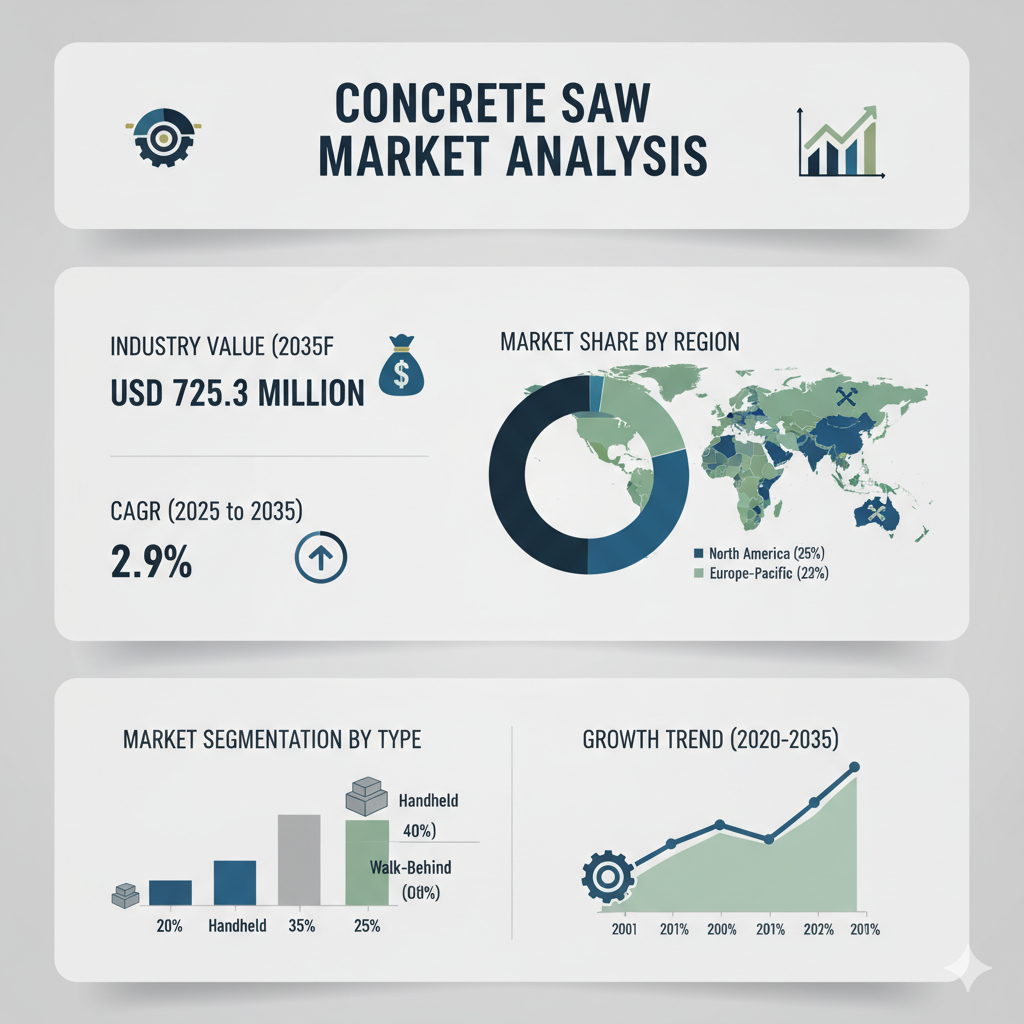
As global infrastructure continues to surge and the demand for precise, efficient cutting tools intensifies, manufacturers of concrete saws stand on the cusp of a transformative era. A new market analysis forecasts that the global concrete saw market will grow from approximately US $545.1 million in 2025 to around US $725.3 million by 2035, at a compound annual growth rate (CAGR) of 2.9%.
This buoyant outlook sets the stage for both established industry players and innovative newcomers alike to expand their horizons, embrace new technologies, and stake their claim in a dynamic marketplace.
Established Manufacturers: Reinforcing Footing & Tech Leadership
Longstanding manufacturers are well positioned to deepen their dominance by widening technology offerings and expanding their global reach. Companies such as Husqvarna Group, STIHL Group, Makita Corporation, Hilti Corporation, and Norton Clipper (Saint-Gobain) hold leading shares in the concrete saw market.
These players are doubling down on innovation:
- Husqvarna continues to deliver walk-behind, handheld, and floor saws with advanced dust-suppression systems and fuel-efficient engines.
- STIHL focuses on compact, high-performance saws for construction and demolition, emphasizing durability and operator comfort.
- Makita invests heavily in cordless and gas-powered models to boost portability and environmental performance.
- Hilti delivers industrial-grade saws with diamond-cutting technologies for large-scale infrastructure.
- Norton Clipper emphasizes high-speed advanced blades for floor and asphalt applications.
For these established manufacturers, the growth strategy is clear: scale globally into emerging regions, ramp up eco-friendly product lines such as electric and battery-powered saws, and integrate smart features like IoT and automation to stay ahead of regional challengers.
New Entrants & Regional Innovators: Capturing Opportunity in the Upswing
While major players hold sizeable market shares, more than 60 percent of the market is fragmented among regional specialists, niche innovators, and emerging manufacturers.
This presents a golden opportunity for newcomers who can pivot quickly, differentiate on cutting-edge technology, or leverage localized service models. Key growth drivers include:
- The trend toward sustainable construction, with electric, battery-powered, and low-emission saws gaining traction.
- The automation wave, featuring IoT-enabled saws, predictive maintenance systems, and remote-controlled cutting machines that reduce downtime and enhance safety.
- Rapid development in regions such as Asia-Pacific, where urbanization, smart city initiatives, and infrastructure expansion drive demand for advanced cutting equipment.
A savvy new manufacturer entering the space might specialize in a compact battery-powered saw tailored to mid-size contractors or develop a dust-control retrofit kit that meets strict regulations in Europe. By aligning with regional trends and evolving regulatory standards, fledgling firms can scale swiftly and carve their niche in the growing market.
Technology as the Growth Engine
Innovation is not a luxury — it is a necessity. Some of the standout technological trends reshaping the concrete saw market include:
- Electric and battery-powered saws becoming favored in indoor or urban environments due to low emissions, quieter operation, and compliance with environmental targets.
- Smart sensors and IoT integration for real-time performance monitoring, predictive maintenance, and greater operator safety.
- Advanced blade technologies — including diamond-tipped and nanocomposite materials — offering faster cuts, longer blade life, and higher efficiency when cutting reinforced concrete, asphalt, or stone.
- Automation and remote-control capabilities that enhance precision and safety in large-scale infrastructure settings.
As both established and emerging players invest in these technologies, the competitive landscape is shifting. Companies that successfully embed smart features and sustainable designs will gain market share, while traditional models may face pricing pressures and limited differentiation.
Global Outlook & Strategic Implications
Regional insights reveal promising opportunities worldwide:
- North America is driven by infrastructure rehabilitation and green building practices, boosting demand for electric saws and ergonomic designs.
- Europe is shaped by strict environmental and safety regulations, heightening the push for low-emission, dust-controlled equipment.
- Asia-Pacific is emerging as the fastest-growing region due to urbanization, major infrastructure roll-outs, and rapid commercial real-estate development.
For established companies, this means optimizing regional distribution, localizing production, and tailoring product portfolios. For new entrants, it’s about identifying underserved niches — such as lightweight saws for urban retrofit projects or remote-controlled machines for large construction sites — and introducing agile, technology-driven solutions.
About the Report
The Concrete Saw Market Growth – Trends & Forecast 2025 to 2035 report provides a comprehensive overview of the market’s structure, segmentation by design type, power source, concrete type, and power range. It also includes detailed regional analysis, competitive benchmarking, and insights into emerging technological themes shaping the industry’s future.
In Conclusion
As the global concrete saw market charts a steady path forward, both legacy manufacturers and new entrants are poised to capture the momentum. For established brands, reinforcing leadership through innovation and global reach remains key. For newcomers, the door is wide open to define new segments, harness next-generation technologies, and respond swiftly to regional demands.
With sustainability, automation, and precision cutting at the forefront, the companies that combine technical excellence with strategic foresight will be the ones shaping the next decade of growth in the concrete saw industry.