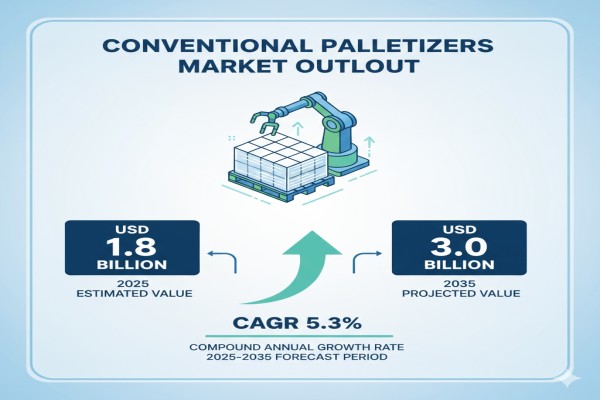
The global conventional palletizers market is projected to witness robust growth over the next decade, rising from an estimated USD 1.8 billion in 2025 to USD 3.0 billion by 2035, registering a compound annual growth rate (CAGR) of 5.3%. This upward trajectory is being fueled by growing industrial automation, operational efficiency demands, and the strategic expansion of both established and emerging manufacturers into new regions.
A detailed 5-year block analysis illustrates a phased growth pattern in the industry. From 2025 to 2029, the market shows moderate uptake, climbing from USD 1.7 billion to USD 1.8 billion. This period is characterized by small and medium-scale manufacturers adopting basic automation solutions to reduce labor dependency and streamline operations.
The mid-period block, spanning 2030 to 2034, marks accelerated adoption, with market value increasing from USD 1.9 billion to approximately USD 2.7 billion. This growth reflects the growing emphasis on operational efficiency, high-volume production, and widespread deployment in food, beverage, and consumer goods industries. By 2035, the market is projected to mature at USD 3.0 billion, with selective expansion in emerging regions complementing saturated high-volume markets.
Get Exclusive Access To Data Tables, Market Sizing Dashboards, And Analyst Insights. Request Sample Report
High-Level Systems Lead Adoption
Among types, high-level conventional palletizers dominate with a 58.9% market share. These systems are designed for high-speed, continuous operation, efficiently stacking products from conveyor belts onto pallets with minimal downtime. Industries such as beverages, chemicals, and packaged goods are increasingly adopting these systems due to their durability, reliability, and adaptability to varying production needs.
Manufacturers are further enhancing flexibility through programmable logic controls and layer-forming mechanisms, reinforcing high-level systems as the backbone of conventional palletizer demand.
Boxes and Cases Remain a Core Application
In terms of applications, boxes and cases account for 34% of market usage. Conventional palletizers are critical in handling standard corrugated boxes and rigid cases, particularly in large-scale operations requiring speed and precision. With the surge in e-commerce and bulk shipments, secure and efficient handling of boxed goods is paramount. Manufacturers are integrating customized palletizers compatible with diverse pallet sizes, ensuring seamless operation while reducing manual labor and improving workflow efficiency.
Food and Beverages Drive Industry Demand
The food and beverage sector contributes the largest share—42%—of end-use demand. The industry relies heavily on conventional palletizers to manage various packaging formats, including trays, shrink-wrapped bundles, and cases, ensuring product stability during storage and transport. With increasing SKU diversity, hygiene standards, and sustainability considerations, automated palletizing solutions are becoming essential for operational continuity and regulatory compliance.
Global Growth and Regional Highlights
Regional growth patterns reflect industrial expansion and e-commerce-driven logistics. China leads with a projected CAGR of 7.2%, propelled by rapid industrialization, rising labor costs, and increasing adoption of automation in manufacturing and logistics.
India follows with 6.6%, supported by industrial modernization, e-commerce growth, and collaborations between domestic and international manufacturers.
Germany’s mature industrial base drives adoption at 6.1% CAGR, emphasizing integration with warehouse management systems and Industry 4.0 initiatives.
The UK and USA show steady growth at 5.0% and 4.5%, respectively, driven by logistics, retail, and e-commerce sectors investing in smart warehouse solutions.
Market Drivers and Trends
Key growth drivers include rising labor costs, workplace safety regulations, and the demand for high-speed, reliable material handling systems. Integration with packaging and supply chain operations is enhancing efficiency, minimizing product damage, and reducing operational delays. Cost-effective solutions are attracting both small and large manufacturers, while industrial modernization and e-commerce expansion are further boosting market adoption.
Competitive Landscape and Innovation
The conventional palletizers market is marked by active competition and technological advancement. Leading players such as Baust & Co GmbH, Brenton Engineering, BW Flexible Systems, Columbia Machine Inc., Concetti SpA, KUKA AG, and MSK Covertech are driving innovation in system flexibility, throughput efficiency, and automation integration. Companies are increasingly offering turnkey solutions, AI-enabled controls, and customized systems that cater to varying packaging formats and production volumes. Emerging players like Wuxi Taiyang Packaging Technology Co. Ltd. are expanding their footprint through versatile solutions and regional collaborations, highlighting the dynamic nature of the market.
Outlook
With consistent adoption, technological innovation, and expanding industrial automation, the conventional palletizers market is poised for sustained growth. Manufacturers are focusing on efficiency, cost-effectiveness, and adaptability, ensuring these systems remain integral to modern production and logistics operations across the globe.
Empower Your Business Decisions With Verified Industry Forecasts And Competitor Intelligence. Buy Full Report
About the Report
The market analysis covers global trends, competitive strategies, regional insights, and projections for 2025–2035. Key segments analyzed include type, application, end-use industry, distribution channel, and geographic regions, providing actionable insights for manufacturers, suppliers, and investors seeking to optimize their strategies in the evolving palletizers market.
About Future Market Insights (FMI)
Future Market Insights, Inc. (ESOMAR certified, recipient of the Stevie Award, and a member of the Greater New York Chamber of Commerce) offers profound insights into the driving factors that are boosting demand in the market. FMI stands as the leading global provider of market intelligence, advisory services, consulting, and events for the Packaging, Food and Beverage, Consumer Technology, Healthcare, Industrial, and Chemicals markets. With a vast team of over 400 analysts worldwide, FMI provides global, regional, and local expertise on diverse domains and industry trends across more than 110 countries.
Contact Us:
Future Market Insights Inc.
Christiana Corporate, 200 Continental Drive,
Suite 401, Newark, Delaware – 19713, USA
T: +1-347-918-3531
For Sales Enquiries: sales@futuremarketinsights.com
Website: https://www.futuremarketinsights.com
LinkedIn| Twitter| Blogs | YouTube