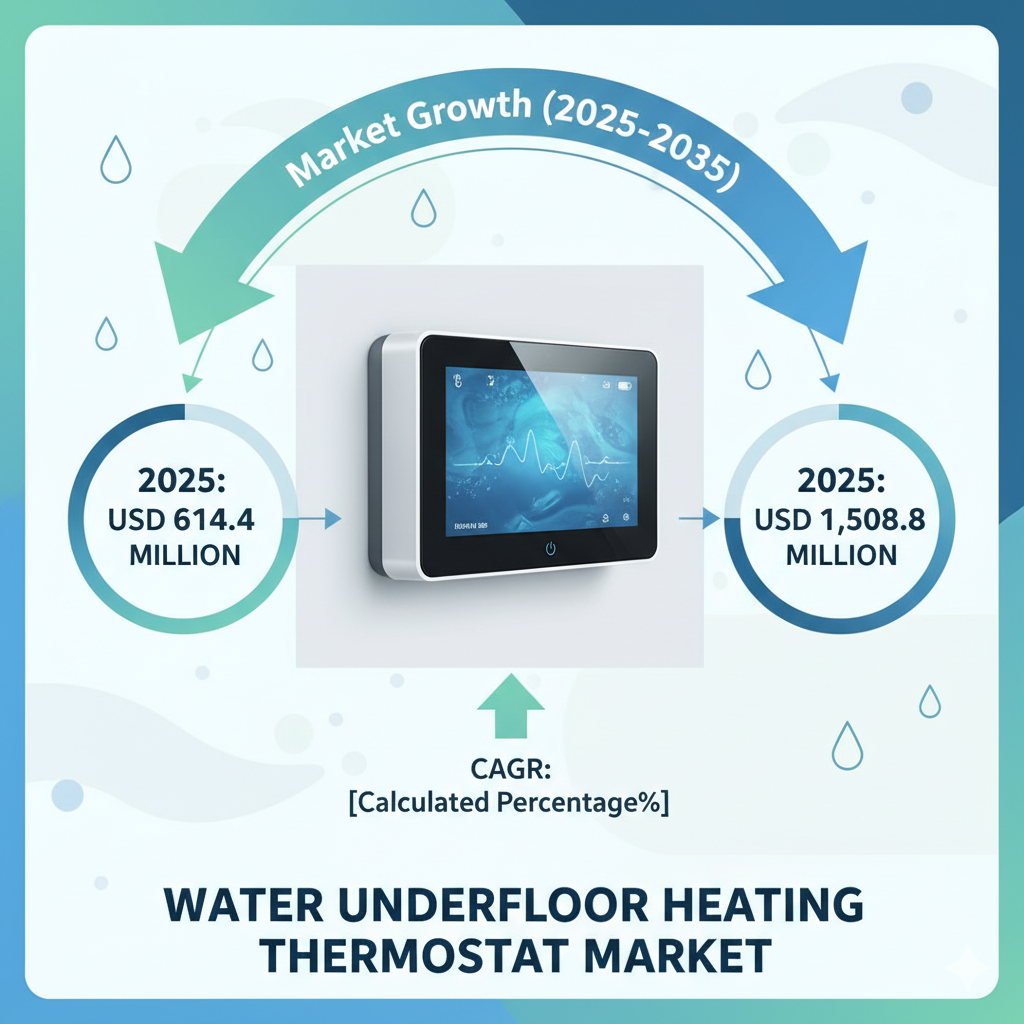
The global Water Underfloor Heating Thermostat Market is entering a defining decade of innovation and adoption. According to the latest market outlook, the sector is forecast to grow from USD 614.4 million in 2025 to USD 1,508.8 million by 2035, fueled by increasing smart home penetration, rising energy costs, and stringent energy-efficiency regulations across developed and emerging economies.
This strong growth reflects a fundamental shift in how residential, commercial, and industrial facilities manage heating efficiency. Thermostat innovation—once limited to programmable controls—is rapidly evolving into intelligent, AI-enabled systems that adapt to user behavior, weather patterns, and energy pricing.
Full Market Report available for delivery. For purchase or customization, please request here – https://www.futuremarketinsights.com/reports/sample/rep-gb-26954
A Decade of Powered Growth: Technology-Led in the First Half, AI-Driven in the Second
The market will expand in two distinct phases:
- 2025–2030: Rapid Adoption Phase
- Market jumps from USD 614.4 to USD 962.8 million (USD 348.4 million growth).
- Smart and wireless thermostats move from luxury add-ons to standard expectations.
- Homeowners shift toward climate automation and app-based management to fight rising energy bills.
During this phase, established players such as Danfoss, Siemens, and Legrand are expected to expand product portfolios with improved wireless integration and user-friendly designs. At the same time, emerging brands like Saswell, ProWarm Underfloor Heating, and Warmup PLC are gaining traction through agile development cycles and intuitive mobile-first platforms.
- 2030–2035: Intelligence and AI Integration Phase
- Market skyrockets from USD 962.8 to USD 1,508.8 million (USD 546.0 million increase).
- Systems will offer predictive maintenance, renewable energy compatibility, and AI-based temperature learning.
As renewable energy systems, heat pumps, and smart grids become mainstream, thermostats capable of self-learning and predictive optimization will dominate.
Smart Homes and Sustainability Are Reshaping the Market
Key market drivers include:
- Energy savings of 20–26% annually via occupancy-based automation and temperature learning.
- Growing consumer affinity toward app-controlled living spaces, voice assistants, and connected homes.
- Government mandates and building codes that require programmable or intelligent thermostats in new construction.
However, challenges remain—especially installation costs and compatibility across different smart home ecosystems. New entrants are tackling these pain points with modular systems and open-protocol connectivity.
Programmable & Intelligent Thermostats Lead the Charge
- Programmable thermostats hold ~45% market share, appealing to cost-conscious users.
- Intelligent thermostats are the fastest-growing category, powered by AI, remote control, predictive scheduling, and seamless home automation.
Major technology creators like Honeywell and Schneider Electric continue to refine user interfaces while new innovators accelerate price-performance advantages.
Home Use Remains the Dominant Segment – Representing 80% of Installations
Consumers are increasingly installing the thermostats in living rooms, bedrooms, luxury bathrooms, and premium residential projects. The shift toward property automation—especially in apartments and renovated homes—has created a surge in retrofit applications.
- China dominates through mass residential development and smart city investments.
- India’s luxury housing boom and smart-city initiatives fuel demand.
- Germany maintains leadership in premium heating innovation and integration with renewable systems.
Emerging brands in China and India are entering the market aggressively with cost-competitive, intelligent thermostat solutions—creating fresh competition for established HVAC manufacturers.
Competitive Landscape: Established Leaders Face Tech-Savvy Innovators
The market features 15–20 active companies globally:
- Market Leaders: Danfoss, Siemens, Legrand
- Tech-First Challengers: Saswell, ProWarm Underfloor Heating, Warmup PLC
- Regional Specialists: Heatmiser, Wunda Group, Nu-Heat UK
While industry giants leverage global distribution and engineering expertise, newcomers are gaining ground through modern UX design, mobile-led interfaces, and affordability.
What’s Next for the Industry?
Manufacturers are prioritizing:
- AI-based temperature learning
- Wireless interoperability across devices
- Integration with solar heating and heat pumps
- Modular thermostats that simplify retrofits
Governments and energy agencies are also expected to introduce incentives, accelerating consumer adoption and reducing upfront costs.
Get Detailed Insights — Request PDF: https://www.futuremarketinsights.com/reports/brochure/rep-gb-26954
Conclusion
The global water underfloor heating thermostat market is no longer just a subset of HVAC—it is becoming a core component of the smart home revolution. As intelligent thermostats evolve from controlled heating to optimized, predictive thermal management, manufacturers—both established and emerging—stand to benefit from unprecedented market opportunity.
About Future Market Insights (FMI)
Future Market Insights, Inc. (ESOMAR certified, recipient of the Stevie Award, and a member of the Greater New York Chamber of Commerce) offers profound insights into the driving factors that are boosting demand in the market. FMI stands as the leading global provider of market intelligence, advisory services, consulting, and events for the Packaging, Food and Beverage, Consumer Technology, Healthcare, Industrial, and Chemicals markets. With a vast team of over 400 analysts worldwide, FMI provides global, regional, and local expertise on diverse domains and industry trends across more than 110 countries.
Contact Us:
Future Market Insights Inc.
Christiana Corporate, 200 Continental Drive,
Suite 401, Newark, Delaware – 19713, USA
T: +1-347-918-3531
For Sales Enquiries: sales@futuremarketinsights.com
Website: https://www.futuremarketinsights.com
LinkedIn| Twitter| Blogs | YouTube