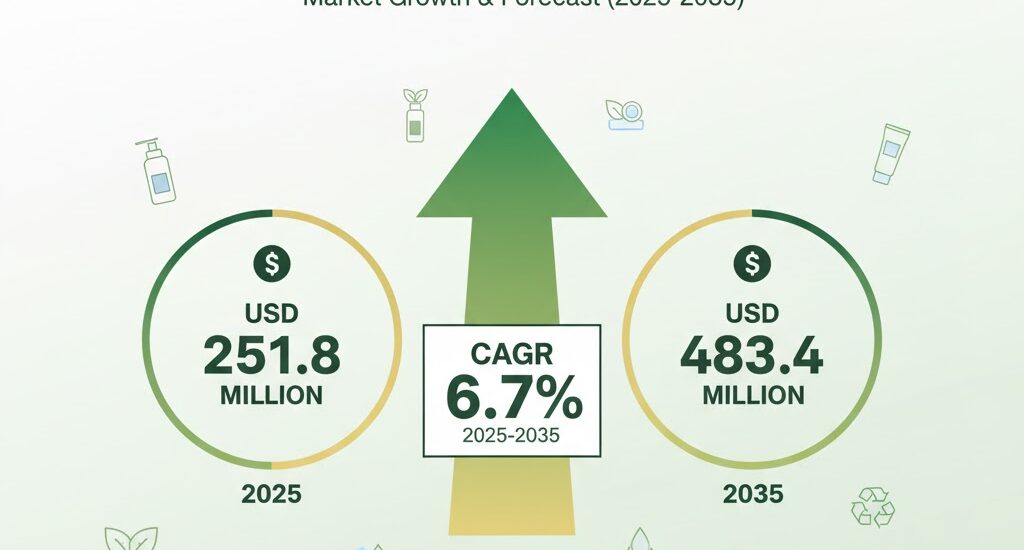
The global upcycled cosmetic ingredients market is entering a decade of opportunity. Valued at USD 251.8 million in 2025, the market is forecast to reach USD 483.4 million by 2035, growing at a CAGR of 6.7%. This surge reflects a powerful shift in consumer values—favoring sustainability, transparency, and clean beauty—while opening vast possibilities for manufacturers ready to lead the circular economy transformation.
At its core, this market reimagines waste. By repurposing by-products from food, agriculture, and beverage industries—such as fruit seeds, coffee grounds, and plant husks—manufacturers are turning potential waste into premium cosmetic ingredients. This dual-purpose innovation reduces environmental impact while providing high-performing, nutrient-rich components for skincare, haircare, and personal care formulations.
Driving Forces: Sustainability and Circular Economy Practices
A global emphasis on climate action and resource efficiency is shaping the beauty industry’s next chapter. Consumers, increasingly aware of the ecological footprint of their purchases, are rewarding brands that incorporate sustainable and upcycled ingredients. This growing eco-conscious mindset is reinforcing partnerships between manufacturers, suppliers, and cosmetic brands seeking to align with responsible sourcing principles.
Government regulations and environmental initiatives worldwide further accelerate this shift. As stricter waste reduction laws emerge, upcycling offers manufacturers a compliant, innovative, and future-proof approach to raw material sourcing—turning environmental responsibility into a competitive advantage.
Digital Engagement Accelerates Adoption
The rise of social media has amplified awareness of sustainable beauty, creating direct bridges between brands and consumers. Influencers, beauty experts, and conscious consumers are spotlighting upcycled cosmetic ingredients—explaining how these ingredients are derived and why they matter. This organic digital storytelling is not only changing perceptions but also boosting adoption across markets.
For manufacturers, this dynamic represents a strategic marketing opportunity: by showcasing their sourcing transparency and environmental commitment, they can strengthen brand credibility and deepen consumer trust.
Challenges: Awareness and Supply Consistency
Despite its momentum, the market faces hurdles. Limited consumer awareness in certain regions and inconsistent supply chains remain barriers to scaling. Since upcycled materials originate from diverse industries, maintaining standardized quality can be complex. Smaller suppliers often struggle to meet volume demands, presenting opportunities for larger manufacturers to invest in partnerships, technological improvements, and integrated supply systems.
By tackling these challenges head-on, companies can secure early-mover advantages in a rapidly evolving industry landscape.
Market Segmentation: Oils and Skincare Lead the Way
By Ingredient Type
Oils hold the largest market share—41.3% in 2025—thanks to their versatility and powerful skin benefits. Upcycled oils such as rosehip, avocado, and jojoba are rich in antioxidants, vitamins, and essential fatty acids. Their performance in moisturizing, rejuvenating, and protecting the skin makes them the cornerstone of modern sustainable cosmetics.
By Source
Plant waste dominates the source segment with 39.2% market share in 2025, as manufacturers turn fruit peels, seeds, and husks into valuable ingredients. These natural materials align perfectly with clean beauty principles, offering hydration, anti-aging benefits, and enhanced skin repair.
By Application
Skincare remains the leading application area, accounting for 32.3% of the market. Upcycled ingredients, such as citrus extracts and coffee grounds, are recognized for their antioxidant-rich properties that help brighten and revitalize the skin, supporting the clean beauty movement that consumers increasingly prioritize.
Explore trends before investing — request a sample report today!:- https://www.futuremarketinsights.com/reports/sample/rep-gb-19943
Regional Outlook: Global Movement Toward Green Innovation
Asia-Pacific
Japan and China are setting regional benchmarks for sustainable production. Japanese consumers prioritize purity and safety, while Chinese consumers increasingly seek high-quality, natural ingredients. Both markets support responsible sourcing and align with government regulations promoting safe and eco-friendly cosmetics.
Europe
Europe remains at the forefront of the circular economy, with Germany and the UK leading the way. Germany’s rigorous environmental policies and consumer awareness drive significant growth, while UK brands are embracing ethical manufacturing under the UK Cosmetics Regulation framework. Europe also acts as a major exporter of refined upcycled ingredients, leveraging its advanced processing technologies.
North America
The U.S. market, growing at a CAGR of 3.2%, uses upcycled ingredients as a differentiation strategy amid intense competition. Compliance with the U.S. Federal Food, Drug, and Cosmetic Act ensures consumer trust and product safety, helping brands emphasize both innovation and responsibility.
Global Trade and Emerging Markets
Trade patterns reveal a global interdependence. North America and Europe dominate in refining and exporting finished upcycled ingredients, while Asia-Pacific, South America, and Africa primarily export raw by-products. This interconnected supply ecosystem offers opportunities for investment in processing technologies and supply chain optimization, especially in emerging economies.
Countries like Brazil and India are leveraging agricultural resources to export fruit seed oils and rice husks, contributing to global sustainability goals while unlocking new economic growth pathways.
Competitive Landscape and Startup Innovation
The market’s fragmented structure allows both established players and startups to thrive. Leading producers—L’Oréal, Givaudan, BASF, Symrise, Croda International, Clariant, Firmenich, Seppic, Akott Evolution, and IFF—are investing in sustainable ingredient innovation and strategic partnerships.
Meanwhile, startups such as UpCircle Beauty, Ecovert, Bioglitz, Fauna & Flora, and Renewal Mill are redefining product design through creative upcycling methods. By converting agricultural and food waste into high-value cosmetic ingredients, these companies are making sustainability both practical and profitable.
Click Here to Purchase the Report:- https://www.futuremarketinsights.com/checkout/19943
A Path Forward for Manufacturers
The upcycled cosmetic ingredients market is more than an emerging trend—it represents a structural evolution toward a circular, responsible beauty industry. Manufacturers embracing this transformation can not only meet rising sustainability demands but also future-proof their operations, strengthen brand loyalty, and unlock new revenue opportunities.
By investing in upcycling technologies, transparent sourcing, and consumer education, cosmetic manufacturers can position themselves as leaders of tomorrow’s sustainable beauty movement—where innovation meets responsibility, and waste becomes worth.
About Future Market Insights (FMI)
Future Market Insights, Inc. (ESOMAR certified, recipient of the Stevie Award, and a member of the Greater New York Chamber of Commerce) offers profound insights into the driving factors that are boosting demand in the market. FMI stands as the leading global provider of market intelligence, advisory services, consulting, and events for the Packaging, Food and Beverage, Consumer Technology, Healthcare, Industrial, and Chemicals markets. With a vast team of over 400 analysts worldwide, FMI provides global, regional, and local expertise on diverse domains and industry trends across more than 110 countries.
Contact Us:
Future Market Insights Inc.
Christiana Corporate, 200 Continental Drive,
Suite 401, Newark, Delaware – 19713, USA
T: +1-347-918-3531
For Sales Enquiries: sales@futuremarketinsights.com
Website: https://www.futuremarketinsights.com
LinkedIn| Twitter| Blogs | YouTube