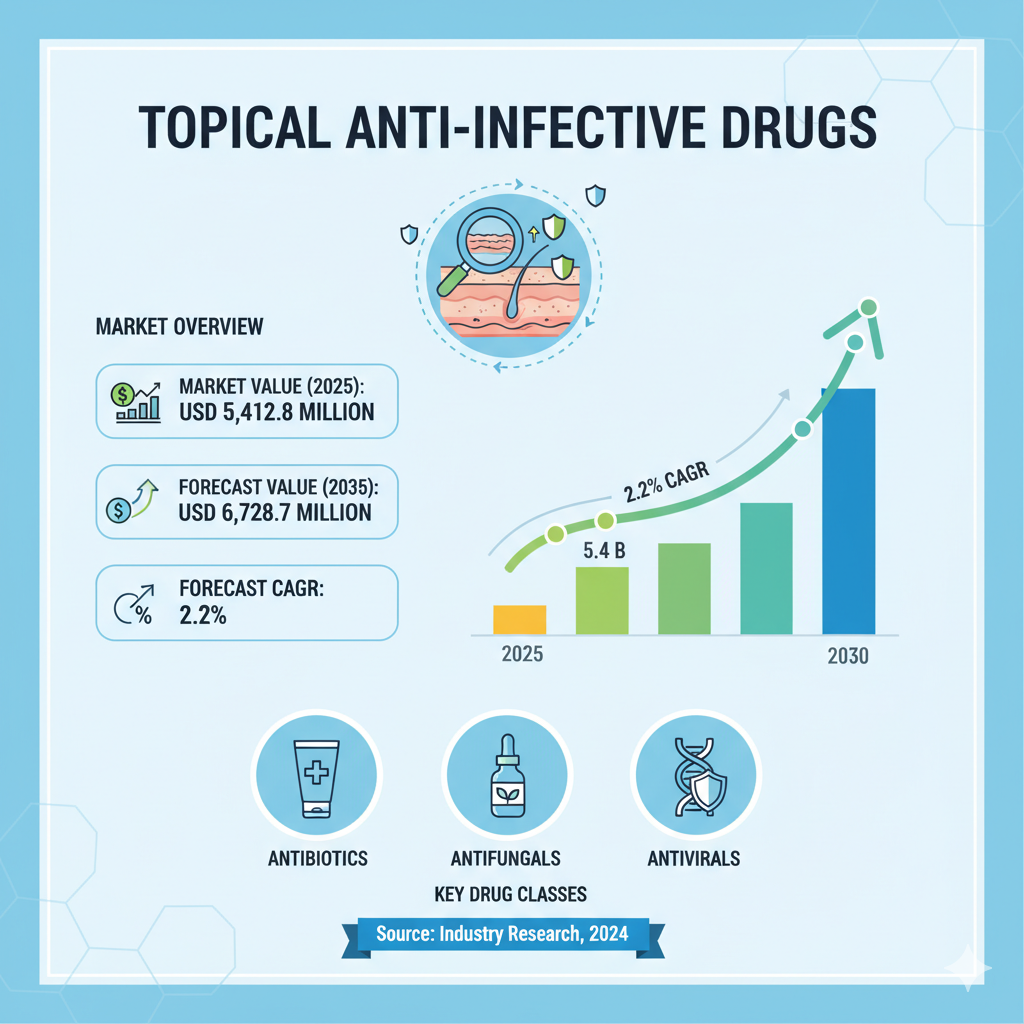
The latest market outlook report, “Topical Anti-infective Drugs Market Size and Share Forecast Outlook 2025–2035,” reveals that the global topical anti-infective drugs market is set to grow from USD 5,412.8 million in 2025 to approximately USD 6,728.7 million by 2035. This represents an absolute increase of USD 1,315.9 million, reflecting a growth of 24.3% over the decade and a steady CAGR of 2.2%. The report underscores how innovation, emerging market expansion, and clinical advancements are redefining this pharmaceutical segment.
Topical anti-infective drugs—critical for treating bacterial and fungal skin infections—continue to gain traction worldwide as rising skin infection cases and new delivery technologies shape patient care outcomes.
Get this Report at $5000 | Claim Your Report at a Discount: https://www.futuremarketinsights.com/reports/sample/rep-gb-26819
Market Overview and Growth Outlook
Between 2025 and 2030, the market is projected to climb to USD 5,905.1 million, accounting for nearly 37.4% of total decade-long growth. From 2030 to 2035, it is expected to accelerate further, reaching USD 6,728.7 million—an increase of USD 823.6 million. This shift is projected to be driven by innovative drug formulations, combination therapies, and over-the-counter expansion, marking a new era of accessible and effective skin infection management.
Key growth regions include China, India, and Germany, while hospitals remain the leading application segment, commanding 58% of total demand due to infection control requirements and advanced antimicrobial stewardship programs.
Drivers of Market Expansion
The surge in skin infections globally, coupled with the growing recognition of localized topical therapies that minimize systemic exposure, underpins the market’s sustained growth. As healthcare providers face mounting antimicrobial resistance challenges, demand for targeted topical solutions delivering efficacy and safety has intensified.
Pharmaceutical manufacturers are increasingly directing their R&D efforts toward specialized products that align with modern infection control protocols and precise patient care standards. These include enhanced drug delivery systems, combination therapies, and adaptive solutions aligned with precision medicine principles.
Emerging Innovation Pathways
The report identifies seven innovation pathways that are shaping future market dynamics:
- Novel Drug Delivery & Nanotechnology Integration (USD 180–270 million): Advanced penetration technologies improve bioavailability and enable targeted delivery.
- Combination Therapy & Multi-target Formulations (USD 220–340 million): Multi-ingredient innovations addressing complex skin conditions deliver strong clinical performance.
- Antimicrobial Resistance & Novel Mechanisms (USD 160–250 million): Cutting-edge research aims to combat resistant strains using new molecular mechanisms.
- Geographic Expansion & Emerging Market Penetration (USD 280–420 million): Strategic partnerships in Asia-Pacific, LATAM, and MEA enhance accessibility.
- Over-the-Counter & Self-Care Solutions (USD 150–230 million): Increasing preference for retail and self-managed care boosts consumer adoption.
- Specialized Applications & Niche Therapeutics (USD 120–180 million): Pediatric and geriatric formulations meet diverse population needs.
- Digital Health Integration & Smart Packaging (USD 100–150 million): Connected packaging and telehealth integration enhance treatment compliance.
Market Segmentation Insights
By product type, ointments lead with 42% market share, reflecting strong user preference for their superior skin penetration, moisture retention, and extended contact efficacy.
By application, the hospital segment dominates at 58%, as infection prevention and institutional therapeutic consistency continue to influence market demand. Hospitals rely heavily on clinically validated topical formulations that ensure patient safety and therapeutic precision.
Regional Growth Highlights
- China (CAGR 3.0%) remains the top-performing market, fueled by major healthcare infrastructure expansion and government-backed pharmaceutical reforms.
- India (CAGR 2.8%) shows strong momentum with evolving public health programs and increasing access to dermatological treatments.
- Germany (CAGR 2.5%) continues to lead Europe through a focus on clinical excellence and regulatory alignment.
- Other strong performers include Brazil (2.3%), the United States (2.1%), the United Kingdom (1.9%), and Japan (1.7%), each emphasizing innovation, training, and therapeutic refinement.
Competitive Landscape and Industry Leaders
The global topical anti-infective drugs landscape combines the clinical expertise of established multinational corporations with the agility of regional innovators. Key players include Bausch Health, LEO Pharma, SK-SF, Kaken Pharmaceutical, Haleon, Bayer, Johnson & Johnson, STADA Arzneimittel, and Galderma. Emerging companies—such as Zhejiang Funo Pharmaceuticals, Jiangsu Fubang Pharmaceuticals, and Shandong Jingwei—are gaining visibility through regionally focused formulations and technologically advanced solutions.
Major pharmaceutical firms are strengthening their research capabilities in response to rising regulatory scrutiny and resistance challenges. Strategic collaborations and geographic diversification remain vital to sustaining market leadership, with companies increasingly investing in local manufacturing, digital therapeutics integration, and patient-centered delivery methods.
Access PDF Brochure Now: https://www.futuremarketinsights.com/reports/brochure/rep-gb-26819
The Road Ahead
The next decade will see topical anti-infective drugs evolving beyond traditional formulations. Integration of precision medicine, nanotechnology, and smart packaging will redefine how these treatments are delivered and monitored. Simultaneously, access-driven growth in developing regions will expand the global market footprint, while advanced healthcare systems in North America and Europe will set new clinical benchmarks.
Industry experts anticipate increased collaboration between large pharmaceutical corporations and niche biotechnology innovators, fostering a competitive environment focused on efficacy, accessibility, and patient quality of life.
As the market enters this next stage, manufacturers who combine scientific innovation with regional expansion, sustainable practices, and digital integration are expected to lead the global transformation of topical anti-infective therapies.
About Future Market Insights (FMI)
Future Market Insights, Inc. (ESOMAR certified, recipient of the Stevie Award, and a member of the Greater New York Chamber of Commerce) offers profound insights into the driving factors that are boosting demand in the market. FMI stands as the leading global provider of market intelligence, advisory services, consulting, and events for the Packaging, Food and Beverage, Consumer Technology, Healthcare, Industrial, and Chemicals markets. With a vast team of over 400 analysts worldwide, FMI provides global, regional, and local expertise on diverse domains and industry trends across more than 110 countries.
Contact Us:
Future Market Insights Inc.
Christiana Corporate, 200 Continental Drive,
Suite 401, Newark, Delaware – 19713, USA
T: +1-347-918-3531
For Sales Enquiries: sales@futuremarketinsights.com
Website: https://www.futuremarketinsights.com
LinkedIn| Twitter| Blogs | YouTube