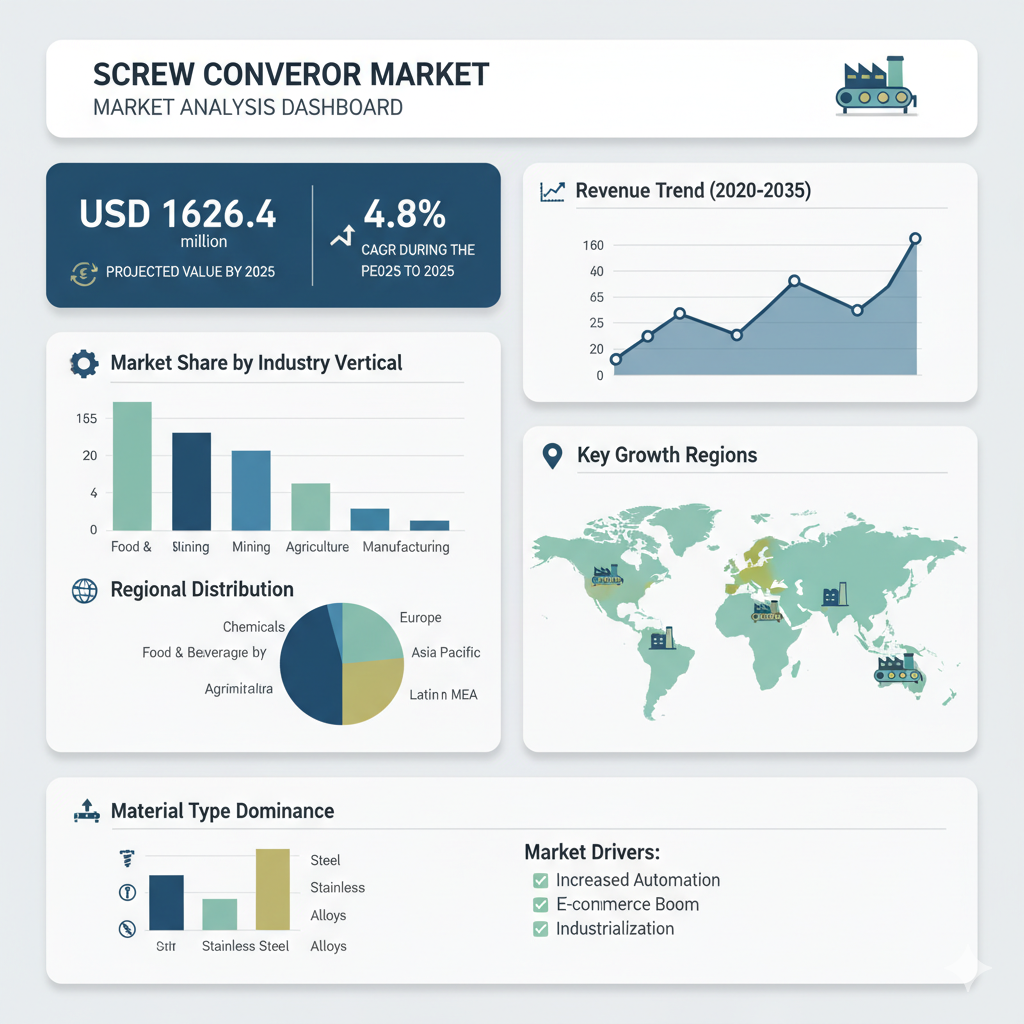
As global industries accelerate their focus on efficiency, automation, and sustainability, the latest industry insights reveal strong growth potential within the screw conveyor market. The sector is projected to reach USD 1.63 billion by 2035, growing at a 4.8 % CAGR from 2025 to 2035.
This steady expansion presents a valuable opportunity for both established manufacturers with proven capabilities and new entrants aiming to establish their footprint. It also signals an era of rapid innovation, where technology, customization, and regional expansion will determine market leadership.
Established Manufacturers: Reinventing Strengths
Leading players such as Screw Conveyor Corporation, Continental Conveyor Ltd., and Syntron Material Handling continue to command a significant portion of the global market, especially in heavy-duty applications. These companies have built reputations around robust engineering, modular designs, and tailored solutions for industries like mining, metallurgy, and construction.
However, even the most established manufacturers are re-engineering their approach to stay ahead. Screw Conveyor Corporation is focusing on modular, heavy-duty systems designed for large-scale mining operations. Continental Conveyor Ltd. is expanding its distribution networks across North America and Asia-Pacific to strengthen supply chains and service capabilities. Syntron Material Handling is integrating digital technology into its products—introducing IoT-enabled, hygienic screw conveyors for food and beverage applications.
These moves illustrate a wider industry shift: traditional manufacturing strength is now being fused with innovation. From smart sensors and predictive maintenance to energy-efficient designs, the next generation of screw conveyors is smarter, cleaner, and more adaptable than ever.
Emerging Manufacturers and Technological Disruption
The market is also witnessing an influx of agile, technology-driven players such as WAMGROUP S.p.A., KWS Manufacturing Company Ltd., and SPIRAC Engineering Pty Ltd. These companies are reshaping competition by focusing on cost-effective, application-specific designs and advanced automation.
For example, WAMGROUP is pushing the boundaries with highly modular, hygienic, and customizable conveyors suited for food processing, agriculture, and wastewater management. Similarly, KWS Manufacturing has emphasized localized production, enabling faster turnaround times and tailored solutions for diverse industry needs.
Emerging manufacturers are leveraging their flexibility to innovate quickly—focusing on specialized product variants like shaftless, tubular, or vertical screw conveyors. This agility allows them to compete effectively with global giants by targeting niche markets and offering customer-centric solutions.
Key Market Drivers and Growth Trends
Several macro trends are propelling this transformation and shaping the strategic roadmap for manufacturers:
- Versatile Rotation Capacities: Conveyors operating within the 45–105 RPM range are expected to hold a dominant market share due to their adaptability across multiple industries.
- High-Demand Industries: Mining and metallurgy continue to lead in adoption, accounting for over one-third of total demand. Agriculture, food processing, and wastewater treatment are also expanding rapidly.
- Technological Advancements: The integration of automation, IoT, and smart monitoring systems is revolutionizing conveyor maintenance and operational efficiency.
- Regional Expansion: Rapid industrialization across Asia-Pacific, Latin America, and parts of Africa offers untapped potential for both established and emerging manufacturers.
These dynamics suggest that the future of the screw conveyor industry will not be defined solely by manufacturing scale but by innovation, adaptability, and customer responsiveness.
Strategic Priorities for Industry Leaders
Manufacturers aiming to capitalize on this growing market should consider:
- Product Innovation: Invest in modular and smart conveyor designs that support customization and digital connectivity.
- Sustainability Focus: Adopt energy-efficient motors and recyclable materials to align with global environmental goals.
- Regional Presence: Strengthen local operations through strategic partnerships, joint ventures, or acquisitions to enhance accessibility and reduce lead times.
- After-Sales Value: Expand service capabilities—maintenance, retrofitting, and remote monitoring—to improve lifecycle value for customers.
- Diversification: Develop specialized conveyors for emerging sectors such as renewable energy, biowaste management, and smart agriculture.
By aligning their strategies with these trends, both established and new manufacturers can secure a stronger position in the evolving global landscape.
A Call to Innovate and Expand
As the screw conveyor market moves toward greater automation and digital integration, the next decade will reward companies that act boldly today. With the market poised to surpass USD 1.6 billion by 2035, the opportunities for innovation, diversification, and regional growth are immense.
Manufacturers that blend engineering excellence with cutting-edge technology and sustainability will not only drive industry transformation but also set new global benchmarks for performance and efficiency.
The screw conveyor market is no longer just about material movement—it’s about moving the industry forward.