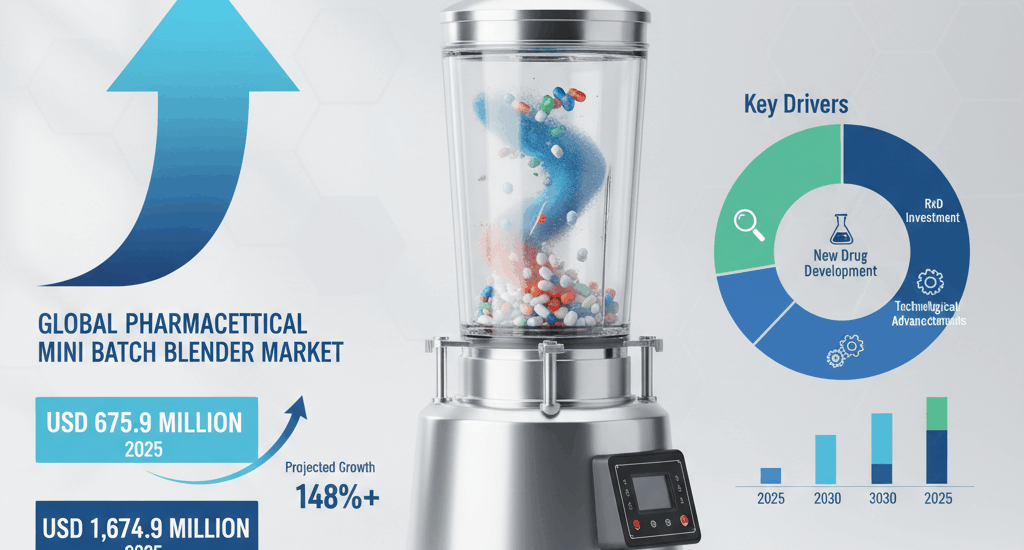
The global Pharmaceutical Mini Batch Blender Market is poised for a decade of robust expansion as pharmaceutical companies shift toward agile, small-scale, and patient-centric manufacturing models. According to recent industry analysis, the market is projected to increase from USD 675.9 million in 2025 to USD 1,674.9 million by 2035, achieving 147.8% growth and registering a CAGR of 9.5%. By the end of the forecast period, the market is expected to grow nearly 2.5X, reflecting the rapid rise in personalized medicine, specialty formulations, and clinical trial manufacturing.
Full Market Report available for delivery. For purchase or customization, please request here – https://www.futuremarketinsights.com/reports/sample/rep-gb-26950
Mini Batch Blending: The Future of Pharmaceutical Production
Pharmaceutical mini batch blenders are gaining preference in drug development because they enable precise mixing of small batches, offer superior containment, support frequent formulation changes, and meet regulatory compliance for cGMP environments. These systems are becoming indispensable in operations ranging from pilot runs and clinical sample production to specialty drug manufacturing.
In 2025, small batches production accounts for 64% of overall market demand. The shift from mass-production to focused, precision-based manufacturing has encouraged pharma companies and contract manufacturers to invest in equipment that supports efficient flexibility without compromising quality.
Established Leaders and New Entrants Drive Innovation
The market’s competitive landscape includes both global heavyweights and fast-emerging innovators:
- Gericke—recognized for its cGMP blending systems and powder processing expertise
- Servolift GmbH—a leader in containment, lifting, and integrated material handling
- AEC—offering advanced automation-ready pharmaceutical blending systems
- MUNSON—known for precision blenders for industrial and pharma applications
- Pharmag—specialized in small-scale and pilot manufacturing solutions
- Conta—focused on containment and clean material transfer
What makes the next decade exciting is the pace of technological advancement and market entry of new manufacturers, especially in Asia. Startups and regional players are developing equipment with digital process monitoring, automatic cleaning, Industry 4.0 integration, and reduced footprint designs, challenging long-standing global suppliers and accelerating healthy competition.
Mobile Blenders Lead Market Growth
By type, the mobile blender segment commands 58% of the market. The mobility of these systems enables manufacturers to shift units between production lines without costly facility reconfigurations—ideal for clinical trial batch production and rapid changeover environments.
Mobile blenders are especially preferred by biotechnology companies and CDMOs, which require exceptional agility across varying drug pipelines.
Why Demand Is Surging
Mini batch blenders are experiencing elevated adoption due to:
- Rising personalized and precision medicine developments
- Growth in high-value small batch drugs and orphan drug pipelines
- Increased investment in clinical trials and pilot-scale manufacturing
- Strong emphasis on validation compliance and documented blending performance
Even minor blending inconsistencies can impact drug stability and efficacy, making precision-controlled equipment a strategic investment for manufacturers.
High-Value Opportunity Pathways (2025–2035)
Several emerging growth avenues could unlock USD 350–450 million in new revenue for equipment manufacturers:
- Mobile blending leadership – USD 100–130M
- High-value formulations and potent APIs – USD 80–110M
- Personalized medicine manufacturing – USD 60–80M
- Continuous manufacturing integration – USD 50–70M
- Clinical trial manufacturing – USD 40–55M
- High-containment systems for oncology drugs – USD 30–45M
- Emerging market expansion – USD 25–35M
- Digital / IoT-enabled smart blenders – USD 15–25M
These pathways reflect a shift toward automation, smart data monitoring, and enhanced containment features—areas where both established manufacturers and new technology entrants are actively innovating.
Get Detailed Insights — Request PDF: https://www.futuremarketinsights.com/reports/brochure/rep-gb-26950
A Decade of Transformation
As the pharmaceutical sector accelerates toward flexibility, precision, and patient-specific therapies, mini batch blenders are becoming the backbone of modern drug production. Established manufacturers are enhancing automation and validation compliance, while new entrants are rapidly introducing cost-effective, compact systems tailored for emerging markets.
About Future Market Insights (FMI)
Future Market Insights, Inc. (ESOMAR certified, recipient of the Stevie Award, and a member of the Greater New York Chamber of Commerce) offers profound insights into the driving factors that are boosting demand in the market. FMI stands as the leading global provider of market intelligence, advisory services, consulting, and events for the Packaging, Food and Beverage, Consumer Technology, Healthcare, Industrial, and Chemicals markets. With a vast team of over 400 analysts worldwide, FMI provides global, regional, and local expertise on diverse domains and industry trends across more than 110 countries.
Contact Us:
Future Market Insights Inc.
Christiana Corporate, 200 Continental Drive,
Suite 401, Newark, Delaware – 19713, USA
T: +1-347-918-3531
For Sales Enquiries: sales@futuremarketinsights.com
Website: https://www.futuremarketinsights.com
LinkedIn| Twitter| Blogs | YouTube