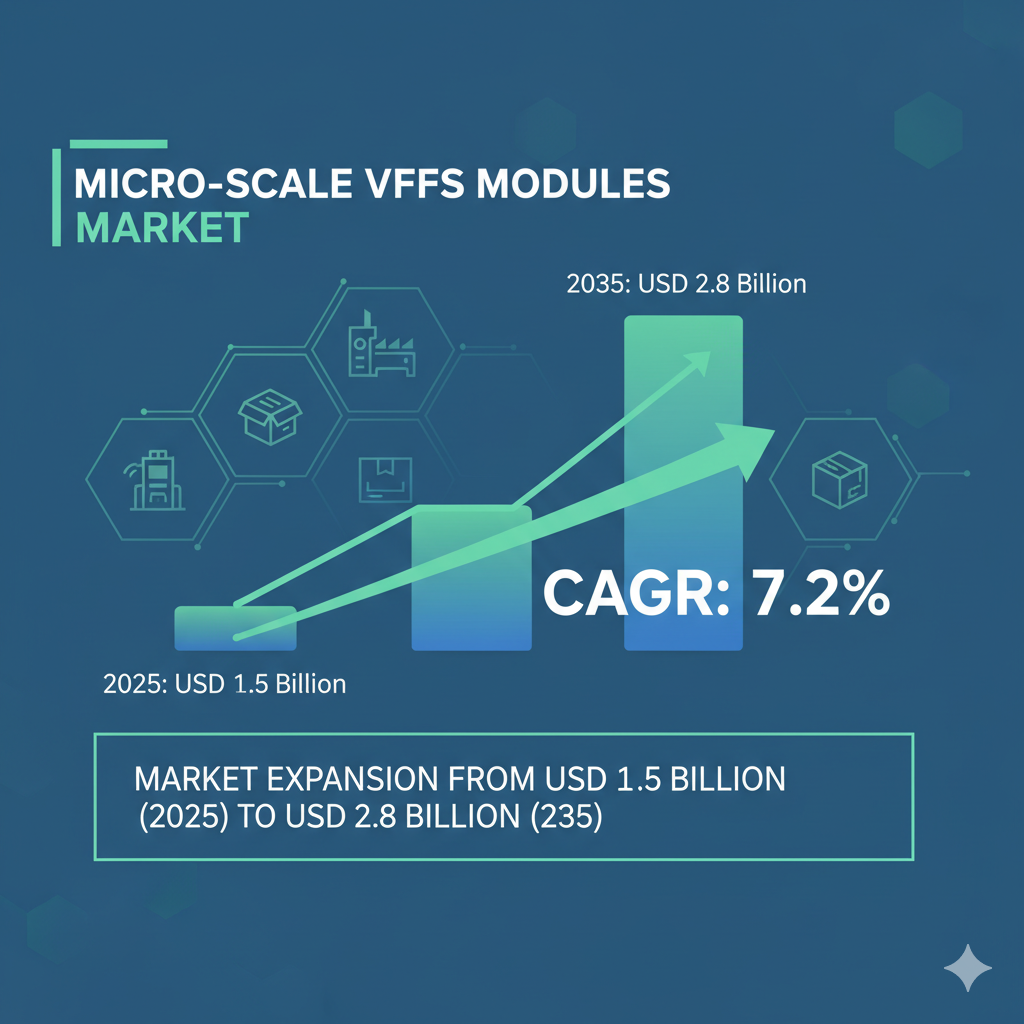
The global Micro-Scale VFFS Modules Market is set for robust expansion, rising from USD 1.5 billion in 2025 to USD 2.8 billion by 2035, according to the latest industry analysis. This growth represents a compound annual growth rate (CAGR) of 7.2%, fueled by surging demand for compact, automated packaging systems suited for small-batch and flexible production environments.
As manufacturers across the FMCG, healthcare, and cosmetics sectors modernize production lines, micro-scale VFFS modules have emerged as vital solutions. Their ability to deliver precision packaging in limited spaces is driving suppliers to rethink machinery design, material compatibility, and automation efficiency.
Get this Report at $5000 | Grab Your Market Insights Today: https://www.futuremarketinsights.com/reports/sample/rep-gb-27059
Compact Automation Defines the Next Packaging Era
From 2020 to 2024, the global packaging industry pivoted toward compact automation. Micro-scale VFFS technology enabled producers to meet fast-changing consumer demands for portion-control packaging, eco-friendly films, and high-output flexibility. By 2035, this miniaturization trend will culminate in smarter, modular VFFS systems embedded with advanced sensors, servo-drives, and predictive maintenance software.
Continuous motion systems currently dominate the market, holding 41.6% share in 2025. Their superior sealing accuracy, speed, and low downtime make them indispensable to food and pharmaceutical manufacturers seeking consistent performance. Upcoming integration with robotic feeding and remote monitoring tools is expected to redefine automation efficiency in small-scale production.
Material and Format Leaders: Laminated Films and Stick Packs
Laminated films remain the preferred packaging material, capturing 38.9% market share in 2025 due to their barrier strength and compatibility with heat and ultrasonic sealing. Meanwhile, the global transition to biodegradable films aligns with sustainability mandates, improving equipment utilization and energy efficiency.
Stick packs continue to dominate pouch types with 36.7% market share, favored for their convenience and portability in food, beverage, and nutraceutical applications. As consumer lifestyles adapt to on-the-go consumption, micro-VFFS modules producing stick, pillow, and 3-/4-side seal pouches will see accelerated adoption.
Food, Healthcare, and FMCG Drive Growth Momentum
The food and beverage sector leads end-use industries, representing 43.2% of the 2025 market. Rising demand for flexible packaging in snacks, powders, and liquids positions VFFS modules as integral to small-batch and multi-format production lines. By 2035, this segment will remain dominant, amplified by the FMCG industry’s push for sustainability and automation.
Between 2025 and 2030, micro-VFFS modules will add USD 0.6 billion in new revenue, primarily from FMCG and healthcare packaging. From 2030 to 2035, another USD 0.7 billion will emerge from cosmetics and nutraceutical packaging as mini-pouch formats expand.
Regional Outlook: Asia-Pacific Leads with Strong Adoption
The Asia-Pacific region, spearheaded by South Korea (7.6% CAGR), will be the fastest-growing hub for micro-scale VFFS modules. Local manufacturers are focusing on compact, energy-efficient production lines, boosted by smart factory policies and sustainability incentives.
- Japan is forecast to reach USD 200 million by 2025, with continuous motion modules taking a 41.4% share. Demand is aided by mini-dose packaging needs in food and pharmaceuticals.
- South Korea’s packaging material market—valued at USD 100 million in 2025—is led by laminated films (39.6%) and recyclable polyethylene, reflecting the country’s eco-driven production upgrades.
- India is set to grow at a 7.1% CAGR, targeting sachet-based packaging and automation for mid-scale FMCG operations.
- China maintains strong momentum from nutraceutical exports and e-commerce packaging automation, aligning with its “Made in Green” manufacturing roadmap.
Globally, the United States (7.3% CAGR), Germany (7.0%), and the United Kingdom (7.1%) are focusing on automation upgrades, digital quality control, and sustainability-driven material innovation. These nations are pioneering circular economy practices through recyclable films and IoT-enabled packaging lines.
Competitive Landscape: Innovation Fuels Consolidation
The micro-scale VFFS modules industry remains moderately consolidated with leading players such as Syntegon, Rovema, Matrix Packaging, BW Flexible Systems (Hayssen), Ilapak, PFM Packaging Machinery, Viking Masek, WeighPack Systems, Nichrome India, and Mespack.
Recent product innovations are reshaping industry standards:
- In July 2023, Syntegon launched its SVX Series, capable of producing up to 600 bags per minute on a compact dual-lane frame, integrated with its Synexio cloud-monitoring tool.
- In May 2024, Mespack debut its MLC Series, producing 2,400 sachets per minute using 16 parallel tracks—one of the fastest micro-VFFS models to date.
Competition is centered on speed, precision, modularity, and eco-film compatibility. As sustainability expectations rise, manufacturers—both established names and new entrants—are accelerating R&D investments to deliver intelligent modules with reduced footprint, advanced motion controls, and predictive diagnostics.
Access Exclusive Report Insights— Request PDF: https://www.futuremarketinsights.com/reports/brochure/rep-gb-27059
Toward a Smarter, Greener Packaging Future
By 2035, the integration of smart automation, eco-friendly films, and digitalized quality monitoring will define micro-scale packaging. As e-commerce, healthcare, and FMCG sectors continue to expand, manufacturers worldwide are positioned to upgrade their lines with energy-efficient, compact VFFS systems that combine speed, precision, and sustainability.
The decade ahead marks a transformative era for the micro-scale VFFS modules market—where innovation meets sustainability, and compact automation becomes the new cornerstone of global packaging excellence.
About Future Market Insights (FMI)
Future Market Insights, Inc. (ESOMAR certified, recipient of the Stevie Award, and a member of the Greater New York Chamber of Commerce) offers profound insights into the driving factors that are boosting demand in the market. FMI stands as the leading global provider of market intelligence, advisory services, consulting, and events for the Packaging, Food and Beverage, Consumer Technology, Healthcare, Industrial, and Chemicals markets. With a vast team of over 400 analysts worldwide, FMI provides global, regional, and local expertise on diverse domains and industry trends across more than 110 countries.
Contact Us:
Future Market Insights Inc.
Christiana Corporate, 200 Continental Drive,
Suite 401, Newark, Delaware – 19713, USA
T: +1-347-918-3531
For Sales Enquiries: sales@futuremarketinsights.com
Website: https://www.futuremarketinsights.com
LinkedIn| Twitter| Blogs | YouTube