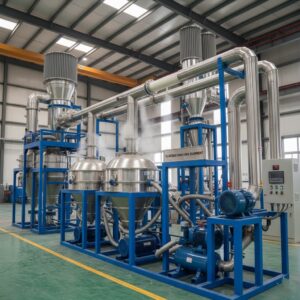
The global fluidized conveying equipment market is poised for steady expansion, projected to grow from USD 2,084.1 million 2025 to USD 3,084.9 million by 2035, at a CAGR of 4.0%. Growth is primarily driven by rising demand for efficient bulk material handling in sectors such as cement, chemicals, pharmaceuticals, and food processing. Early-stage growth is powered by automation investments and operational efficiency, while emerging economies will accelerate adoption in the later years of the forecast.
Report Coverage & Deliverables
This comprehensive market report covers:
- Market size and forecast from 2025 to 2035
- Peak-to-trough growth pattern analysis revealing phases of acceleration and stabilization
- Segmentation by capacity (Below 200 TPH, 200-400 TPH, 400+ TPH), application (cement, chemical, power, mining, food), and end-use (manufacturing plants, processing facilities)
- Regional analysis across North America, Europe, Asia-Pacific, Latin America, and Middle East & Africa
- Competitive landscape featuring key players like Bruks Siwertell, Vortex, Kemex, and Metso
- Market dynamics, challenges, and growth opportunities
- Strategic recommendations for stakeholders on design, automation, and integration
Key Factors Shaping Market Dynamics
- Automation & Efficiency: Investments in automated and smart conveying systems enhance operational efficiency and reduce downtime, fueling demand particularly in mature industrial regions.
- Capacity Preferences: Mid-range 200-400 TPH systems dominate due to optimal balance of throughput, reliability, and cost-effectiveness, meeting the bulk of industrial handling needs.
- Industry-Specific Demand: Cement industry leads with 36% market share, driven by modernization and emission control requirements. Chemical and pharmaceutical sectors require precision and contamination control, supporting steady equipment demand.
- Emerging Market Growth: Rapid industrialization and infrastructure projects in China and India foster significant market expansion post-2030, with local manufacturing and cost-effective solutions boosting adoption.
- Economic & Regulatory Influences: Short-term trough phases reflect production adjustments and economic fluctuations; regulatory compliance in regions like Europe demands premium, quality-assured equipment.
Key Takeaways
- The market value is forecasted to rise from USD 2.08 billion (2025) to USD 3.08 billion (2035), growing at a 4.0% CAGR.
- 200-400 TPH conveying systems hold the largest market share (48%), favored for their reliability and integration capabilities.
- Cement applications will continue to lead, with 36% market share and a robust CAGR of 5.8%, driven by production efficiency and automation adoption.
- Emerging economies, notably China (5.4% CAGR) and India (5.0% CAGR), are key growth drivers due to expanding industrial infrastructure and modernization efforts.
- Mature markets such as Germany and the United States maintain steady growth through technological leadership and advanced automation integration.
Regional Analysis
- China: Fastest growth at 5.4% CAGR, underpinned by aggressive industrial policies, domestic production incentives, and widespread adoption of automated fluidized conveying solutions in cement and chemical sectors.
- India: Growing at 5.0%, driven by government investment in industrial modernization, urban manufacturing hubs adopting advanced conveying systems, and increasing international collaborations.
- Germany: Steady 4.6% growth fueled by engineering excellence, premium automation systems, EU compliance, and integrated facility management solutions.
- Brazil: Expanding at 4.2% CAGR, supported by infrastructure projects and growing industrial sectors seeking cost-effective conveying equipment balancing performance with affordability.
- United States: Mature market growing at 3.8%, with strong industrial programs, established infrastructure, and broad adoption of automated fluidized conveying technologies in cement and chemical processing.
Key Segments of Market Report
By Capacity Range:
- Below 200 TPH: Holds 32% share, preferred for specialized, small-to-medium scale operations requiring flexible, cost-effective solutions.
- 200-400 TPH: Dominant segment with 48% share, favored for industrial-scale bulk handling balancing capacity and operational efficiency.
- 400+ TPH: Large-scale industrial applications capture 20%, serving high-demand cement plants, power generation, and mining operations.
By Application:
- Cement Industry: Leading application segment with 36% share and rapid growth due to modernization and smart conveying needs.
- Chemical Industry: 28% share, driven by pharmaceutical and precision powder handling requirements.
- Power Generation: 18% share, focusing on coal, ash, biomass handling, and environmental compliance systems.
- Mining & Metals: 12%, involving ore processing and mineral transport.
- Food Processing & Specialty Applications: Growing niche segments focusing on hygienic, contamination-free conveying solutions.
By End-Use:
- Manufacturing Plants: Lead demand generation with 5.2% CAGR due to consistent need for standardized, efficient material handling.
- Processing Facilities, Power Stations, Mining Operations, Construction Projects: Represent diversified demand sources reflecting the broad applicability of fluidized conveying technologies.
Conclusion & Strategic Recommendations
The fluidized conveying equipment market is characterized by a cyclical growth pattern with peaks driven by investment surges and troughs caused by operational adjustments. Long-term prospects remain strong, supported by ongoing industrial automation trends, capacity optimization efforts, and expanding adoption in emerging economies.
To capitalize on market opportunities, manufacturers and suppliers should:
- Prioritize operational efficiency in equipment design over raw capacity.
- Develop integrated solutions combining pneumatic systems, control units, filtration, and smart monitoring.
- Offer preconfigured automation workflows enabling predictive maintenance and real-time performance tracking.
- Align pricing models with value-based service tiers, including installation, maintenance, and digital monitoring subscriptions.
- Focus on regional customization to meet regulatory and operational requirements, especially in emerging markets with infrastructure growth.
This Report Now at Just $5000 | Limited-Time Discount Offer! https://www.futuremarketinsights.com/reports/sample/rep-gb-27298
Checkout Now to Access Industry Insights: https://www.futuremarketinsights.com/checkout/27298
About Future Market Insights (FMI)
Future Market Insights, Inc. (ESOMAR certified, recipient of the Stevie Award, and a member of the Greater New York Chamber of Commerce) offers profound insights into the driving factors that are boosting demand in the market. FMI stands as the leading global provider of market intelligence, advisory services, consulting, and events for the Packaging, Food and Beverage, Consumer Technology, Healthcare, Industrial, and Chemicals markets. With a vast team of over 400 analysts worldwide, FMI provides global, regional, and local expertise on diverse domains and industry trends across more than 110 countries.
Contact Us:
Future Market Insights Inc.
Christiana Corporate, 200 Continental Drive,
Suite 401, Newark, Delaware – 19713, USA
T: +1-347-918-3531
For Sales Enquiries: sales@futuremarketinsights.com
Website: https://www.futuremarketinsights.com
LinkedIn| Twitter| Blogs | YouTube