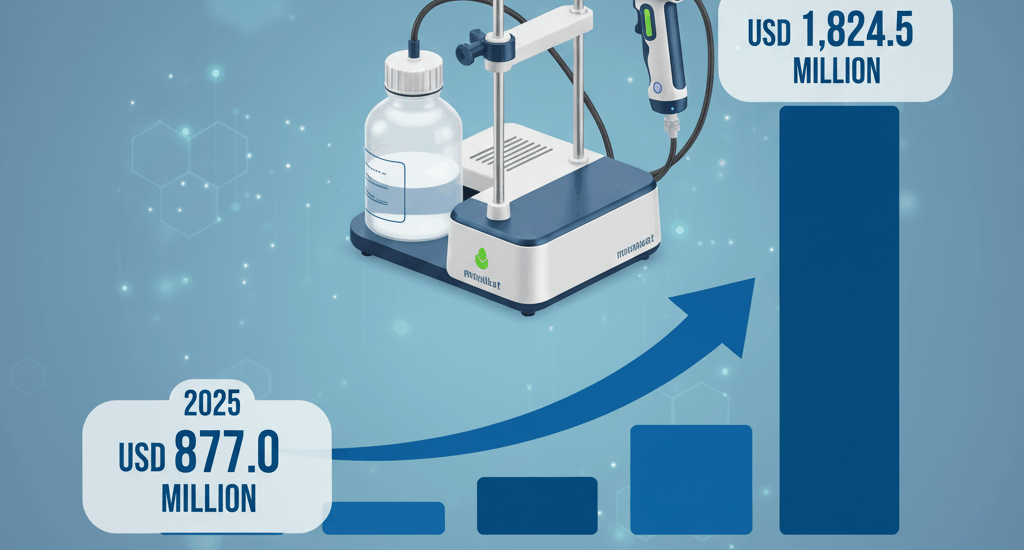
The global cell culture waste aspirator market is on a strong upward trajectory, growing from USD 877 million in 2025 to an estimated USD 1,824.5 million by 2035. With a robust compound annual growth rate (CAGR) of 7.6%, the market is fueled by rapid technological advancements, rising automation in biotechnology laboratories, and increasing demand for contamination-free workflows. The expansion is expected to create an absolute value gain of USD 947.5 million over the next decade.
Get this Report at $5000 | Claim Your Report at a Discount: https://www.futuremarketinsights.com/reports/sample/rep-gb-26398
Rapid Early Growth and Market Dynamics
Between 2025 and 2029, the market enters a decisive acceleration phase, driven by the widespread adoption of automated laboratory systems and an intensified focus on waste management, regulatory compliance, and contamination control. Manufacturers that introduce high-precision aspirators with digital interfaces, intelligent control systems, and ergonomic designs are capturing early momentum.
By 2030, the market transitions into a more measured growth phase. Maturity in developed regions, coupled with heightened competition, stabilizes expansion, though emerging economies – particularly in Asia-Pacific and Latin America – sustain strong demand due to expanding life sciences infrastructure. The steady shift toward energy-efficient, digitally integrated aspirators underscores the market’s focus on sustainable and scalable innovation.
Market Composition and Key Segments
Biopharmaceutical laboratories dominate with 38% of global demand, followed by academic and research institutions at 26%. These end-users rely on aspirators to maintain sterile culture environments and facilitate safe disposal of cell media and reagents. Clinical diagnostics laboratories account for 16% of applications, while industrial biotechnology facilities and contract research organizations represent 12% and 8%, respectively.
Low-flow aspirators (<10 L/min) lead the flow rate segment with a 40% share, preferred for gentle precision in biomedical R&D and small-scale lab operations. Medium-flow (10–20 L/min) and high-flow (>20 L/min) aspirators follow, reflecting use in larger or industrial setups.
Biomedical research remains the strongest growth segment, representing 45% of total market demand. These aspirators are crucial in drug discovery, stem cell research, and regenerative medicine. Major manufacturers such as Sartorius, Thermo Fisher Scientific, and Eppendorf are expanding portfolios to meet evolving laboratory automation requirements.
Opportunity Pathways for Market Expansion
Six opportunity pathways are shaping the decade ahead:
- Low-Flow Precision Systems (USD 200–300 million) – Serving delicate culture and contamination-sensitive operations in biomedical R&D.
- Biomedical R&D Expansion (USD 250–400 million) – Driven by cell therapy and regenerative medicine workflows.
- Digital and IoT-Enabled Aspirators (USD 150–250 million) – Incorporating predictive monitoring and data connectivity.
- Automation and Robotics Integration (USD 180–300 million) – Enhancing sterile fluid handling and workflow reproducibility.
- Asia-Pacific Infrastructure Growth (USD 250–400 million) – Stimulated by strong biotech investments in China and India.
- Clinical and Translational Diagnostics (USD 120–200 million) – Driven by labs seeking precision aspirators for high-throughput diagnostic environments.
These pathways mirror the increasing convergence of smart technologies, automation, and biosafety in laboratory ecosystems.
Regional Growth Leaders
Asia-Pacific leads global market momentum, with China growing at a CAGR of 10.3% and India at 9.5%, supported by government-backed biotech initiatives and industrial modernization. Germany and Brazil follow at 8.7% and 8%, primarily due to strong pharmaceutical R&D and biotech infrastructure. The United States grows at 7.2%, driven by continued federal support for biomanufacturing and lab automation, while Japan and the United Kingdom post moderate growth as mature domains adopt next-generation aspirators for efficiency and sustainability.
Across Europe, the market is set to rise from USD 311.9 million in 2025 to USD 614.8 million in 2035. Germany remains the key hub with nearly 28% of the regional share, followed by the UK and France. Growth across Italy, Spain, and the Netherlands is supported by laboratory modernization and a strong regulatory focus on biosafety.
Competitive Landscape
The market’s competitive ecosystem features both established and emerging players innovating to redefine operational efficiency and product usability. Leading companies include Rocker, Integra Biosciences, Research Products International, Chemglass Life Sciences, and Accuris Instruments.
- Rocker’s BENCHROCKER and CHEMcell systems emphasize gentle waste management with precision control.
- Integra Biosciences’ VACUSIP line stands out with its battery-powered mobility and low-noise design.
- Chemglass Life Sciences offers modular systems for in-house vacuum integration.
- Accuris Instruments continues to innovate with adjustable vacuum pressure and ergonomic, space-saving designs.
- Research Products International provides durable aspirators compatible with laboratory vacuum systems.
Collectively, these players are shaping a more automated, efficient, and environmentally responsible landscape for cell culture management.
Access In-Depth Market Analysis: https://www.futuremarketinsights.com/reports/brochure/rep-gb-26398
Future Outlook
The cell culture waste aspirator market is poised for continued transformation. Growing life sciences investments, rising focus on laboratory safety, and demand for contamination-free environments are propelling steady adoption worldwide. As integration with IoT platforms, robotics, and data analytics becomes standard, aspirator manufacturers are embracing a new era of laboratory precision and sustainability.
The decade ahead promises a blend of innovation, collaboration, and digitalization—ensuring that cell culture waste aspirators remain indispensable in modern biotechnology research and production.
About Future Market Insights (FMI)
Future Market Insights, Inc. (ESOMAR certified, recipient of the Stevie Award, and a member of the Greater New York Chamber of Commerce) offers profound insights into the driving factors that are boosting demand in the market. FMI stands as the leading global provider of market intelligence, advisory services, consulting, and events for the Packaging, Food and Beverage, Consumer Technology, Healthcare, Industrial, and Chemicals markets. With a vast team of over 400 analysts worldwide, FMI provides global, regional, and local expertise on diverse domains and industry trends across more than 110 countries.
Contact Us:
Future Market Insights Inc.
Christiana Corporate, 200 Continental Drive,
Suite 401, Newark, Delaware – 19713, USA
T: +1-347-918-3531
For Sales Enquiries: sales@futuremarketinsights.com
Website: https://www.futuremarketinsights.com
LinkedIn| Twitter| Blogs | YouTube