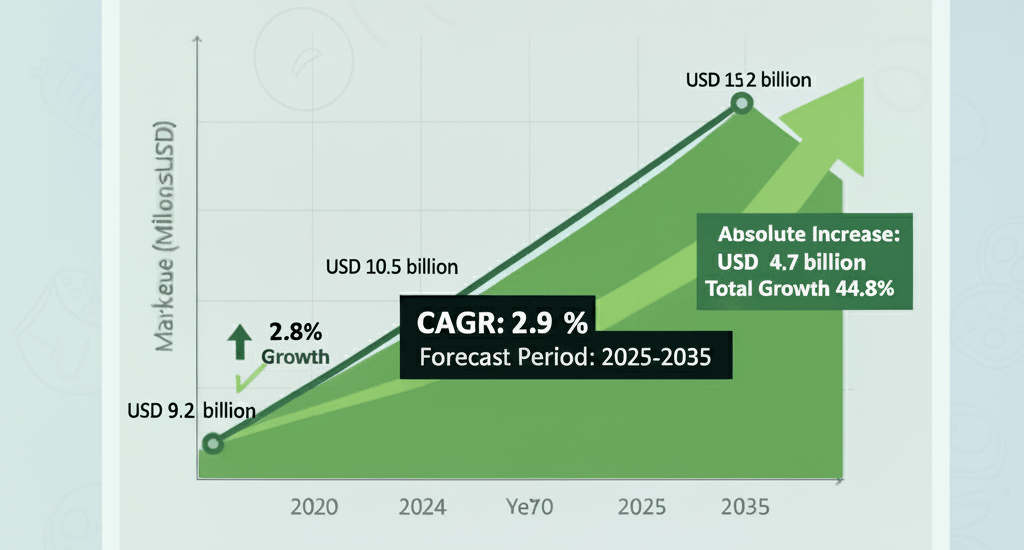
Future Market Insights (FMI), a leading provider of market intelligence and consulting services, today announced the publication of its latest comprehensive report, “Artificial Sweetener Market Size & Trends 2025-2035.” The demand for global Artificial Sweetener market is expected to be valued at USD 10.5 Billion in 2025, forecasted at a CAGR of 2.9% to have an estimated value of USD 15.2 Billion from 2025 to 2035. From 2020 to 2025 a CAGR of 2.8% was registered for the market.the report highlights how escalating concerns over obesity, diabetes, and calorie control are fueling demand for non-nutritive sweeteners (NNS) like aspartame, sucralose, and stevia. As consumers prioritize healthier lifestyles, this market is poised to transform the food and beverage sector, providing calorie-free alternatives without compromising taste, while addressing ongoing debates on long-term health impacts.
Artificial Sweetener Market Insights: Trends, Growth Drivers, Challenges, Opportunities, and Competitive Landscape:
The artificial sweetener market is experiencing steady expansion driven by shifting consumer behaviors and demographic trends. Key trends include a surge in demand for low-calorie and sugar-free products, with 40% of American consumers reducing sugar intake in the past year and 65% globally cutting back on sugary beverages, according to the International Food Information Council. Urbanization and rising health awareness are accelerating this shift, particularly in low- and middle-income countries where over 80% of diabetics reside, per the International Diabetes Federation. In 2025, 35% of global diabetics are substituting artificial sweeteners for sugar, underscoring their role in managing lifestyle diseases.
Growth drivers are predominantly health-related: the rising prevalence of obesity and diabetes is pushing consumers toward NNS, which offer sweetness without calories, tooth decay, or blood sugar spikes. The food and beverage industry is responding by integrating these sweeteners into sodas, desserts, and snacks, enhancing market penetration. Features like natural profiles and clean labels are further boosting adoption, especially in carbonated drinks where sugar reduction maintains flavor integrity.
However, challenges persist. Debates over health effects continue, with some studies linking artificial sweeteners to potential risks like cancer, obesity, and metabolic issues. Regulatory scrutiny from bodies like the FDA, which deems them safe in moderation, adds complexity. High production costs for certain sweeteners and consumer skepticism toward “artificial” ingredients could hinder growth in price-sensitive markets.
Opportunities abound for innovation. The report identifies potential in developing versatile, affordable sweeteners stable across pH and temperature levels, catering to diverse applications. Emerging markets in Asia and Africa offer untapped potential amid urbanization and westernized diets. Companies investing in R&D for functional foods—products offering health benefits beyond nutrition—can capitalize on weight management and blood sugar control trends.
The competitive landscape is tiered: Tier 1 players hold 40% market share with extensive portfolios and global reach, leveraging advanced technology for quality compliance. Tier 2 mid-sized firms command 50% through regional influence and regulatory adherence, while Tier 3 small-scale entities occupy 10% in niche, local markets. Strategies like mergers, facility expansions, and distribution agreements are key to gaining edges.
Artificial Sweetener Market Update: Evolving Debates and Regulatory Shifts:
The artificial sweetener sector has seen notable updates in 2025, reflecting both optimism and caution. In April, research from the American Physiological Society highlighted potential risks with erythritol, a popular sugar alcohol, suggesting it may impair blood vessel health, increase oxidative stress, and elevate heart attack risks. This followed a May study by the German Center for Diabetes Research (DZD), which found artificial sweeteners stimulate hunger signals in the brain, potentially countering their calorie-saving benefits.
July brought endocrine insights from ENDO 2025, linking sucralose and glycyrrhizin consumption to higher risks of early puberty in children, particularly boys. August’s Washington Post analysis affirmed sweeteners’ safety for Type 2 diabetes management but questioned their overall health superiority to natural options.
September marked a pivotal moment with a Neurology journal study, reported by CNN and The Guardian, associating low/no-calorie sweeteners with accelerated cognitive decline—equivalent to 1.6 years of brain aging—and worse outcomes for diabetics. Harvard Health and Medical News Today echoed these findings, noting faster memory and thinking declines with higher intake of aspartame and xylitol. While causation isn’t proven, these studies amplify calls for moderation and balanced diets rich in whole foods.
Regulatory responses include the UK’s ongoing programs to combat obesity through innovative low-sugar products, and FDA reviews emphasizing safe consumption limits. Despite these concerns, market projections from sources like Straits Research (CAGR 5.6% to USD 12.25 billion by 2033) and Mordor Intelligence (CAGR 4.8% to USD 5.17 billion by 2030) indicate resilience, driven by health trends. In the US, Renub Research forecasts growth to USD 3.25 billion by 2033 at 5% CAGR, with regional hotspots in California and Texas.
Artificial Sweetener Market Applications: Unlocking Value Across Sectors:
Businesses in food and beverages, which hold 40% market share, can leverage the report’s insights to reformulate products like carbonated drinks and condiments, reducing sugar without sacrificing appeal—ideal for meeting clean-label demands. Dairy, bakery, and confectionery sectors benefit from aspartame’s dominance (50% share in 2025), using its 200x sweetness intensity for gums and sugar-free treats, enhancing palatability and shelf stability.
Pharmaceuticals and dietary supplements gain from NNS in low-calorie formulations for weight management and diabetes control, while personal care applications explore sweeteners in oral products for non-cariogenic benefits. The report’s country-wise forecasts—US and UK at 2.4% CAGR, China at 3.2%—guide targeted expansions, such as in North America’s dominant consumption or China’s urbanization-driven demand for western-style low-sugar goods.
Manufacturers can optimize supply chains with production, import/export stats, and attractiveness analyses, while investors identify high-growth segments like sucralose for versatile pH stability.
Artificial Sweetener Key Players Shaping the Market:
Leading manufacturers include DuPont, Tate & Lyle PLC, Cargill, Incorporated, Archer Daniels Midland Company, Ajinomoto Co., Inc., Nestlé S.A., Ingredion Incorporated, Wilmar International Limited, JK Sucralose, and Roquette Freres. These innovators are focusing on calorie-free alternatives for diabetes and obesity, investing in R&D for blood sugar-neutral flavors.
Full Market Report available for delivery. For purchase or customization, please request here: https://www.futuremarketinsights.com/checkout/95
Request for Discount: https://www.futuremarketinsights.com/reports/sample/rep-gb-95
Artificial Sweetener Recent Developments in the Market:
Beyond health studies, 2025 has witnessed product launches and partnerships. In October, FMI’s US Sweetener Market report projected USD 3.7 billion in 2025 at 5.4% CAGR, emphasizing regional adoption. Persistence Market Research’s October update on broader sweeteners forecasted USD 157.5 billion by 2032 at 4.7% CAGR, highlighting natural-artificial blends. Statista noted global sweeteners at USD 207.53 billion in 2025, with 7.65% annual growth.
Innovations include Tate & Lyle’s expanded sucralose facilities in Asia and Cargill’s clean-label NNS for beverages. Amid debates, the industry pushes transparency, with Ajinomoto emphasizing FDA-approved safety in marketing campaigns.
Explore More Related Studies Published by FMI Research:
Decaffeinated Coffee Market- https://www.futuremarketinsights.com/reports/decaffeinated-coffee-market
Royal Jelly Market- https://www.futuremarketinsights.com/reports/royal-jelly-market
Coffee Extracts Market- https://www.futuremarketinsights.com/reports/coffee-extracts-market
About Future Market Insights (FMI)
Future Market Insights, Inc. (ESOMAR certified, recipient of the Stevie Award, and a member of the Greater New York Chamber of Commerce) offers profound insights into the driving factors that are boosting demand in the market. FMI stands as the leading global provider of market intelligence, advisory services, consulting, and events for the Packaging, Food and Beverage, Consumer Technology, Healthcare, Industrial, and Chemicals markets. With a vast team of over 400 analysts worldwide, FMI provides global, regional, and local expertise on diverse domains and industry trends across more than 110 countries.
Contact Us:
Future Market Insights Inc.
Christiana Corporate, 200 Continental Drive,
Suite 401, Newark, Delaware – 19713, USA
T: +1-347-918-3531
For Sales Enquiries: sales@futuremarketinsights.com
Website: https://www.futuremarketinsights.com
LinkedIn| Twitter| Blogs | YouTube