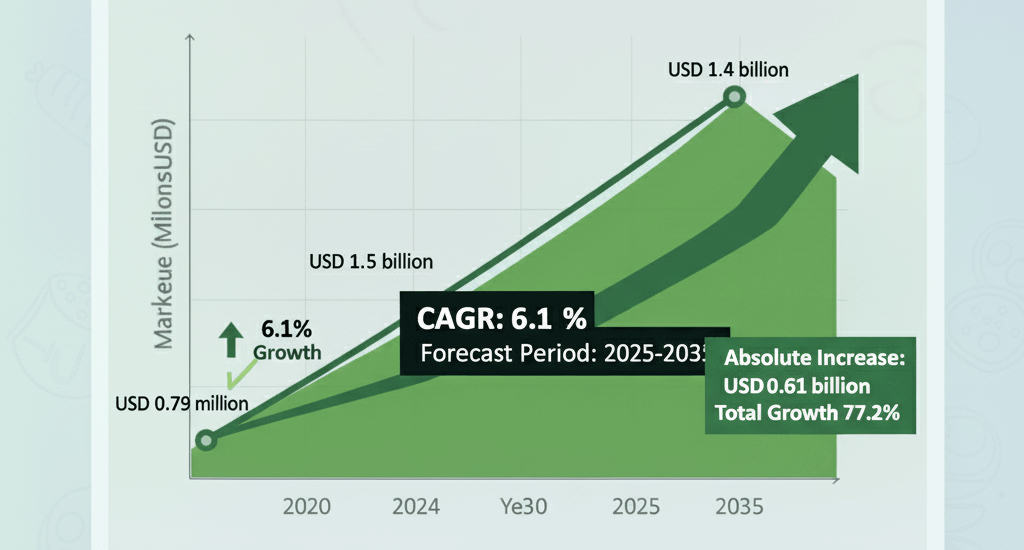
Future Market Insights (FMI), a leading provider of market intelligence and consulting services, today announced the publication of its latest comprehensive report, “Alcohol Use Disorder Treatment Market Size & Share 2025-2035.” AUD Treatment industry will expand immensely in 2025 to 2035 as a result of growing awareness of mental disease, improving addiction treatment, and advocacy by governments for alcohol treatment programs. The market is anticipated to go from USD 0.79 billion in 2025 to USD 1.4 billion. CAGR in 2035 for the given forecast period will be 6.1%.The report highlights the escalating demand for innovative treatments amid rising awareness of mental health issues, government advocacy, and technological advancements in addiction care. As alcohol dependency continues to affect millions worldwide, this report provides critical insights for stakeholders to navigate emerging opportunities and address persistent challenges in this vital healthcare sector.
AUD Treatment Market Insights: Trends, Drivers, Challenges, Opportunities, and Competitive Landscape:
The AUD treatment market is undergoing a transformative phase, driven by a confluence of societal, technological, and policy factors. Key trends include the integration of artificial intelligence (AI) in personalized treatment protocols, the rise of digital therapeutics such as tele-psycho-counseling and mobile apps for relapse prevention, and a shift toward medication-assisted treatment (MAT) combined with behavioral therapies. The report underscores how growing awareness of alcohol-related mental and physical health impacts is fueling demand, particularly in regions with high alcohol consumption rates.
Growth drivers are multifaceted. Increasing alcohol dependency and substance abuse disorders have necessitated advanced pharmacological options like naltrexone, disulfiram, and acamprosate, alongside evidence-based therapies such as cognitive behavioral therapy (CBT) and motivational enhancement therapy (MET). Government initiatives, including public education campaigns, expanded insurance coverage for addiction treatment, and investments in rehabilitation facilities, are central to this momentum. For instance, in North America, policies like the U.S. Affordable Care Act have boosted access to inpatient rehab and telemedicine, while Asia-Pacific nations are rapidly adopting tech-driven interventions to reach underserved populations.
However, the market faces notable challenges. Stigma surrounding AUD discourages timely treatment-seeking, while limited healthcare access in emerging economies, high treatment costs, and regulatory hurdles for new drugs impede progress. Relapse rates remain high due to non-adherence, and psychosocial barriers exacerbate these issues. Despite these obstacles, opportunities abound. Advances in MAT, including extended-release formulations and novel drug delivery systems, promise improved efficacy. The expansion of digital health solutions—such as AI-based monitoring and wearable biosensors—enhances patient engagement and accessibility, particularly in remote areas. Additionally, public-private partnerships and investments in low-cost programs are set to democratize treatment, fostering sustainable growth.
The competitive landscape is dynamic, with pharmaceutical giants and specialized firms vying for dominance. North America leads with a robust ecosystem of policies and innovations, while Asia-Pacific emerges as the fastest-growing region due to rising mental health awareness and government-backed programs. The report provides a detailed segmentation analysis by disorder type (alcohol abuse, dependence, addiction, and alcoholism) and treatment type (medication, therapy, and multidisciplinary approaches), offering granular insights into market dynamics.
AUD Treatment Market Update: Evolving Landscape and Future Projections:
From 2020 to 2024, the AUD treatment industry witnessed historic shifts, accelerated by the global pandemic’s impact on mental health. Governments expanded funding and insurance for AUD treatments, while telehealth adoption surged to overcome access barriers. Pharmaceutical companies ramped up production of FDA-approved medications, and hybrid models blending in-person and virtual therapies gained traction. Market growth was propelled by heightened awareness of AUD’s health consequences, leading to increased demand for integrated recovery programs incorporating mindfulness, nutritional therapy, and peer support.
Looking ahead to 2025-2035, the industry is on the cusp of revolutionary changes. The report forecasts a pivot toward precision medicine, AI-optimized diagnostics, and patient-tailored plans informed by genetic and neurobiological research. Policies will mandate universal access to MAT and digital interventions, with large-scale investments in generic drugs and sustainable formulations enhancing affordability. Production dynamics will prioritize scalable, region-specific supply chains, while end-user trends favor home-based models, mobile health apps, and AI-driven tools. Environmental sustainability in pharmaceutical manufacturing and public-private collaborations will further define the era, ensuring broader treatment equity. Comparative analysis in the report illustrates this evolution: regulatory landscapes shifting from expanded funding to mandatory access, technological advancements from telehealth to wearable biosensors, and growth drivers from awareness campaigns to AI integration.
AUD Treatment Market Applications: Leveraging Insights for Business and Healthcare Advancement:
This report is an invaluable resource for diverse industries and businesses. Pharmaceutical companies can use the findings to refine R&D strategies, focusing on innovative formulations like long-acting injectables and AI-assisted therapies to capture market share. Rehabilitation centers and mental health providers will benefit from insights into multidisciplinary models, enabling them to optimize programs for higher recovery rates and patient retention. Policymakers and governments can draw on regional trends to design targeted initiatives, such as expanding detox centers in high-prevalence areas like Asia-Pacific or enhancing insurance in North America.
For investors, the report highlights high-growth segments like alcohol dependence treatment, projected to lead due to rising demand for MAT and digital solutions. Tech firms in digital health can explore opportunities in AI-powered apps and telemedicine, bridging gaps in underserved regions. Overall, businesses across healthcare, insurance, and wellness sectors can apply these insights to foster innovation, improve outcomes, and drive revenue in a market ripe for expansion.
AUD Treatment Key Players Shaping the Market:
The report features a detailed competitive outlook, with market share analysis revealing Alkermes plc holding 14-18%, followed by Pfizer Inc. (10-14%), Novartis AG (8-12%), Teva Pharmaceutical Industries Ltd. (7-11%), and Indivior PLC (5-9%). Other key players, comprising 40-50% combined, include Otsuka Pharmaceutical Co., Ltd., Eli Lilly and Company, AbbVie Inc., Braeburn Pharmaceuticals, and H. Lundbeck A/S. These companies are advancing the field through offerings like Alkermes’ Vivitrol for craving reduction, Pfizer’s AI-integrated platforms, and Teva’s affordable generics.
Full Market Report available for delivery. For purchase or customization, please request here: https://www.futuremarketinsights.com/checkout/16418
Request for Discount: https://www.futuremarketinsights.com/reports/sample/rep-gb-16418
AUD Treatment Recent Developments in the Market:
Recent advancements underscore the market’s innovative trajectory. In December 2024, recovery programs increasingly embraced MAT, combining therapies with medications like naltrexone to curb cravings, as highlighted by Oar Health. By July 2025, digital health adoption accelerated, with telemedicine and online support groups gaining prominence, per ResearchAndMarkets. Emerging pharmacological targets, such as somatostatin-based therapies, were explored in a 2025 ScienceDirect review, promising new management options. Additionally, U.S. statistics from the 2023 NSDUH (updated in 2025) showed 73,000 youth receiving treatment, signaling progress in early intervention. Market reports from 2025, including those from Research Nester and IMARC Group, confirm upward revisions in projections, driven by targeted therapies and clinical pipelines.
Explore More Related Studies Published by FMI Research:
Placental Growth Factors Market- https://www.futuremarketinsights.com/reports/placental-growth-factors-market
Burn Matrix Devices Market – https://www.futuremarketinsights.com/reports/burn-matrix-devices-market
Engineered Cell Therapy Market – https://www.futuremarketinsights.com/reports/engineered-cell-therapy-market
About Future Market Insights (FMI)
Future Market Insights, Inc. (ESOMAR certified, recipient of the Stevie Award, and a member of the Greater New York Chamber of Commerce) offers profound insights into the driving factors that are boosting demand in the market. FMI stands as the leading global provider of market intelligence, advisory services, consulting, and events for the Packaging, Food and Beverage, Consumer Technology, Healthcare, Industrial, and Chemicals markets. With a vast team of over 400 analysts worldwide, FMI provides global, regional, and local expertise on diverse domains and industry trends across more than 110 countries.
Contact Us:
Future Market Insights Inc.
Christiana Corporate, 200 Continental Drive,
Suite 401, Newark, Delaware – 19713, USA
T: +1-347-918-3531
For Sales Enquiries: sales@futuremarketinsights.com
Website: https://www.futuremarketinsights.com
LinkedIn| Twitter| Blogs | YouTube