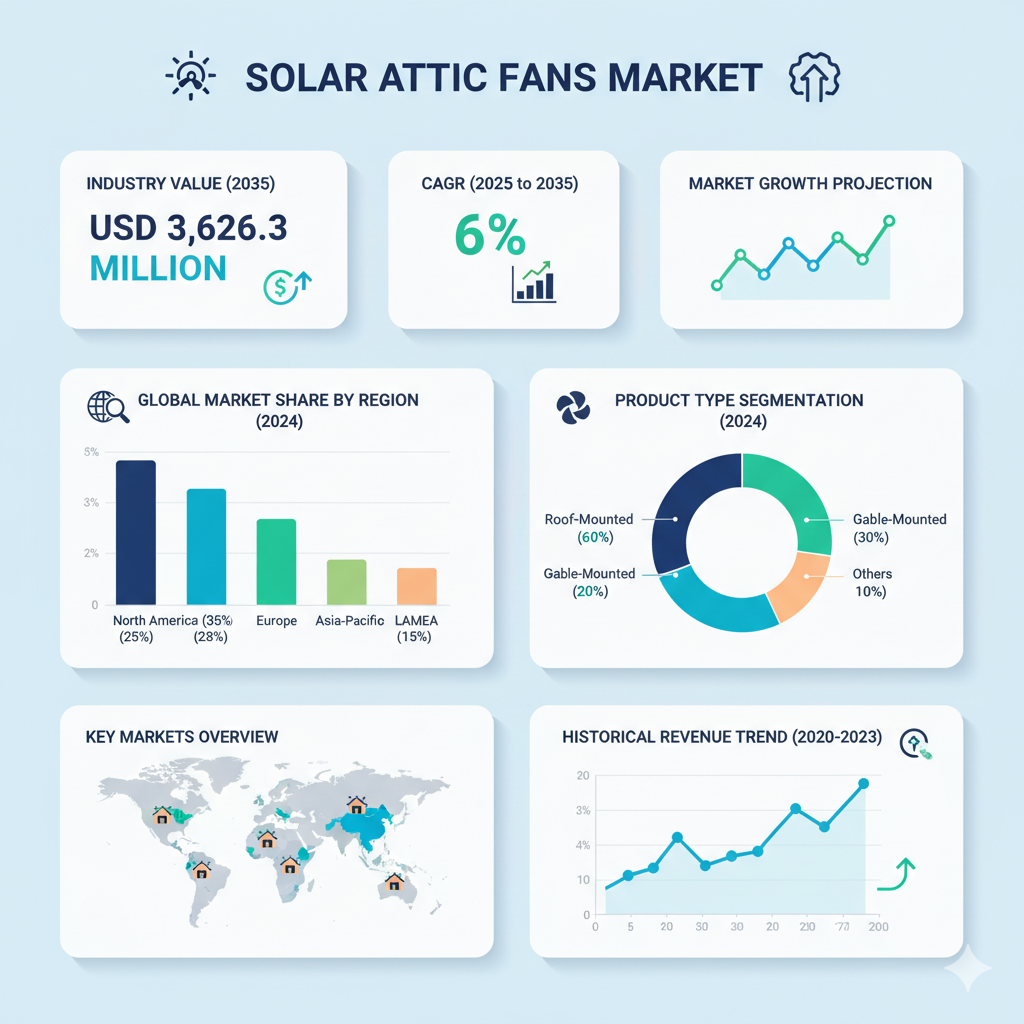
The global solar attic fans market is entering a new era of growth and innovation, opening up major opportunities for both established manufacturers and ambitious new entrants. With a projected value surge from USD 2,024.9 million in 2025 to approximately USD 3,626.3 million by 2035—representing a CAGR of around 6 %—the sector is set to redefine energy-efficient ventilation solutions worldwide.
Established Manufacturers Lead with Innovation
Leading manufacturers are doubling down on research and technological advancement to strengthen their competitive edge. These companies are leveraging advanced solar technologies, strong global supply chains, and diverse product portfolios to meet the increasing demand for sustainable ventilation systems.
Key strategies driving their market expansion include:
- High-Efficiency Solar Panels: Adoption of monocrystalline and PERC cell technologies that deliver optimal energy conversion, even under variable sunlight conditions.
- Smart Automation: Integration of intelligent thermostats and humidity sensors that regulate fan speed and operation in real time, improving comfort and energy savings.
- Strategic Expansion: Partnerships, mergers, and acquisitions aimed at reaching untapped markets in residential, commercial, and industrial sectors.
- Durable Design: A shift toward lightweight, corrosion-resistant materials like aluminum that enhance longevity and recyclability.
For these established players, the road ahead involves strengthening research and development, expanding into high-growth regions such as Asia-Pacific and Latin America, and embracing automation to remain at the forefront of technological advancement.
New Entrants Capture Regional Opportunities
While the market is dominated by major global brands, new and regional manufacturers are making rapid progress by offering cost-effective and innovative solutions. These emerging companies are capitalizing on key market drivers such as rising awareness of energy efficiency, affordable product ranges, and supportive government policies.
Their advantages include:
- Affordable Retrofits: Development of solar attic fans suitable for older residential buildings, particularly in regions with strong energy-efficiency mandates.
- Policy Support: Government incentives and rebates—such as tax credits in the United States and energy subsidies in Europe and Asia—making solar ventilation more accessible to consumers.
- Popular Mid-Range Products: Rising demand for 20–50 W solar attic fans, which offer the ideal balance of power efficiency and affordability for most households.
- Localized Strategies: Regional manufacturers gain traction by producing locally, reducing import costs, and tailoring solutions to local climate and building codes.
For new entrants, the next step is scaling wisely—investing in differentiated product lines such as hybrid solar-electric systems, developing smart features for automated performance, and partnering with local distributors to boost market reach.
Technology and Sustainability at the Core
Across the industry, innovation and sustainability are reshaping the market landscape. The latest generation of solar attic fans is not only energy-efficient but also integrates seamlessly with broader smart home ecosystems. The trend is clear—ventilation is becoming smarter, cleaner, and more connected.
Additional trends include:
- Retrofit Market Growth: Homeowners and businesses are upgrading existing structures with solar attic fans to reduce HVAC costs, extend roof life, and enhance air quality.
- Material Preference: Aluminum continues to dominate due to its lightweight, rust-resistant, and fully recyclable nature, accounting for nearly half of the material share.
- Design Evolution: Roof-mounted fans remain the preferred choice, holding over half of the market share thanks to their optimal exposure to sunlight and universal installation compatibility.
Strategic Takeaways for Manufacturers
- For Industry Leaders: Invest heavily in next-generation solar panel technologies, expand regional manufacturing capabilities, and integrate after-sales services to boost customer satisfaction and long-term profitability.
- For Emerging Players: Target niche markets, leverage cost-efficient production, and focus on product modularity to meet diverse power requirements. Emphasize compliance with local energy standards and incentive programs.
- For All Market Participants: Sustainability and innovation must guide every decision—using recyclable materials, reducing carbon footprints, and offering low-maintenance, durable designs are no longer optional but essential.
Outlook: A Market Ready for Expansion
As global urbanization accelerates and governments tighten building efficiency regulations, solar attic fans are transitioning from niche products to mainstream ventilation solutions. The anticipated growth to USD 3.6 billion by 2035 reflects not only strong consumer demand but also a collective industry push toward cleaner, renewable-powered technologies.
The next decade will belong to manufacturers—both established and emerging—who can innovate responsibly, scale sustainably, and deliver smart, energy-efficient solutions to an increasingly eco-conscious world. The solar attic fans market is ready for transformation, and the stage is set for those prepared to lead it.
About the Report
The Solar Attic Fans Market Growth – Trends, Demand & Innovations 2025–2035 report by Future Market Insights provides an in-depth analysis of global market trends, key growth drivers, competitive dynamics, and emerging opportunities across product types, materials, capacities, applications, and regions.