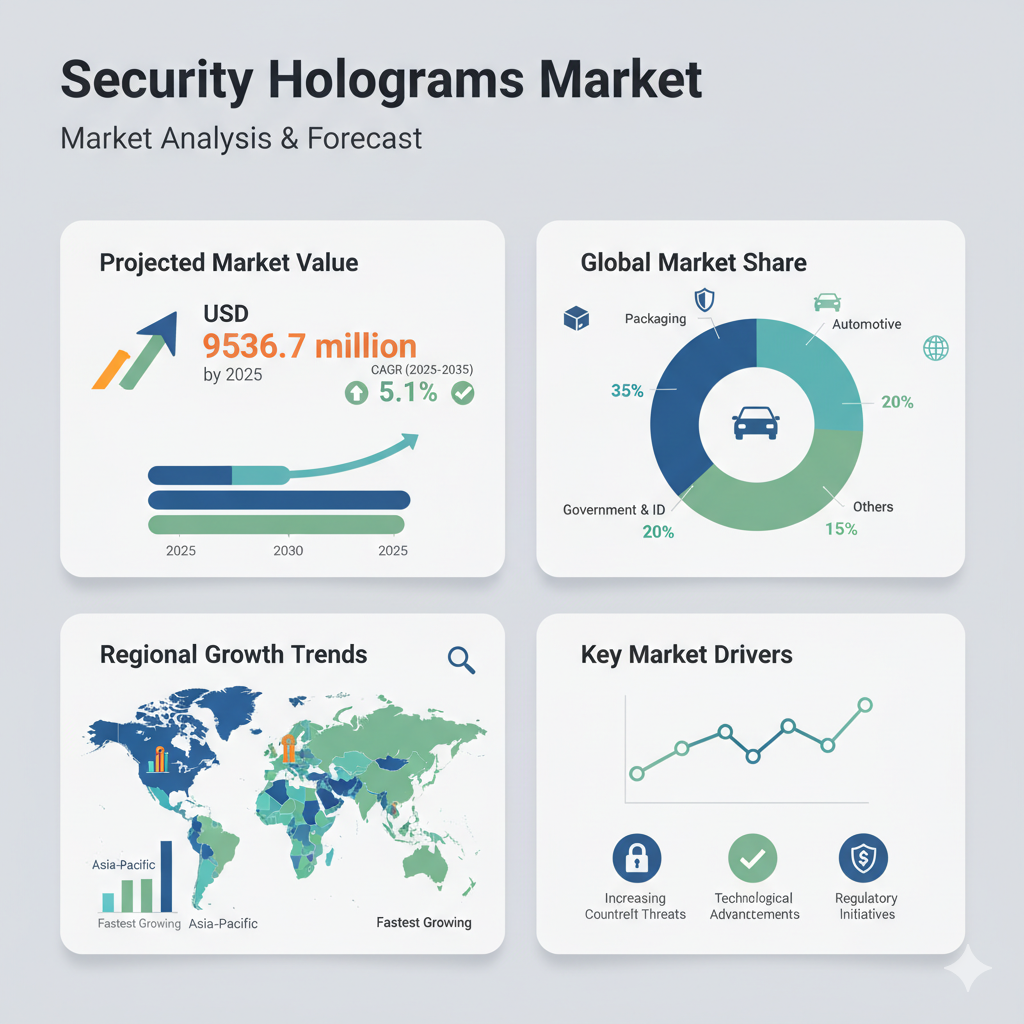
The global security holograms market is entering a transformative period marked by rapid innovation, technological integration, and expanding opportunities for both established players and emerging manufacturers. Recent industry analysis projects the market to reach approximately USD 9.5 billion by 2035, registering a compound annual growth rate (CAGR) of around 5.1% between 2025 and 2035.
This surge reflects a worldwide push for enhanced anti-counterfeiting solutions and the growing emphasis on brand protection across industries such as pharmaceuticals, consumer goods, electronics, and government documentation.
Established Leaders Strengthen Their Technological Edge
Leading manufacturers such as De La Rue plc, Holostik India Ltd., and the KURZ Group continue to shape the direction of the security holograms industry. These companies have invested heavily in advanced optical technologies, high-precision manufacturing, and material innovations designed to improve the security, durability, and sustainability of their products.
De La Rue has been integrating artificial intelligence and mobile-based authentication tools to modernize holographic validation systems. KURZ’s latest holographic elements now combine color-shifting designs and motion-based optical effects to deliver heightened resistance against tampering. Meanwhile, Holostik has introduced “phygital” holograms — physical-digital hybrids that blend nano-optical security patterns with embedded track-and-trace codes — offering end-to-end transparency and brand protection.
For these established players, the focus is not only on strengthening existing product lines but also on redefining what holographic security can achieve in a digitally connected world.
Emerging Players Find New Growth Pathways
Alongside market leaders, a new generation of manufacturers is making a mark by focusing on agility, innovation, and regional adaptability. Smaller firms are entering the field with modular technologies, customizable solutions, and cost-efficient production methods that appeal to local packaging and consumer goods sectors.
These companies are particularly active in high-growth regions such as Asia-Pacific, which is projected to hold the largest market share by 2035. With rising concerns about counterfeit products and stricter government regulations on product authentication, emerging firms are capitalizing on new business opportunities through strategic collaborations and localized supply chains.
Technology at the Heart of Transformation
The next decade of growth in the security holograms market will be defined by convergence — the blending of physical security with digital intelligence. Manufacturers are increasingly incorporating technologies such as blockchain, the Internet of Things (IoT), and artificial intelligence (AI) into their holographic systems.
These integrations enable real-time verification, tamper-proof data recording, and seamless consumer interaction. For example, a single hologram could soon contain both visual authentication elements and encrypted digital identifiers that allow instant verification via smartphone. This fusion of physical and digital authentication is expected to revolutionize how consumers and businesses ensure product integrity.
Sustainability has also emerged as a central theme. Leading producers are experimenting with biodegradable substrates, recyclable films, and solvent-free production methods, aligning with global efforts toward environmental responsibility.
Drivers of Market Expansion
Several factors are fueling the rapid growth of the security holograms market:
- Escalating Counterfeiting Threats – The proliferation of counterfeit products across industries is pushing brands and governments to adopt advanced security features, making holograms an indispensable safeguard.
- Regulatory Enforcement – Governments worldwide are mandating secure packaging, excise stamps, and digital tracking on critical products, boosting demand for high-security holographic solutions.
- Technological Advancements – The introduction of nanostructured imaging, laser interference lithography, and AI-powered inspection systems is enhancing both the functionality and visual complexity of holograms.
- Consumer Awareness – With consumers increasingly prioritizing authenticity and transparency, brands are leveraging holograms as visible trust marks that reinforce product credibility.
The Road Ahead for Manufacturers
The evolving market landscape offers abundant opportunities for both established corporations and emerging innovators. To stay competitive, manufacturers are encouraged to focus on:
- Investing in R&D to develop multi-layered holographic technologies that integrate physical and digital authentication.
- Adopting sustainable materials and eco-friendly production techniques that align with international environmental standards.
- Expanding globally through regional partnerships, especially in markets with high counterfeit prevalence.
- Building end-to-end security ecosystems by collaborating with software developers, packaging firms, and supply-chain specialists.
As security holograms evolve from visual deterrents into smart authentication systems, the boundary between physical protection and digital assurance will continue to blur. The future of the market lies not only in producing eye-catching holograms but in creating intelligent, data-driven systems that connect products, brands, and consumers through trust and transparency.
About the Report
The Security Holograms Market Share Analysis provides comprehensive insights into global market dynamics, technological trends, and competitive strategies shaping the future of the holographic security industry. The report covers detailed forecasts, regional performance analysis, and profiles of leading as well as emerging manufacturers through 2035.