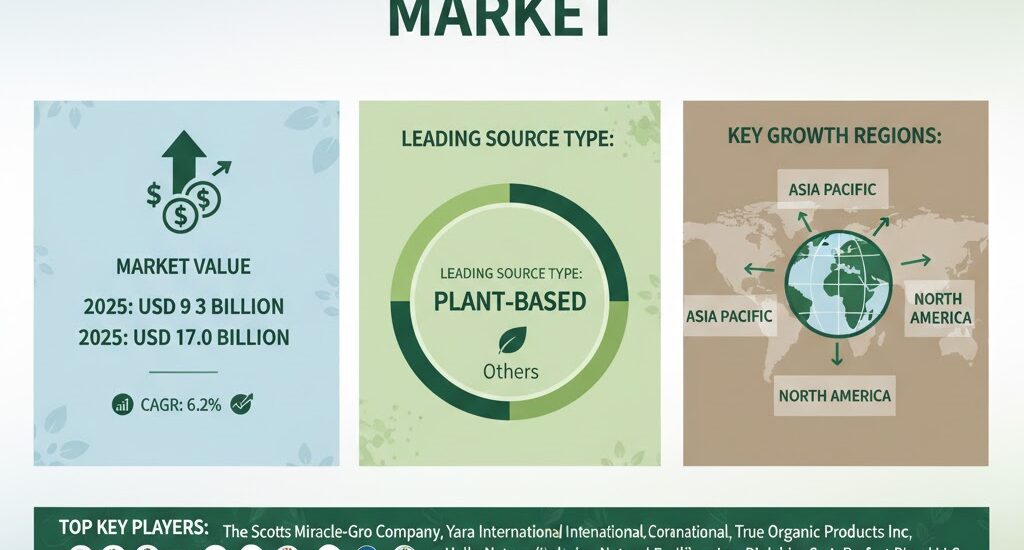
The global organic fertilizer market is poised for robust expansion, projected to grow from USD 9.3 billion in 2025 to USD 17.0 billion by 2035, reflecting a 6.2% CAGR. This marks an absolute increase of USD 7.7 billion, driven by the global shift toward eco-friendly agriculture, regenerative farming, and soil health enhancement. Future Market Insights identifies the decade ahead as a pivotal phase for manufacturers, offering opportunities to align with sustainability mandates while meeting escalating global food demand.
The organic fertilizer sector is forecast to grow nearly 1.8 times in size over the next ten years, as farming communities, agri-input companies, and governments collectively push toward climate-resilient and biologically enriched production systems. However, maintaining supply consistency and managing the price gap compared to synthetic fertilizers remain crucial challenges.
Manufacturers at the Forefront of Green Transformation
Manufacturers in the agricultural sector face a defining moment. With consumers increasingly demanding chemical-free produce and governments enforcing stricter environmental regulations, organic fertilizers are emerging as indispensable components of modern farming systems. Farmers utilizing organic nutrients experience 15–25% improvement in soil organic matter, directly translating to long-term productivity and farm resilience.
From 2025 to 2030, the market will expand from USD 9.3 billion to USD 12.8 billion, fueled by investments in organic processing technologies, precision application systems, and regenerative soil programs. The following five years (2030–2035) are projected to add another USD 4.2 billion in market value, emphasizing advanced composting, biostimulant integration, and crop-specific organic formulations that maximize efficiency and sustainability.
Plant-Based Organic Fertilizers Lead Market Transformation
Among all product categories, plant-based organic fertilizers command a 49% share of the market in 2025, making them the dominant source type. These formulations—ranging from composted plant matter and green manure to seaweed and algal extracts—deliver superior nutrient balance and microbial enrichment while supporting circular economy models.
Their key advantages include:
- Renewable and low-impact sourcing
- High carbon sequestration potential
- Enhanced microbial diversity for improved soil structure
- Compatibility with vegan and eco-certified farming systems
The animal-based segment follows with a 38% share, valued for nutrient density and rapid soil response, while mineral/organic-mineral fertilizers represent the remaining 13%, catering to specific soil deficiencies.
Buy Now & Save: Premium Market Report at $5,000 | Discount Details Inside :- https://www.futuremarketinsights.com/reports/sample/rep-gb-1948
Dry Formulations Dominate Global Adoption
By form, dry organic fertilizers hold approximately 63% of the market in 2025. These products—granules, pellets, and composted solids—offer stability, ease of transport, and scalability, making them the preferred choice for large-scale and mechanized farming. Liquid organic fertilizers account for the remaining 37%, gaining popularity in greenhouse horticulture and fertigation systems due to their rapid uptake and precision control.
For manufacturers, this segmentation reveals two critical innovation paths:
- Dry systems for broad-acre crops with extended shelf life and mechanized compatibility.
- Liquid systems for high-value horticultural crops requiring targeted nutrient delivery.
Regional Growth Drivers and Opportunities
Asia Pacific Leads the Expansion
Asia Pacific dominates the growth trajectory, with India (7.3% CAGR) and Vietnam (7.1% CAGR) emerging as global leaders. India’s government-backed programs such as the PM-PRANAM scheme and its nationwide organic farming missions drive fertilizer adoption through 30–50% input subsidies and infrastructure investment in composting and manure processing.
Vietnam’s growth is powered by export-oriented horticulture and government incentives for climate-smart agriculture, particularly in the Mekong Delta and Central Highlands regions.
Brazil, USA, and Europe Sustain Strong Momentum
Brazil maintains a 7.0% CAGR, leveraging integrated crop-livestock systems and organic coffee production for global markets.
In the United States (6.9% CAGR), technology-driven precision agriculture and compliance with USDA organic standards fuel innovation in nutrient management.
Europe, led by Germany, France, and Italy, continues to adopt circular farming systems aligned with EU Green Deal objectives, maintaining a steady 5.8% CAGR through 2035.
Key Market Drivers and Challenges
Growth Drivers
- Consumer Demand for Organic Food – Global organic food sales expanding 10–15% annually require consistent organic fertilizer supply.
- Soil Health Regeneration – Organic fertilizers increase soil carbon by 0.3–0.5% per year, reducing synthetic nitrogen reliance.
- Government Incentives – Subsidies, certification programs, and environmental mandates encourage transition to organic practices.
Market Constraints
- Supply inconsistencies due to raw material variability.
- 30–70% price premiums over synthetic fertilizers.
- Technical skill gaps among transitioning farmers.
Competitive Landscape: Innovation and Partnership as Core Strategies
The organic fertilizer market includes 25–30 key players, with the top three—The Scotts Miracle-Gro Company, Yara International, and Coromandel International—controlling approximately 18–22% of global share.
Their competitive edge lies in certification reliability, R&D expertise, and global distribution networks.
Emerging challengers such as True Organic Products Inc. and Hello Nature (Italpollina) Srl excel in customized formulations and regional partnerships. Specialized firms like Suståne Natural Fertilizer Inc., Biolchim S.p.A, and Perfect Blend LLC enhance market diversity through tailored crop solutions.
Empowering the Future: A Call to Industry Collaboration
The next decade of organic fertilizer development demands joint efforts between governments, manufacturers, and technology innovators:
- Governments should support infrastructure for composting, certification, and training.
- Industry bodies must define standardized nutrient and safety testing protocols.
- OEMs are encouraged to develop controlled-release biofortified products and efficient composting machinery.
- Investors can unlock value by financing regional processing centers and biotech innovations that enhance soil vitality.
A Sustainable Path Forward
As the world transitions toward regenerative agriculture, the organic fertilizer industry stands as both a commercial and environmental opportunity. With projected revenues of USD 17 billion by 2035, this market represents a foundation for a resilient global food system—where manufacturers play a decisive role in nurturing soils, sustaining farmers, and feeding the future responsibly.
Click Here to Purchase the Report:- https://www.futuremarketinsights.com/checkout/1948
About Future Market Insights (FMI)
Future Market Insights, Inc. (ESOMAR certified, recipient of the Stevie Award, and a member of the Greater New York Chamber of Commerce) offers profound insights into the driving factors that are boosting demand in the market. FMI stands as the leading global provider of market intelligence, advisory services, consulting, and events for the Packaging, Food and Beverage, Consumer Technology, Healthcare, Industrial, and Chemicals markets. With a vast team of over 400 analysts worldwide, FMI provides global, regional, and local expertise on diverse domains and industry trends across more than 110 countries.
Contact Us:
Future Market Insights Inc.
Christiana Corporate, 200 Continental Drive,
Suite 401, Newark, Delaware – 19713, USA
T: +1-347-918-3531
For Sales Enquiries: sales@futuremarketinsights.com
Website: https://www.futuremarketinsights.com
LinkedIn| Twitter| Blogs | YouTube