The global Melaleuca alternifolia (Tea Tree Oil) market is poised for impressive expansion, reflecting the world’s growing shift toward natural, clean-label, and sustainable wellness solutions. Valued at USD 60.0 million in 2025, the market is projected to reach USD 122.4 million by 2035, expanding at a strong CAGR of 7.4%.
This growth underscores the rising global awareness about natural health benefits, the expanding role of Tea Tree Oil in foods and dietary supplements, and the innovation wave driven by both established leaders and emerging manufacturers.
Natural Wellness Fuels Demand
Tea Tree Oil, derived from Melaleuca alternifolia, has emerged as a versatile ingredient in health and wellness industries. Once confined to aromatherapy and skincare, it is now a prized component in functional foods, supplements, and even gourmet products. Its antimicrobial and anti-inflammatory properties, coupled with consumer interest in natural living, have accelerated its global acceptance.
Manufacturers such as doTERRA and Young Living are spearheading research into new botanical formulations, combining Tea Tree Oil with other essential oils to create multifunctional products. Meanwhile, food producers are capitalizing on clean-label trends, incorporating the oil as both a natural flavoring and preservative. Regulatory approvals across key markets are further legitimizing its role in functional foods and nutraceuticals, widening its commercial reach.
Semi-Annual Market Trends Show Sustained Acceleration
The industry’s momentum continues to build. Between 2025 and 2035, the first half of the decade is projected to grow at a 7.2% CAGR, with the pace quickening to 7.7% in the second half. By the latter part of the decade, Tea Tree Oil’s CAGR is expected to stabilize around 7.9%, reflecting continuous market maturity and expanding applications in personal care, health, and nutrition sectors.
Expanding Role in Food and Flavors
Tea Tree Oil’s culinary applications are gaining prominence among food innovators and health-conscious consumers. Its distinct yet subtle, cumin-like aroma and germ-resistant qualities make it a valuable ingredient in natural flavorings and preservative systems. Companies such as Herbalife have already incorporated Tea Tree Oil into their nutritional shakes and health snacks, emphasizing its dual benefit—taste and wellness.
As consumers increasingly reject synthetic additives, Tea Tree Oil offers a toxin-free, antimicrobial alternative that enhances both the flavor and shelf life of food products. From natural marinades and sauces to functional beverages, its potential in the clean-label revolution is limitless.
Booming Nutritional Supplements Segment
The dietary supplements industry is undergoing a green transformation, with Tea Tree Oil positioned at the center of this evolution. Brands like NOW Foods, Nature’s Way, and Zahler are developing capsule and tincture formulations that leverage the oil’s antimicrobial, immune-supporting, and skin health benefits.
This rise in demand aligns with a global trend toward evidence-based natural remedies. As more research validates the oil’s therapeutic potential, manufacturers are investing in refining extraction and standardization techniques to ensure consistency and potency across product lines.
Innovation in Extraction and Product Development
The Melaleuca alternifolia industry is witnessing significant technological advancements, particularly in steam distillation, cold pressing, and solvent-free extraction methods. These approaches preserve the oil’s bioactive compounds and ensure high purity levels.
Tier 1 manufacturers such as doTERRA, Young Living, and Melaleuca, Inc. employ stringent quality standards and proprietary extraction technologies to produce premium-grade Tea Tree Oil used in luxury skincare and health supplements.
Tier 2 players like Thursday Plantation and Tasmannia focus on mid-market consumers, balancing cost-efficiency with quality. Their oils are widely used in natural skincare, aromatherapy, and eco-friendly cleaning products.
Meanwhile, Tier 3 local manufacturers serve regional markets through small-scale extraction, producing affordable utility oils for soaps, ointments, and artisanal foods. Together, these layers form a vibrant, competitive ecosystem that fuels global innovation and accessibility.
Regional Insights: Global Opportunities on the Rise
The United States leads with a projected 7.6% CAGR, fueled by consumer preferences for natural skincare and functional foods. American brands like Herbivore Botanicals and Mad Hippie are popularizing Tea Tree Oil-based skincare lines, while Tea Tree Oil Infusions experiments with food-grade applications in sauces and gourmet condiments.
China, growing at 7.4% CAGR, integrates Tea Tree Oil into traditional medicine and dietary supplements, aligning ancient herbal practices with modern wellness trends.
Japan, at 7.3% CAGR, is blending Tea Tree Oil with local botanicals like yuzu and green tea. Companies such as Kagoshima’s Kurobuta are innovating organic skincare lines that merge Japanese purity with Australian-origin Tea Tree benefits. These cross-cultural innovations are redefining the market’s global scope.
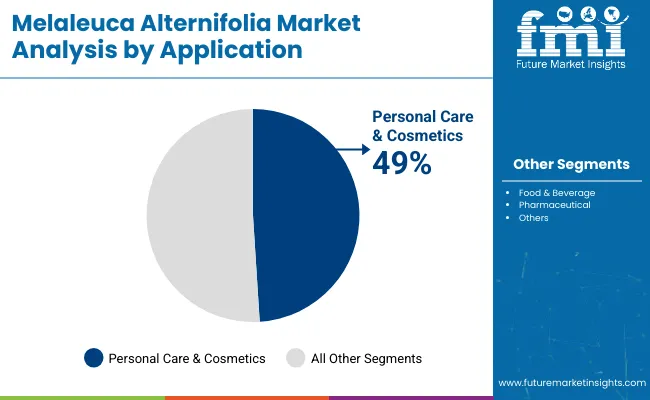
Personal Care and Cosmetic Applications Dominate
In 2025, personal care and cosmetics represent 48.6% of global Tea Tree Oil consumption. The segment continues to thrive as consumers seek natural, chemical-free solutions for acne, inflammation, and general skin health. Tea Tree Oil’s proven antimicrobial action has made it a cornerstone in cleansers, serums, moisturizers, and hair treatments.
Brands such as Plant Therapy, Aromatics, and Nature’s Sunshine are diversifying their product portfolios with Tea Tree-based formulations, targeting younger, eco-conscious consumers through transparent labeling and sustainable sourcing.
Commercial Use Drives Market Expansion
The commercial end-use segment, accounting for 60.6% of market share in 2025, remains the largest revenue contributor. Food producers, nutraceutical firms, and skincare manufacturers are leveraging Tea Tree Oil as a functional ingredient that delivers both performance and consumer appeal.
Through digital campaigns and wellness education, producers are increasing consumer awareness about Tea Tree Oil’s versatility. Informative marketing—through blogs, social media, and video content—helps foster trust and long-term brand loyalty in a fast-growing natural products market.
Access Expert Analysis & Forecasts – Buy Now Before Prices Rise! https://www.futuremarketinsights.com/checkout/4501
Explore trends before investing — request a sample report today! https://www.futuremarketinsights.com/reports/sample/rep-gb-4501
Competition and Technological Progress
The competitive landscape is rich with innovation and scientific collaboration. Established players such as BASF, DSM, and Kraft Heinz are exploring Tea Tree Oil’s applications in biotechnology, enzyme production, and green chemistry. Meanwhile, researchers like Peifu Kong have pioneered microencapsulation techniques using beta-cyclodextrin to enhance Tea Tree Oil’s stability and antimicrobial potency—an advancement poised to redefine its industrial use.
However, the industry also faces challenges, including potential EU regulatory changes classifying Tea Tree Oil as toxic, which could impact exports from South Africa and other producing regions. Leading manufacturers are actively engaging with policymakers to ensure sustainable, science-backed standards that protect both consumers and businesses.
Sustainability and Future Outlook
Between 2025 and 2035, the Tea Tree Oil industry is expected to shift decisively toward sustainable sourcing, ethical production, and transparent trade practices. As consumers increasingly demand traceable, eco-friendly products, producers are responding with organic certifications, fair-trade partnerships, and regenerative farming initiatives.
This decade marks a turning point where traditional healing meets modern science. The Melaleuca alternifolia market’s expansion not only supports economic growth but also underscores humanity’s collective return to nature as the foundation of wellness.
From global giants like doTERRA and Young Living to emerging innovators in Asia and Latin America, the next ten years will redefine Tea Tree Oil as a symbol of purity, innovation, and sustainable prosperity.
About Future Market Insights (FMI)
Future Market Insights, Inc. (ESOMAR certified, recipient of the Stevie Award, and a member of the Greater New York Chamber of Commerce) offers profound insights into the driving factors that are boosting demand in the market. FMI stands as the leading global provider of market intelligence, advisory services, consulting, and events for the Packaging, Food and Beverage, Consumer Technology, Healthcare, Industrial, and Chemicals markets. With a vast team of over 400 analysts worldwide, FMI provides global, regional, and local expertise on diverse domains and industry trends across more than 110 countries.
Contact Us:
Future Market Insights Inc.
Christiana Corporate, 200 Continental Drive,
Suite 401, Newark, Delaware – 19713, USA
T: +1-347-918-3531
For Sales Enquiries: sales@futuremarketinsights.com
Website: https://www.futuremarketinsights.com
LinkedIn| Twitter| Blogs | YouTube