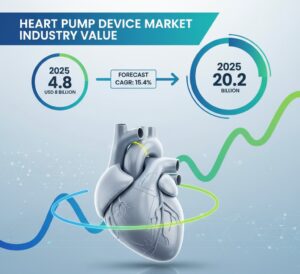
The global heart pump device market is poised for significant expansion between 2025 and 2035, fueled by rising heart failure prevalence, groundbreaking technological advancements, and increasing acceptance of minimally invasive cardiac therapies. With a market valued at USD 4.8 billion in 2025 and projected to surge to USD 20.2 billion by 2035 at a compound annual growth rate (CAGR) of 15.4%, this sector is witnessing both established manufacturers and new entrants aggressively innovating and expanding their footprints.
Market Overview: An Era of Innovation and Expansion
Heart pump devices, critical in managing end-stage heart failure and other severe cardiac conditions, are gaining widespread acceptance among healthcare providers and patients alike. The advent of minimally invasive procedures, enhanced biocompatibility, longer device durability, and improved patient mobility are pivotal in driving adoption rates globally.
Leading players such as Abbott, ABIOMED, CorWave SA, LivaNova PLC, Berlin Heart, SynCardia Systems LLC, Jarvik Heart, and BiVACOR Inc. are spearheading advancements by investing heavily in research and development. These companies are not only refining existing technologies like Left Ventricular Assist Devices (LVADs) but are also collaborating with research institutions to pioneer new artificial heart systems and remote monitoring capabilities.
Emerging manufacturers and startups, especially in markets like South Korea and China, are also entering this lucrative market, bringing innovative solutions such as magnetically levitated centrifugal pumps and compact wireless devices that enhance patient care and device reliability.
Key Segments of the Heart Pump Device Market Report
The heart pump device market is segmented by type, product, end use, and geography, providing a comprehensive framework for understanding its growth dynamics:
By Type:
- Implanted Heart Pump Devices (Dominating with 68.7% market share in 2025)
- Extracorporeal Heart Pump Devices
By Product:
- Ventricular Assist Devices (VADs), including:
- Left Ventricular Assist Devices (LVADs) – Leading product segment with approximately 69.7% share
- Right Ventricular Assist Devices (RVADs)
- Bi-ventricular Assist Devices (BiVADs)
- Percutaneous Ventricular Assist Devices (PVADs)
- Total Artificial Hearts (TAHs)
- Intra-aortic Balloon Pumps (IABPs)
- Extracorporeal Membrane Oxygenation (ECMO)
By End Use:
- Hospitals (Accounting for 83.4% of the market share)
- Cardiac Centers
- Others
By Region:
- North America
- Latin America
- Western Europe
- Eastern Europe
- Balkan & Baltic Countries
- Russia & Belarus
- Central Asia
- East Asia
- South Asia & Pacific
- Middle East & Africa
Market Growth Drivers and Industry Trends
- Technological Advancements: Continuous innovation in miniaturization, wireless monitoring, and magnetically levitated pumps enhances device efficiency and patient comfort. For example, ABIOMED’s FDA-approved Impella heart pumps incorporate these technologies to improve outcomes in acute myocardial infarction and cardiogenic shock patients.
- Aging Population & Cardiovascular Disease Prevalence: With the global population aging and cardiovascular diseases on the rise, especially in developed and emerging economies, demand for durable heart support solutions grows substantially.
- Increased Awareness and Clinical Research: Greater awareness among healthcare professionals and patients about ventricular assist devices’ benefits, supported by extensive clinical trials, is encouraging wider adoption.
- Reimbursement and Healthcare Infrastructure: Supportive reimbursement frameworks and increasing investments in healthcare infrastructure, particularly in North America, Europe, and Asia-Pacific, provide a favorable environment for market expansion.
- Shift to Minimally Invasive Procedures: Less invasive surgical methods reduce complications and recovery time, making implanted devices more accessible and attractive to patients and clinicians.
Spotlight on Leading and Emerging Market Players
Established Giants:
- Abbott continues to enhance its portfolio with cutting-edge implanted devices.
- ABIOMED’s recent acquisition by Johnson & Johnson is expected to accelerate innovation and market reach.
- LivaNova PLC and Berlin Heart focus on improving biocompatibility and device lifespan.
Innovators and New Entrants:
- BiVACOR Inc. and CorWave SA are pioneering fully implantable heart pumps with advanced flow dynamics and durability.
- South Korea’s burgeoning market sees domestic companies investing heavily in R&D to rival multinational firms, introducing downsized devices and remote patient monitoring systems.
- India’s IIT Kanpur launched the “Hridyantra” initiative aimed at developing next-generation artificial hearts, showcasing how academic and industry collaborations foster innovation.
Regional Market Highlights
- North America leads the market, with the U.S. forecast to reach USD 20.2 billion by 2035. Growing obesity, hypertension, and an aging demographic are key factors driving demand.
- China’s heart pump device market is expanding rapidly, driven by robust clinical research and favorable regulatory reforms, with a projected CAGR of 21.7%.
- Japan invests heavily in healthcare technology advancement, anticipating a market size of USD 2.3 billion by 2035.
- The United Kingdom shows rising consumer and clinician acceptance, with market growth at a CAGR of 21.5%.
- South Korea’s market is expected to grow at an impressive 22.2% CAGR, fueled by intense competition between local and foreign firms and a strong R&D focus.
Challenges and Market Restraints
Despite the optimistic outlook, the heart pump device market faces challenges such as:
- Potential complications like thrombosis, infections, and device malfunctions remain concerns.
- Limited knowledge and infrastructure in rural or underserved regions restrict broad adoption.
- The shortage of donor hearts continues to make transplantation an elusive option, keeping reliance on mechanical devices high but also underscoring the need for further innovation.
Future Outlook and Opportunities
Looking ahead, the heart pump device market is expected to sustain a strong CAGR of 15.4% over the next decade, reaching USD 20.2 billion by 2035. The following trends will shape its trajectory:
- Patient-Centric Innovations: Customizable and remotely monitored heart pump systems are becoming mainstream, enabling individualized treatment plans and enhanced patient care.
- Cross-Sector Collaborations: Partnerships between medical device companies, healthcare providers, and research institutions will accelerate technology development and market penetration.
- Expansion into Emerging Markets: Increasing healthcare spending in Asia-Pacific and other developing regions offers fertile ground for growth.
- Clinical Trial Momentum: Continued research will provide evidence-based validation, facilitating regulatory approvals and physician confidence.
This Report Now at Just $5000 | Limited-Time Discount Offer! https://www.futuremarketinsights.com/reports/sample/rep-gb-18987
Checkout Now to Access Industry Insights: https://www.futuremarketinsights.com/checkout/18987
About Future Market Insights (FMI)
Future Market Insights, Inc. (ESOMAR certified, recipient of the Stevie Award, and a member of the Greater New York Chamber of Commerce) offers profound insights into the driving factors that are boosting demand in the market. FMI stands as the leading global provider of market intelligence, advisory services, consulting, and events for the Packaging, Food and Beverage, Consumer Technology, Healthcare, Industrial, and Chemicals markets. With a vast team of over 400 analysts worldwide, FMI provides global, regional, and local expertise on diverse domains and industry trends across more than 110 countries.
Contact Us:
Future Market Insights Inc.
Christiana Corporate, 200 Continental Drive,
Suite 401, Newark, Delaware – 19713, USA
T: +1-347-918-3531
For Sales Enquiries: sales@futuremarketinsights.com
Website: https://www.futuremarketinsights.com
LinkedIn| Twitter| Blogs | YouTube