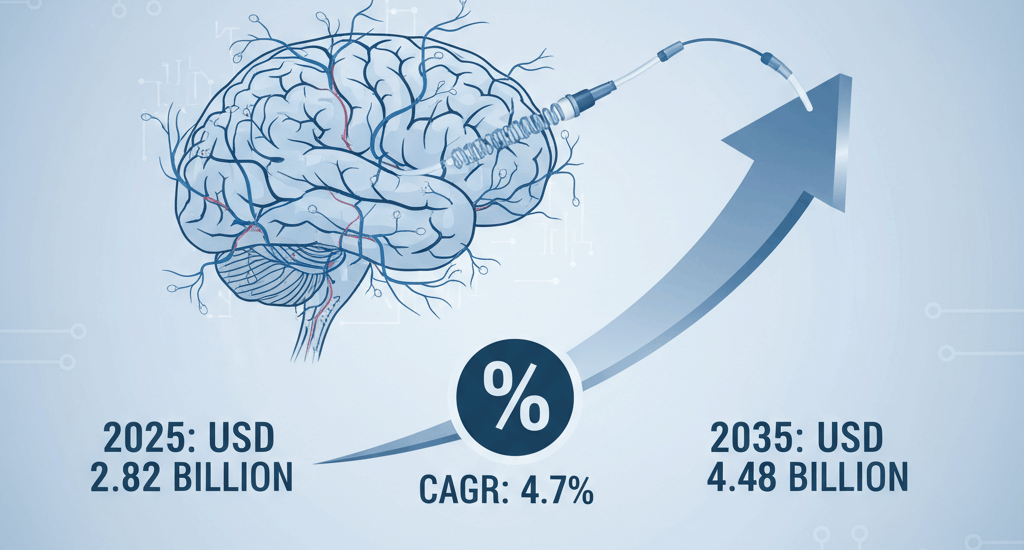
The latest report “Neurointerventional Device Market Size, Share, and Forecast Outlook 2025–2035” reveals a steady expansion trajectory for the global neurointerventional devices industry. Valued at USD 2.82 billion in 2025, the market is projected to reach USD 4.48 billion by 2035, reflecting a compound annual growth rate of 4.7%. This growth is propelled by rising incidences of ischemic stroke, brain aneurysms, and arteriovenous malformations (AVMs), as well as continued innovation in minimally invasive neurovascular procedures.
With the global population aging rapidly, the burden of neurovascular diseases is climbing, driving demand for advanced, safe, and effective interventional devices. Established players and a new generation of manufacturers are seizing this opportunity to introduce technologies that enhance procedural precision, shorten recovery times, and expand treatment accessibility worldwide.
Full Market Report available for delivery. For purchase or customization, please request here – https://www.futuremarketinsights.com/reports/sample/rep-gb-871
Established Leaders Drive Clinical and Technological Transformation
Industry frontrunners including Stryker, Medtronic, Boston Scientific, and Penumbra continue to lead development in high-performance neurointerventional systems. These companies are investing heavily in research and development to deliver devices that improve precision, safety, and long-term outcomes in complex cerebrovascular cases.
A key milestone in this ongoing innovation is the WEB Aneurysm Embolization System, an intrasaccular device from MicroVention, Inc. that revolutionizes the treatment of wide-neck bifurcation aneurysms. “With more than 10,000 units sold in the United States, WEB devices are transforming patient outcomes by offering a single, intrasaccular treatment option,” said Carsten Schroeder, President and CEO of MicroVention, Inc. “Our mission is to work side-by-side with physicians to turn clinical insights into life-saving neurotechnologies.”
This spirit of collaboration is defining the next phase of growth in neurointervention, fostering an innovation ecosystem centered on real-world clinical needs and physician feedback.
New Entrants and Regional Manufacturers Transform Competition
The market is witnessing increasing activity from emerging and mid-sized manufacturers looking to scale globally. Tier 2 companies such as Terumo, Phenox GmbH, and Rapid Medical are developing flexible microcatheters, bioactive coatings, and flow modulation systems tailored for precision-driven neurosurgery. Their competitive differentiation lies in rapid prototyping, customization, and technological agility.
In fast-growing markets like China and India, domestic players such as MicroPort and Meril Life Sciences are expanding aggressively. Through partnerships, value-based pricing, and government-aligned health initiatives, these firms are bringing affordable, high-quality neurointerventional solutions to regions historically underserved by advanced neurovascular care.
Product Innovation Anchors Market Growth Through 2035
Embolic coils remain the largest segment, commanding a 34.1% share in 2025. Advances in hydrogel-coated and detachable coils from Medtronic and Stryker are enhancing occlusion durability and navigation through intricate neurovascular structures. These coils are increasingly preferred for their precision and reduced retreatment rates, supported by improved imaging visibility and catheter compatibility.
Coiling procedures dominate globally, comprising nearly 41.7% of all neurointerventional techniques. Adjunctive technologies such as balloon-assisted and stent-assisted coiling are providing physicians with greater control during procedures, offering safer and more predictable results. High-definition imaging tools, including 3D rotational angiography and fusion imaging, continue to refine diagnostic accuracy and treatment outcomes.
Regional Highlights Reveal Different Growth Pathways
- North America remains the largest and most technologically advanced market, driven by established stroke centers, comprehensive reimbursement coverage, and rapid adoption of next-generation imaging platforms.
- Germany stands out in Europe for its evidence-based adoption of CE-marked coils and flow diverters, maintaining a steady CAGR of 3.3%.
- China is emerging as a strategically vital hub, with domestic innovation and government-led initiatives under “Healthy China 2030” fueling a 3.6% CAGR.
- India leads global growth with a forecasted 9.3% CAGR through 2035, supported by expanding hospital infrastructure and public health reforms under the Ayushman Bharat initiative.
- The United Kingdom is leveraging NHS-backed trials and value-based procurement through NICE to ensure equitable access and steady growth of 3.6%.
This diversification reflects a balanced global ecosystem where established economies drive innovation and emerging regions expand reach and access.
Overcoming Market Barriers Through Collaboration and Integration
While the market outlook is positive, challenges persist. High device costs, regulatory complexity, and training gaps inhibit consistent adoption, particularly in resource-limited regions. However, integration of AI-guided imaging, navigation technologies, and real-time data analytics is rapidly bridging these divides.
As AI-driven procedural guidance becomes mainstream, the boundaries between imaging and intervention are blurring. Platforms like Penumbra’s REAL Neuro System, launched in 2024, exemplify this transformation by enabling real-time feedback, reduced radiation exposure, and enhanced operator control. Such innovations are reshaping procedural workflows and advancing global adoption of neurointerventional therapies.
Consolidation and Future Outlook
The neurointerventional devices market is consolidating around leading players such as Medtronic, Stryker, Penumbra, Johnson & Johnson’s Cerenovus, and Terumo, which continue to dominate through comprehensive neurovascular portfolios. Strategic acquisitions of technology-driven startups are expanding therapeutic reach and accelerating commercialization cycles.
Harmonization of regulatory frameworks and transparent procurement models will be critical in the coming decade. As hospitals invest in hybrid cath labs and digital integration, the global neurointerventional ecosystem will continue its transformation—delivering safer, smarter, and more accessible cerebrovascular care for patients worldwide.
Access In-Depth Market Analysis: https://www.futuremarketinsights.com/reports/brochure/rep-gb-871
Key Companies Featured:
Medtronic plc | Stryker Corporation | Penumbra, Inc. | Terumo Corporation | MicroVention, Inc. (Terumo Group) | Johnson & Johnson (Cerenovus) | Phenox GmbH | Rapid Medical | Balt USA
About Future Market Insights (FMI)
Future Market Insights, Inc. (ESOMAR certified, recipient of the Stevie Award, and a member of the Greater New York Chamber of Commerce) offers profound insights into the driving factors that are boosting demand in the market. FMI stands as the leading global provider of market intelligence, advisory services, consulting, and events for the Packaging, Food and Beverage, Consumer Technology, Healthcare, Industrial, and Chemicals markets. With a vast team of over 400 analysts worldwide, FMI provides global, regional, and local expertise on diverse domains and industry trends across more than 110 countries.
Contact Us:
Future Market Insights Inc.
Christiana Corporate, 200 Continental Drive,
Suite 401, Newark, Delaware – 19713, USA
T: +1-347-918-3531
For Sales Enquiries: sales@futuremarketinsights.com
Website: https://www.futuremarketinsights.com
LinkedIn| Twitter| Blogs | YouTube