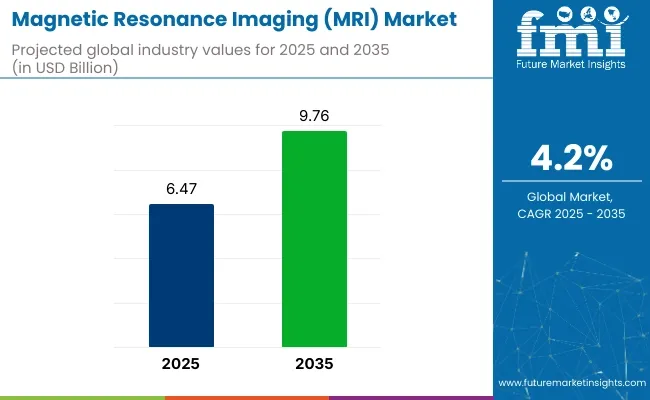
The magnetic resonance imaging (MRI) market is worth USD 6.47 billion in 2025 and is anticipated to register USD 9.76 billion by 2035. The market is poised to expand at a 4.2% CAGR during the forecast period. Growth is being driven by increasing demand for high-precision diagnostic imaging in neurology, oncology, and cardiovascular applications.
The global Magnetic Resonance Imaging (MRI) market, valued at USD 6.47 billion in 2025, is projected to grow steadily to USD 9.76 billion by 2035, expanding at a 4.2% CAGR. This growth is being propelled by surging demand for high-precision diagnostic imaging across neurology, oncology, and cardiovascular care, alongside rapid advancements in MRI technology and increasing healthcare investments worldwide.
MRI systems, renowned for their non-invasive and radiation-free diagnostic capabilities, are becoming integral to modern healthcare. They provide critical insights into early disease detection, anatomical visualization, and long-term patient monitoring—particularly essential in an era marked by rising chronic disease prevalence and aging populations.
Precision Imaging Meets AI Integration
Healthcare systems are embracing AI-enabled MRI technologies that promise faster, smarter, and more accurate imaging. Leading imaging manufacturers are introducing next-generation innovations, including high-field (3T and 7T) scanners, silent MRI systems, and AI-integrated diagnostic platforms. These innovations aim to enhance diagnostic accuracy, reduce scan times, and streamline clinical workflows.
AI-driven MRI platforms now offer real-time image analysis, automated lesion detection, and workflow optimization, particularly in high-volume radiology centers. The convergence of imaging hardware and AI software is setting a new benchmark for efficiency, enabling clinicians to deliver faster, more reliable diagnoses.
Emerging players and established manufacturers alike are expanding R&D investments to explore portable and low-cost MRI scanners. This shift is unlocking new market opportunities, particularly in rural and semi-urban healthcare facilities, where access to advanced imaging has historically been limited.
Expanding Access and Patient Comfort
The growing adoption of mobile imaging units and remote diagnostic platforms is extending MRI accessibility beyond major cities. Healthcare providers are leveraging tele-radiology and cloud-based interpretation to bridge the diagnostic gap in underserved regions.
Moreover, the rising popularity of open MRI systems is transforming the patient experience. Their open architecture enhances comfort and reduces scan anxiety, catering especially to pediatric, geriatric, and claustrophobic patients. Technological advancements—such as motion correction, improved radiofrequency coils, and AI-driven image enhancement—are helping open MRI systems close the performance gap with closed models, making them viable options for targeted imaging.
In 2025, closed MRI systems continue to dominate with a 68.5% global share, valued for their superior resolution and deeper tissue penetration—essential for complex neurological and musculoskeletal evaluations. Meanwhile, open systems hold a 31.5% share, gaining ground through patient-centric innovation.
High-Field MRI Systems Gain Momentum
By field strength, the high-field MRI systems segment is expected to witness the fastest growth—at a 6.1% CAGR—as healthcare institutions increasingly favor precision imaging. Operating at 1.5T and above, these systems offer exceptional signal-to-noise ratios and image clarity, facilitating early disease detection in complex cases.
High-field MRI currently commands 45% of the market share, while mid-field systems (0.3T–1.0T), valued for their affordability and versatility, account for 22%. The balance between cost and performance makes mid-field MRI the preferred choice in general hospitals and emerging markets.
Neurology: The Cornerstone of MRI Demand
The neurology segment, holding a 43% share in 2025, remains the largest application area for MRI. Rising global incidences of stroke, epilepsy, multiple sclerosis, and neurodegenerative disorders have cemented MRI’s role as the gold standard for brain and spinal imaging.
With the integration of functional MRI (fMRI) and diffusion tensor imaging (DTI), healthcare providers can now map neural pathways and monitor brain function with unprecedented accuracy. The cardiology segment follows with a 28% share, supported by growing use of cardiac MRI in diagnosing coronary artery disease, myocarditis, and congenital abnormalities.
Hospitals Lead Global Installations
Hospitals represent the largest end-user group, accounting for 61.3% of global MRI installations. Their comprehensive care models, integration of MRI with therapeutic workflows, and capacity to manage high patient volumes make them key drivers of demand.
Ambulatory surgical centers (34%) and diagnostic imaging centers are also witnessing rapid adoption, driven by decentralized healthcare models emphasizing outpatient diagnostics, cost-efficiency, and faster turnaround times.
Regulatory and Policy Support Accelerate Adoption
Supportive regulatory frameworks are reinforcing market expansion. Agencies such as the U.S. FDA, European EMA, and Japan’s PMDA are setting stringent performance and safety standards for high-field and AI-enabled MRI systems.
Governments are simultaneously revising reimbursement policies and mandating interoperability and cybersecurity compliance, encouraging healthcare providers to transition toward digital, connected imaging ecosystems.
Regional Market Insights
United States: The U.S. remains a powerhouse in MRI adoption, driven by advanced healthcare infrastructure, high expenditure, and rapid equipment upgrades. The growing prevalence of chronic diseases and the aging population continue to fuel steady demand for high-resolution imaging technologies.
United Kingdom: Backed by NHS initiatives, the U.K. market is expanding through investments in MRI infrastructure and public health campaigns promoting early diagnosis. Efforts to reduce diagnostic waiting times have accelerated MRI installations across hospitals and regional clinics.
India: The Indian MRI market is witnessing transformative growth as healthcare access expands across urban and rural landscapes. Government-led healthcare initiatives and private investments are driving installations of low-cost, AI-enabled MRI systems. The country’s rising middle class, increasing health awareness, and booming medical tourism are creating immense opportunities for global and domestic MRI manufacturers.
Competitive Landscape: Innovation and Collaboration Define the Future
The MRI industry’s competitive landscape is evolving rapidly as both established leaders and new entrants invest heavily in R&D, product differentiation, and strategic partnerships.
- In May 2024, GE HealthCare unveiled a “premium” MRI system designed to help neuroscientists gain deeper insights into brain function. The system is under FDA review for 510(k) clearance after its successful installation at Brigham and Women’s Hospital.
- Around the same time, Siemens Healthineers launched the Magnetom Terra 7T MRI scanner, the world’s first 7T system approved for clinical use in the U.S. and Europe. Designed for both brain and knee imaging, it represents a major leap in ultra-high-field MRI.
Other notable players such as Philips, Canon Medical Systems, Fujifilm Holdings, Hitachi Medical Systems, and Esaote SpA are also advancing hybrid imaging, low-noise MRI, and AI-driven diagnostic solutions.
Emerging manufacturers, particularly from Asia, are focusing on cost-effective, compact MRI solutions, targeting underserved healthcare markets with scalable technologies.
Request Your Sample Report Today and discover growth opportunities!
https://www.futuremarketinsights.com/reports/sample/rep-gb-858
Checkout Now to Access Industry Insights:
https://www.futuremarketinsights.com/checkout/858
About Future Market Insights (FMI)
Future Market Insights, Inc. (ESOMAR certified, recipient of the Stevie Award, and a member of the Greater New York Chamber of Commerce) offers profound insights into the driving factors that are boosting demand in the market. FMI stands as the leading global provider of market intelligence, advisory services, consulting, and events for the Packaging, Food and Beverage, Consumer Technology, Healthcare, Industrial, and Chemicals markets. With a vast team of 400 analysts worldwide, FMI provides global, regional, and local expertise on diverse domains and industry trends across more than 110 countries.
Contact Us:
Future Market Insights Inc.
Christiana Corporate, 200 Continental Drive,
Suite 401, Newark, Delaware – 19713, USA
T: +1-845-579-5705
For Sales Enquiries: sales@futuremarketinsights.com
Website: https://www.futuremarketinsights.com
LinkedIn| Twitter| Blogs | YouTube