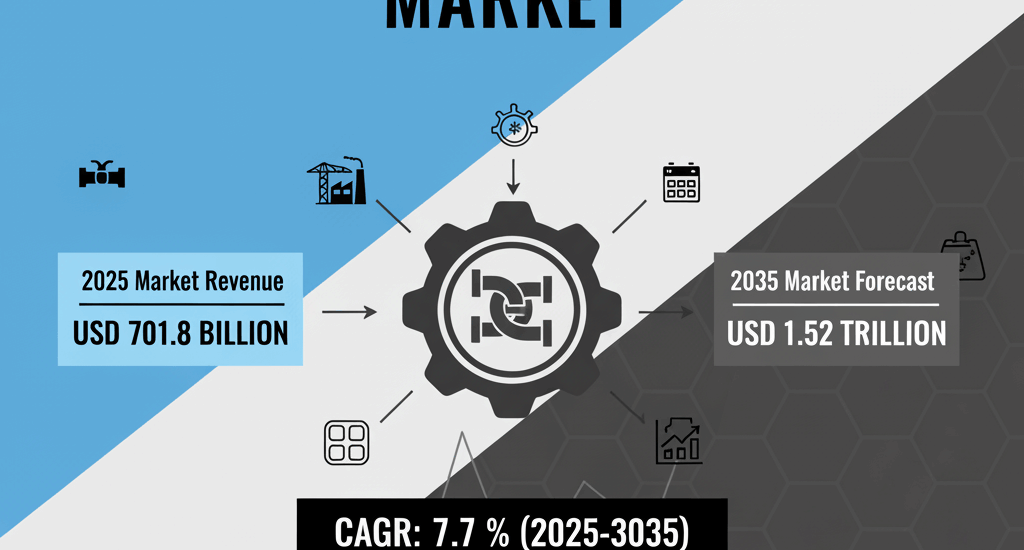
The global industrial tubes market is entering a transformative decade, projected to grow from USD 701.8 billion in 2025 to USD 1.52 trillion by 2035, at a strong CAGR of 7.7%. According to the latest industry report, “Industrial Tubes Market Forecast and Outlook 2025–2035,” this growth is fueled by massive global infrastructure upgrades, a rise in advanced manufacturing technologies, and the growing demand for sustainable, performance-driven tubing solutions.
North America and Asia Pacific continue to lead the industrial tubes sector, supported by government-backed infrastructure initiatives, expanding energy diversification, and the modernization of industrial bases. The strategic interplay between established industry giants and ambitious new entrants is reshaping market boundaries — driving competition, innovation, and collaboration across regions.
Get this Report at $5000 | Exclusive Discount Inside! https://www.futuremarketinsights.com/reports/sample/rep-gb-17516
Bright Outlook for Industry Expansion
Steel remains the backbone of industrial tube production, prized for its tensile strength and affordability. However, seamless tubes — essential for high-pressure applications in oil & gas and petrochemical facilities — are becoming the new standard for performance and safety. With the global energy transition underway, lightweight materials such as aluminum and composites are gaining traction in new mobility sectors like electric vehicles (EVs), aerospace, and renewable energy.
The report notes that infrastructure modernization, energy diversification, and sustainability goals are driving unprecedented investment in automation, AI-enabled quality control, and recyclable low-carbon materials. Countries like China and India continue to dominate high-volume steel tube production, while Japan and Germany focus on precision-engineered, high-performance alloys. This regional specialization reflects a maturing global supply chain increasingly driven by technology and ESG priorities.
Market Drivers and Emerging Technologies
Global industrialization is being reshaped by the interplay of automation and sustainability. Manufacturers are embedding Internet of Things (IoT) sensors into smart tubing for predictive maintenance and corrosion monitoring, pushing the boundaries of industrial reliability. Modular and multi-use tubing systems are also emerging as vital components in renewable energy and high-tech fabrication facilities.
Government policy is accelerating this transformation. From the U.S. Infrastructure Investment and Jobs Act (IIJA) to China’s “Made in China 2025” policy and the European Union’s Green Deal, industrial tubing is gaining strategic importance as an enabling component of next-generation infrastructure. These policy frameworks are fostering not only market expansion but also the birth of new industrial ecosystems around sustainable manufacturing and circular economy principles.
Material and Manufacturing Insights
The study reveals that steel will maintain its market leadership through 2035 due to its strength and affordability, while aluminum and composite tubes gain share across EV and aerospace applications. Europe’s focus on green steel and carbon-neutral solutions contrasts with Asia’s continued reliance on cost-efficient carbon steel. This dual narrative highlights the global trade-off between cost optimization and sustainability targets.
By manufacturing method, seamless tubes are expected to post the fastest growth due to their superior mechanical integrity. Advances in extrusion and rotary piercing techniques are reducing waste and improving product uniformity, giving seamless tube producers a competitive edge in oil & gas, petrochemicals, and aerospace.
In terms of end use, the automotive sector is projected to expand the quickest, driven by electrification and the shift to lightweight structural materials. The oil & gas and petrochemical sectors, while mature, remain central to global demand due to the continuous need for corrosion-resistant and pressure-resistant pipelines.
Regional and Competitive Landscape
Regionally, China leads global expansion at an anticipated 9.1% CAGR, followed by South Korea at 7.8% and the United States at 8.2%. Western Europe continues to champion green innovation, led by Germany’s hydrogen strategy and France’s carbon-neutral manufacturing initiatives. Meanwhile, India’s Production-Linked Incentive (PLI) schemes are fostering rapid capacity growth in specialty steel and advanced tube production.
The industrial tubes market remains moderately fragmented, featuring both global corporations and agile local entrants. Key players include Vallourec, Tenaris, ArcelorMittal, Tata Steel, Nippon Steel & Sumitomo Metal Corporation, TMK Group, Jindal Saw Ltd., and Baosteel Group. Leading firms are investing in automation, sustainable metallurgy, and regional partnerships to boost competitiveness.
Vallourec, for example, recently reduced its net debt from €1.49 billion to €240 million within two years and launched new supply contracts with TotalEnergies and Petrobras. Similarly, Nippon Steel and JFE Steel are advancing digital welding systems and sustainable production models in Asia, while Tenaris and TMK Group are ramping up production for the expanding hydrogen storage and EV manufacturing sectors.
Strategic Imperatives for Manufacturers
To maintain momentum in this competitive landscape, industry leaders and new entrants alike are urged to:
- Invest in automation and AI-driven quality control to optimize efficiency and consistency.
- Adopt circular economy principles by developing recyclable and low-emission materials.
- Strengthen global supply chain resilience through diversified sourcing and strategic partnerships.
- Align with emerging ESG mandates to access premium markets, particularly in Europe and Japan.
Get Detailed Insights — Request PDF: https://www.futuremarketinsights.com/reports/brochure/rep-gb-17516
Looking Ahead
From high-pressure oil & gas pipelines to precision-engineered tubing for hydrogen storage and EVs, the industrial tubes market is set to define the backbone of 21st-century infrastructure. Manufacturers who can combine intelligent production, sustainability compliance, and scalable innovation will be best positioned to lead through 2035.
About Future Market Insights (FMI)
Future Market Insights, Inc. (ESOMAR certified, recipient of the Stevie Award, and a member of the Greater New York Chamber of Commerce) offers profound insights into the driving factors that are boosting demand in the market. FMI stands as the leading global provider of market intelligence, advisory services, consulting, and events for the Packaging, Food and Beverage, Consumer Technology, Healthcare, Industrial, and Chemicals markets. With a vast team of over 400 analysts worldwide, FMI provides global, regional, and local expertise on diverse domains and industry trends across more than 110 countries.
Contact Us:
Future Market Insights Inc.
Christiana Corporate, 200 Continental Drive,
Suite 401, Newark, Delaware – 19713, USA
T: +1-347-918-3531
For Sales Enquiries: sales@futuremarketinsights.com
Website: https://www.futuremarketinsights.com
LinkedIn| Twitter| Blogs | YouTube