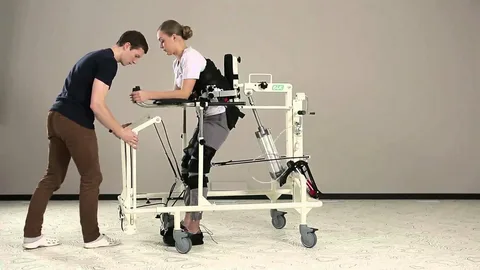
The global sales of gait trainer are estimated to be worth USD 395.6 million in 2025 and are anticipated to reach a value of USD 637.8 million by 2035. Sales are projected to rise at a CAGR of 4.9% over the forecast period between 2025 and 2035. The revenue generated by gait trainer in 2024 was USD 377.1 million.
The global gait trainer market is set for a decade of steady growth, fueled by a surge in demand for advanced rehabilitation technologies, AI-integrated exoskeletons, and smart treadmill systems designed to help patients regain mobility and independence. According to the latest industry insights, global sales of gait trainers are expected to reach USD 395.6 million in 2025, up from USD 377.1 million in 2024, and are projected to grow further to USD 637.8 million by 2035, registering a CAGR of 4.9% during the forecast period.
Gait trainers, essential tools for rehabilitation, are evolving rapidly as manufacturers—both established and emerging—leverage innovations in robotics, artificial intelligence (AI), sensors, and virtual reality (VR) to enhance rehabilitation outcomes. The market encompasses a variety of products, including walkers, treadmill-based trainers, and exoskeletons, each tailored to different levels of mobility impairment.
Technology-Driven Recovery: AI and Robotics Transforming Rehabilitation
The gait trainer industry is undergoing a technological revolution. Traditional walker-type models remain popular for patients with moderate walking limitations, but the spotlight is increasingly turning toward robotic exoskeletons and AI-driven treadmill systems that provide real-time feedback and dynamic gait correction.
Modern gait trainers are being enhanced with integrated sensors, data analytics, and VR interfaces that allow healthcare professionals to track progress in real time. This makes therapy more precise and personalized, ensuring improved outcomes for patients recovering from strokes, spinal cord injuries, or neurological disorders.
“AI and robotic integration are redefining rehabilitation,” said a spokesperson for ReWalk Robotics, a leader in exoskeleton development. “Our latest designs adapt to a patient’s motion in real time, creating individualized therapy sessions that accelerate recovery and restore confidence.”
Market Insights: Exoskeletons Take the Lead
Among all product types, exoskeletons are projected to dominate the market in 2025, accounting for 53.4% of global market share. These robotic suits have become game-changers for patients with severe mobility challenges, offering mechanical support and feedback that traditional gait trainers cannot match.
By enabling early mobility intervention and reducing recovery time, exoskeletons are now considered essential in rehabilitation programs. Their widespread adoption in hospitals and rehab centers underscores a growing emphasis on high-performance recovery tools and personalized rehabilitation.
The industry is also witnessing strong activity from new entrants and mid-sized companies that are reshaping competition. Meyland Smith A/S, Rex Bionics Ltd., and Rifton Equipment, for instance, are focusing on cost-effective exoskeletons and hybrid treadmill systems that make advanced rehabilitation accessible to more patients worldwide.
Hospitals Lead End-User Demand
Hospitals continue to be the largest end-user segment for gait trainers, accounting for 43.5% of the market in 2025. The increasing volume of patients needing mobility rehabilitation—particularly those recovering from strokes or neurological disorders—has fueled this dominance.
Hospitals are rapidly adopting advanced gait training systems, including robotic treadmills and AI-enhanced exoskeletons, to improve recovery outcomes. These technologies allow therapists to deliver more effective, data-driven care while reducing the physical strain of manual rehabilitation techniques.
In parallel, rehabilitation centers and home-care settings are also embracing portable and user-friendly gait trainers. Emerging companies are developing compact and semi-automated gait training systems suitable for home use—expanding accessibility for aging populations and long-term patients.
Emerging Trends: Hybrid and VR-Integrated Systems
One of the most exciting trends reshaping the gait trainer market is the rise of hybrid models that combine multiple rehabilitation technologies. These systems merge treadmill-based motion training with robotic exoskeleton assistance, allowing patients to practice walking in controlled, dynamic environments.
Such hybrid systems enhance muscle coordination and neuroplasticity by providing simultaneous support, feedback, and motion training. This approach not only accelerates recovery but also improves patient engagement and motivation.
Meanwhile, virtual reality (VR) integration is transforming rehabilitation by enabling immersive, interactive therapy environments. Patients can simulate walking on sidewalks, climbing stairs, or navigating obstacles—all from a clinical or home-based treadmill system.
“The fusion of VR with robotic gait training has changed the psychology of rehabilitation,” said a senior therapist at Hocoma AG, a leading developer of robotic rehab systems. “It turns repetitive exercises into immersive experiences that boost patient motivation and speed up recovery.”
Industry Outlook: Growth Moderates but Remains Robust
A semi-annual performance review shows a steady but moderated pace of growth in the coming decade. The market’s CAGR for 2025–2035 is expected to average 4.9% in H1 and 4.4% in H2, reflecting a stable expansion driven by technology upgrades and increased rehabilitation demand.
Despite these positive trends, certain challenges persist. The complexity of operating advanced gait trainers—especially robotic exoskeletons—can limit adoption in smaller rehabilitation facilities. Moreover, the need for trained professionals and high equipment costs remain key barriers in emerging markets.
However, ongoing innovation by Tier 2 and Tier 3 companies is addressing these hurdles through lightweight, AI-enabled, and affordable gait trainer solutions, signaling strong growth potential in Asia-Pacific and Latin America.
Regional Outlook: Asia-Pacific Emerges as a Growth Hotspot
Geographically, Asia-Pacific is poised for the fastest growth, led by China (5.3% CAGR) and India (5.7% CAGR) through 2035. The increasing incidence of stroke and neurological disorders, combined with large-scale healthcare investments, is fueling demand for robotic rehabilitation solutions.
In China, rising stroke recovery cases are creating significant opportunities for exoskeleton manufacturers, while India’s expanding healthcare infrastructure and growing adoption of AI-based medical technologies are positioning it as a major emerging market.
Meanwhile, Germany continues to lead Western Europe with widespread deployment of robotic-assisted treadmill systems in hospitals, while the United States, with a large base of mobility-impaired individuals, remains a key market for advanced gait trainer technologies.
Competitive Landscape: Established Leaders and New Innovators
The gait trainer market features a dynamic mix of established leaders and emerging innovators:
- Tier 1 Leaders (39.8% market share) – Companies such as Biodex Medical Systems, Medica Medizintechnik GmbH, ReWalk Robotics, and Alter G Inc. are global pioneers investing heavily in AI-driven rehabilitation and patient-centric technologies.
- Tier 2 Innovators (36.2% market share) – Firms like Meyland Smith A/S, Rex Bionics Ltd., Rifton Equipment, and Medical Depot Inc. (Drive Medical) focus on niche segments and regional expansion, introducing affordable, adaptable rehabilitation systems.
- Emerging Entrants – Start-ups and mid-sized manufacturers are increasingly investing in VR-based, sensor-integrated gait trainers and wearable exoskeletons aimed at bridging the affordability gap in rehabilitation care.
Recent innovations include Ekso Bionics’ launch of GaitCoach™ in 2024, a next-generation gait therapy software designed for personalized rehabilitation, and Trexo Robotics’ collaboration with Keystone Education Group, which introduced robotic gait trainers for children with autism spectrum disorder—broadening the market’s clinical reach.
The Future: Personalized, Accessible, and Intelligent Rehabilitation
Looking ahead, the gait trainer market is expected to evolve toward lightweight, AI-adaptive, and telemedicine-compatible systems that extend rehabilitation beyond hospitals. Integration with machine learning, AR, and wearable analytics will further personalize therapy and enhance patient engagement.
As both established manufacturers and new players accelerate innovation, the gait trainer industry is moving closer to a future where every patient can walk again with confidence—supported by intelligent, data-driven rehabilitation technology.
Request Your Sample Report Today and discover growth opportunities!
https://www.futuremarketinsights.com/reports/sample/rep-gb-2213
Checkout Now to Access Industry Insights:
https://www.futuremarketinsights.com/checkout/2213
About Future Market Insights (FMI)
Future Market Insights, Inc. (ESOMAR certified, recipient of the Stevie Award, and a member of the Greater New York Chamber of Commerce) offers profound insights into the driving factors that are boosting demand in the market. FMI stands as the leading global provider of market intelligence, advisory services, consulting, and events for the Packaging, Food and Beverage, Consumer Technology, Healthcare, Industrial, and Chemicals markets. With a vast team of 400 analysts worldwide, FMI provides global, regional, and local expertise on diverse domains and industry trends across more than 110 countries.
Contact Us:
Future Market Insights Inc.
Christiana Corporate, 200 Continental Drive,
Suite 401, Newark, Delaware – 19713, USA
T: +1-845-579-5705
For Sales Enquiries: sales@futuremarketinsights.com
Website: https://www.futuremarketinsights.com
LinkedIn| Twitter| Blogs | YouTube