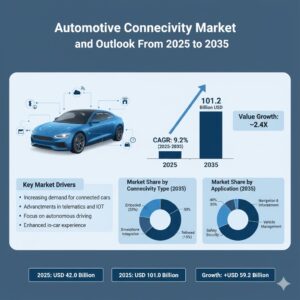
The global automotive connectivity market is accelerating into a transformative decade, redefining how vehicles communicate, operate, and enhance human mobility. Valued at USD 42.0 billion in 2025, the market is expected to reach USD 101.2 billion by 2035, expanding at a robust CAGR of 9.2%. This projection marks a 2.4X increase from 2024’s valuation of USD 38.4 billion, underscoring the rapid adoption of connected technologies that are reshaping the future of transportation.
The automotive ecosystem is being revolutionized by the fusion of connectivity, automation, and personalization. Advanced infotainment systems, 5G networks, and artificial intelligence are converging to make vehicles smarter, safer, and more adaptive. As consumers demand seamless integration between their cars and digital lifestyles, automakers are intensifying efforts to embed real-time updates, predictive diagnostics, and immersive infotainment within vehicles.
Connected Vehicles Redefining Modern Mobility
Automotive connectivity is no longer a luxury feature—it has become a critical pillar of the intelligent vehicle revolution. From predictive maintenance to vehicle-to-everything (V2X) communication, connectivity enables cars to think, learn, and interact dynamically with their surroundings. The growing preference for advanced in-vehicle systems reflects a global shift toward smarter, more efficient mobility solutions.
According to the report, the market saw a year-on-year growth of 9.1% in 2025, supported by continuous investments in embedded technologies and software-defined vehicle (SDV) platforms. SDVs represent a paradigm shift where software, rather than hardware, defines vehicle performance. They allow manufacturers to roll out over-the-air (OTA) updates, ensuring vehicles stay current with the latest features and security enhancements—without requiring physical intervention.
Companies such as Qualcomm, Harman International, Bosch, and NXP Semiconductors are leading this transition, while newer players are entering the market with AI-powered applications that deliver personalized driving experiences. Together, these innovators are creating a cohesive digital ecosystem where cars evolve alongside technology.
Access Expert Analysis & Forecasts – Buy Now Before Prices Rise!
Software-Defined Vehicles: The Core of Automotive Innovation
The rise of software-defined vehicles is reshaping manufacturing philosophies across the automotive landscape. Traditional mechanical upgrades are giving way to digital enhancements that can be delivered remotely. This flexibility has reduced product development cycles and increased customer satisfaction through real-time performance optimization.
As SDVs gain prominence, cybersecurity has emerged as a major focus area. Manufacturers are now prioritizing secure communication networks and encryption protocols to safeguard against cyber threats. The transition toward software-driven architectures also supports future integration with autonomous systems, establishing a foundation for fully connected and self-driving vehicles by the next decade.
ADAS and V2X: Building a Safer, Smarter Road Network
Connectivity lies at the heart of advanced driver assistance systems (ADAS), which are increasingly integrated into modern vehicles to enhance safety and convenience. Technologies such as adaptive cruise control, lane-keeping assist, and automated emergency braking depend on real-time data from sensors and external networks.
Vehicle-to-everything (V2X) communication further amplifies these capabilities by enabling interaction between vehicles and infrastructure. This synchronized communication minimizes collisions, reduces congestion, and improves overall traffic efficiency. Global automakers like Toyota, Ford, and Continental are actively developing V2X solutions to build an ecosystem where connected vehicles work together to create safer roads.
5G and Embedded Connectivity Powering Next-Gen Mobility
Among the various connectivity technologies, 5G networks are projected to dominate the market with a 30.2% share by 2025. The ultra-low latency and high-speed data transmission of 5G enable real-time vehicle communication, paving the way for innovations like remote diagnostics, cloud-based navigation, and autonomous driving.
Meanwhile, embedded connectivity—expected to hold a 42.4% market share in 2025—has emerged as a cornerstone for intelligent vehicle design. Embedded systems ensure continuous online access for vehicles, supporting critical functions like navigation, telematics, and safety alerts. This technology eliminates dependency on smartphones, providing a more reliable and secure experience for drivers.
Established leaders like Qualcomm and Bosch are pioneering 5G-enabled chipsets and connectivity modules, while startups are building cloud-based platforms to manage these data flows efficiently. The synergy between hardware and software innovation continues to redefine automotive intelligence.
Explore trends before investing — request a sample report today!
Regional Insights: USA, Germany, and China Take the Lead
The United States remains a key market, projected to reach USD 17.5 billion by 2035 with a CAGR of 6.9%. The nation’s strong emphasis on road safety and advanced driver-assistance technologies has fueled widespread adoption of connected systems. The National Highway Traffic Safety Administration (NHTSA) reported that 40% of new vehicles sold in 2023 featured connectivity-enhanced safety tools such as dynamic brake support and automated lane correction.
Germany, home to automotive giants like Mercedes-Benz, BMW, and Volkswagen, continues to lead Europe’s connectivity evolution. With a projected CAGR of 7.8%, the country’s focus on AI-driven systems and partnerships between automotive leaders has accelerated the development of Level 3 autonomous driving.
China dominates the Asia-Pacific market, projected to grow at 6.5% annually to reach USD 22.5 billion by 2035. Supported by a USD 15 billion government investment in smart vehicle infrastructure in 2023, China’s automotive landscape is rapidly transitioning toward electric and connected mobility. Companies like Great Wall Motors are setting benchmarks by integrating Level 2 ADAS systems in their mass-market vehicles, reinforcing the country’s leadership in automotive digitalization.
India and Australia are emerging as promising markets, with growth rates of 10.6% and 9.5%, respectively, driven by urbanization, rising disposable incomes, and government initiatives promoting intelligent transport systems.
Industry Dynamics and Competitive Landscape
Tier-1 companies currently dominate about 65% of the automotive connectivity market, with players such as Harman International, Qualcomm, and Denso generating annual revenues exceeding USD 500 million from connectivity solutions. Tier-2 manufacturers, including Panasonic and Ford Motor Company, hold the remaining 35–40%, focusing on mid-scale innovations and regional markets.
The industry’s competitive intensity is further amplified by rapid innovation cycles. For instance, at MWC 2024, Harman introduced AI-powered in-vehicle connectivity solutions with personalized voice recognition and enhanced smartphone integration. Around the same time, Qualcomm unveiled Wi-Fi 7 for automotive, enabling faster, more reliable data transmission and enriching the in-vehicle experience.
Emerging manufacturers are leveraging these technological advances to expand their footprint, forming strategic collaborations with telecom operators and cloud service providers. These alliances aim to reduce costs, accelerate 5G adoption, and democratize access to connected mobility.
About Future Market Insights (FMI)
Future Market Insights, Inc. (ESOMAR certified, recipient of the Stevie Award, and a member of the Greater New York Chamber of Commerce) offers profound insights into the driving factors that are boosting demand in the market. FMI stands as the leading global provider of market intelligence, advisory services, consulting, and events for the Packaging, Food and Beverage, Consumer Technology, Healthcare, Industrial, and Chemicals markets. With a vast team of over 400 analysts worldwide, FMI provides global, regional, and local expertise on diverse domains and industry trends across more than 110 countries.
Contact Us:
Future Market Insights Inc.
Christiana Corporate, 200 Continental Drive,
Suite 401, Newark, Delaware – 19713, USA
T: +1-347-918-3531
For Sales Enquiries: sales@futuremarketinsights.com
Website: https://www.futuremarketinsights.com
LinkedIn| Twitter| Blogs | YouTube