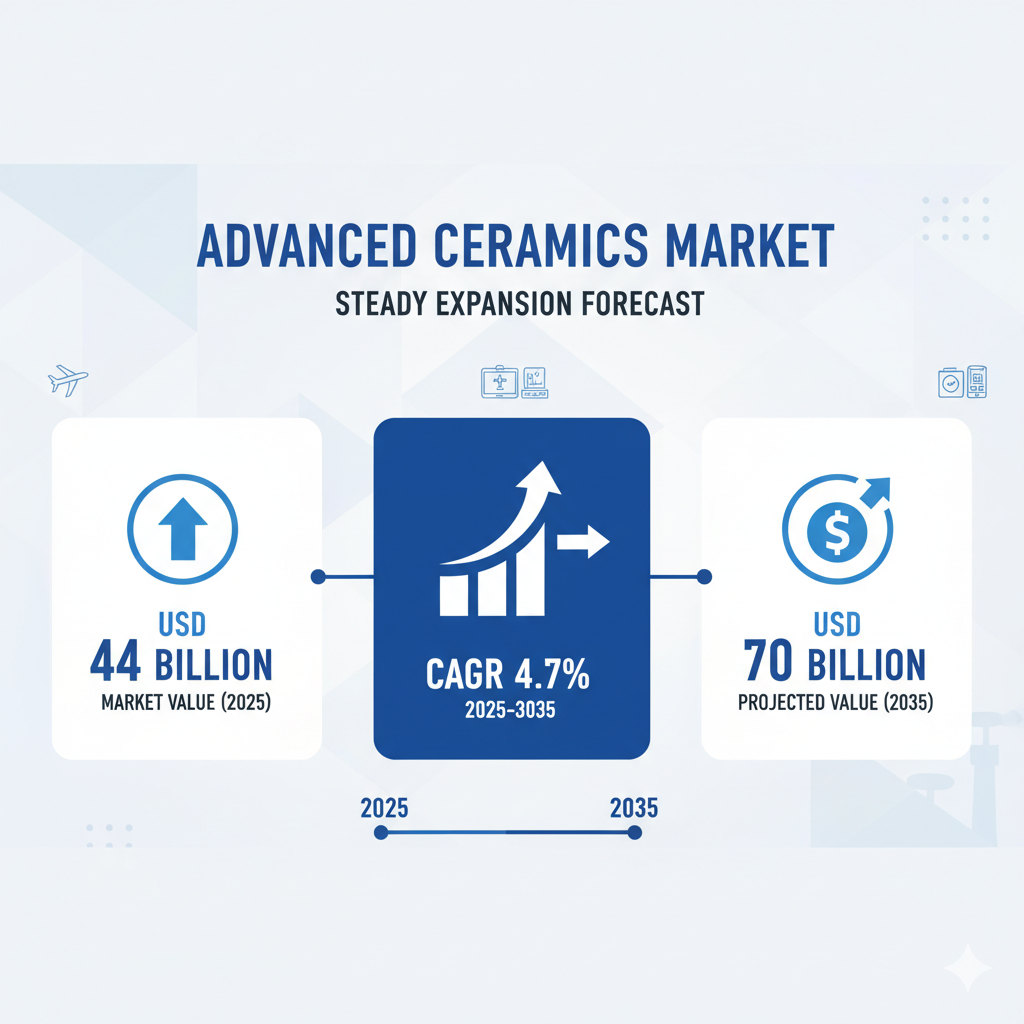
The global advanced ceramics market is entering a decade of robust expansion, forecast to grow from an estimated USD 44 billion in 2025 to USD 70 billion by 2035, registering a steady CAGR of 4.7%. This growth, as outlined in the new report “Advanced Ceramics Market Forecast and Outlook 2025 to 2035,” highlights the sector’s pivotal role in powering next-generation technologies across industries ranging from aerospace to healthcare.
Engineered for exceptional strength, thermal resistance, chemical durability, and precision performance, advanced ceramics are redefining industrial materials. Unlike traditional ceramics confined to decorative or low-load uses, these advanced variants are manufactured through carefully controlled processes such as powder synthesis and sintering—delivering consistent, high-value performance in the world’s most demanding environments.
Get this Report at $5000 | Exclusive Discount Inside! https://www.futuremarketinsights.com/reports/sample/rep-gb-300
Expanding Industrial Horizons
The demand for advanced ceramics is closely tied to global shifts toward high-efficiency and sustainable technologies. From solid-state batteries and hydrogen fuel cells to semiconductors and medical prosthetics, ceramics are becoming central to energy-efficient, high-performance design.
Medical applications are leading adoption, projected to grow at the fastest pace of 5.8% annually through 2035. Their superior biocompatibility and chemical stability make ceramic materials ideal for implants, surgical tools, and prosthetics. As the global population ages and healthcare modernization accelerates, demand for wear-resistant and durable materials continues to surge.
Beyond healthcare, advanced ceramics play a critical role in electric mobility, electronics miniaturization, and renewable energy. In electric vehicles, they enhance battery safety and efficiency, while in power electronics, they provide thermal management and electrical insulation. In aerospace and defense applications, ceramics withstand extreme heat and pressure, ensuring lightweight resilience and operational safety.
Technological Advancements Powering Growth
One of the strongest drivers in the decade ahead will be rapid improvements in ceramic manufacturing techniques. Additive manufacturing, nanostructuring, and hybrid composite processing now allow ceramics to be tailored at the molecular level—transforming them into enablers of quantum computing, transparent armor, and hydrogen energy systems.
Matrix composites, the fastest-growing ceramic class with a 5.3% CAGR projection, are revolutionizing turbine, jet engine, and space vehicle design due to their combined strength, low weight, and thermal tolerance. Meanwhile, monolithic ceramics maintain a strong presence for their affordability and durability, widely used in automotive and electronic insulation.
On the materials side, silicon carbide stands out with the highest projected growth rate of 5.6%. Renowned for its hardness and heat resistance, this material is increasingly vital in semiconductor fabrication and power electronics. Alumina remains the most widely used ceramic material because of its cost-effectiveness and versatile performance across industrial, medical, and electronic uses.
Emerging Leaders and Market Dynamics
From established giants to new entrants, industry players are intensifying investments in research and development to meet escalating demand. Companies such as KYOCERA Corporation, 3M, Murata Manufacturing, Corning Incorporated, and Saint-Gobain continue to innovate, while newcomers are leveraging additive manufacturing and localized production to expand their market presence. The trend toward mergers and acquisitions is reshaping the competitive landscape—exemplified by Momentive Technologies’ acquisition of CoorsTek, boosting its capabilities in semiconductor ceramics.
Across regions, the market displays strong momentum. The United States and Germany are leading R&D and manufacturing hubs, while Japan, South Korea, and China are accelerating their leadership in electronics-related ceramics. India and Canada are emerging as high-potential markets, backed by infrastructure expansion, healthcare modernization, and the rise of renewable energy industries. The United Kingdom and France, emphasizing clean energy transitions, are reinforcing investments in sustainable ceramic materials for defense, transportation, and medical applications.
Policy and Supply Chain Considerations
Geopolitical developments and supply chain constraints continue to influence the market. Europe is taking steps to classify magnesite—a key material for high-temperature ceramics—as a strategic resource to reduce import reliance. Simultaneously, sustainability efforts are prompting companies to reduce energy consumption during production and find recycling pathways for ceramic waste.
Though high manufacturing costs, processing complexity, and limited raw material availability remain challenges, ongoing technological innovations are steadily addressing these barriers. Manufacturers are focusing on scalable production and energy-efficient sintering methods to lower costs while preserving performance and reliability.
Looking Ahead: Innovation and Collaboration
The coming decade will see advanced ceramics evolve from specialized materials into foundational components of future technologies. As governments and corporations prioritize sustainable growth, clean energy solutions, and high-performance design, ceramics will remain at the forefront of material innovation.
Collaborations between research institutions, manufacturers, and technology firms are expected to intensify—fostering breakthroughs in nanoceramics, transparent armor, and bio-compatible composites. Established companies are expected to form joint ventures with emerging manufacturers to accelerate advancements and expand access to global markets.
The report underscores that the advanced ceramics sector is not only a cornerstone of modern engineering but also a catalyst for industrial transformation. By 2035, continued technological and commercial convergence is expected to establish ceramics as a crucial material class defining the next wave of industrial progress.
Access PDF Brochure Now: https://www.futuremarketinsights.com/reports/brochure/rep-gb-300
Key Players in the Global Market:
Kyocera Corporation, CoorsTek Inc., CeramTec GmbH, Morgan Advanced Materials, Saint-Gobain, Corning Incorporated, Murata Manufacturing Co. Ltd., 3M (Ceradyne Inc.), AGC Inc., Applied Ceramics Inc., Blasch Precision Ceramics Inc., COI Ceramics Inc., International Ceramics Inc., MARUWA Co. Ltd., Materion Corporation, McDanel Advanced Ceramic Technologies, Rauschert GmbH, NGK Insulators Ltd., Ferrotec (USA) Corporation, and EBARA Corporation.
About Future Market Insights (FMI)
Future Market Insights, Inc. (ESOMAR certified, recipient of the Stevie Award, and a member of the Greater New York Chamber of Commerce) offers profound insights into the driving factors that are boosting demand in the market. FMI stands as the leading global provider of market intelligence, advisory services, consulting, and events for the Packaging, Food and Beverage, Consumer Technology, Healthcare, Industrial, and Chemicals markets. With a vast team of over 400 analysts worldwide, FMI provides global, regional, and local expertise on diverse domains and industry trends across more than 110 countries.
Contact Us:
Future Market Insights Inc.
Christiana Corporate, 200 Continental Drive,
Suite 401, Newark, Delaware – 19713, USA
T: +1-347-918-3531
For Sales Enquiries: sales@futuremarketinsights.com
Website: https://www.futuremarketinsights.com
LinkedIn| Twitter| Blogs | YouTube